

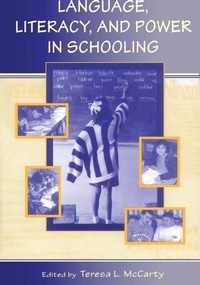
Language, Literacy, and Power in Schooling
1st Edition
Published on 21. April 2006
352 pages
978-1-135-62182-7 (ISBN)
Description

Language, Literacy, and Power in Schooling brings critical ethnographic perspectives to bear on language, literacy, and power in culturally and linguistically diverse contexts, showing how literacy and schooling are negotiated by children and adults and how schooling becomes a key site of struggle over whose knowledge, discourses, and literacy practices "count." Part I examines tensions between the local and the general in literacy development and use; Part II considers face-to-face interactions surrounding literacy practices in ethnically diverse classrooms; and Part III widens the ethnographic lens to position literacy practices in the context of globalization and contemporary education policies. Each section includes a substantive introduction by the editor and a synthetic commentary by a leading literacy researcher.
Above all, this is a book oriented toward social action. Unpacking the complexity of literacy practices and experiences in diverse settings, the authors seek not only to build new knowledge, but to inform and transform the pedagogies and policies that limit human potentials. The chapters in this volume have much to teach us about the roots of inequality and the possibilities for positive change. Together, they highlight the urgent need for critical literacy researchers to engage politically, confronting education policies that deny the rich multiplicity of human literacies, thereby carving ever-deeper cleavages between those with and without access to literacies of power.
The dual focus on language and literacy with critical-ethnographic accounts of identity and schooling speaks to a growing constituency of scholars and practitioners concerned with the role of literacy and discourse in alternatively affirming or negating knowledge, power, and identity, both within and outside of schools.
Above all, this is a book oriented toward social action. Unpacking the complexity of literacy practices and experiences in diverse settings, the authors seek not only to build new knowledge, but to inform and transform the pedagogies and policies that limit human potentials. The chapters in this volume have much to teach us about the roots of inequality and the possibilities for positive change. Together, they highlight the urgent need for critical literacy researchers to engage politically, confronting education policies that deny the rich multiplicity of human literacies, thereby carving ever-deeper cleavages between those with and without access to literacies of power.
The dual focus on language and literacy with critical-ethnographic accounts of identity and schooling speaks to a growing constituency of scholars and practitioners concerned with the role of literacy and discourse in alternatively affirming or negating knowledge, power, and identity, both within and outside of schools.
Reviews / Votes
"This book is a rich resource in the discourse on language, literacy, and cultural diversity. The volume includes many of the noted scholars in the filed of language and literacy development as well as several in the field of multicultural studies. This text will be of interest to anyone engaged in the study of how language, literacy, and culture impact the learning and success of children in American schools."-PsycCRITIQUES
"As a rich book of many conditions, facts and figures, realities, stories, and professional researching, 'Language, Literacy, and Power in Schooling' is especially useful for those who are interested in what ethnographical research can do in our schools when our aim is to study the state of language, literacy, and power in schooling."
-The Reading Matrix
"...the volume is a valuable contribution to research on the roles of language and literacy in negotiating power within the dialectic of local and global forces."
-Studies in Second Language Acquisition
"Language, Literacy, and Power in Schooling is a rare collection. Featuring ethnographic research in a critical tradition by scholars with long histories of working in schools, it is in the 'literacy as social practices' tradition but also acknowledges psycholinguistic aspects, thus showing literacy to be a thoroughly but not solely socio-cultural and ideological phenomenon. The contributors provide nuanced discussions of power, of the relations between race and literacy, and of how interactions in classrooms construct students as types of literates both in and out of school. Altogether, this collection confirms the sterility of currently mandated views of literacy and literacy pedagogy. More important in these darkening times, it offers hope as it honors people's ingenuity and agency in urban schools in the U.S., on the Navajo reservation, in Hopi schools, in the Chiapas highlands, and elsewhere."
-Carole Edelsky, Arizona State University
"These conceptually solid and interesting chapters contain a wealth of material relevant to ongoing debates about literacy and diversity. A great strength is the amount of new research presented here. This volume will be of interest to literacy researchers, educational anthropologists, qualitative researchers, and all concerned with equity and diversity."
-Kathryn Au ,University of Hawai'i
More details
Language
English
Place of publication
London
United Kingdom
Publishing group
Taylor & Francis Ltd
Target group
Professional and scholarly
Product notice
Reflowable
File size
0,73 MB
ISBN-13
978-1-135-62182-7 (9781135621827)
Copyright in bibliographic data and cover images is held by Nielsen Book Services Limited or by the publishers or by their respective licensors: all rights reserved.
Schweitzer Classification
Other editions
Additional editions
Teresa L. McCarty
Language, Literacy, and Power in Schooling
Book
04/2005
Routledge
€208.40
Shipment within 10-20 days
Teresa L. McCarty
Language, Literacy, and Power in Schooling
Book
04/2005
Routledge
€70.10
Shipment within 10-20 days
Content
Contents: Preface. T.L. McCarty, Introduction: The Continuing Power of the "Great Divide." Part I: "Taking Hold" of Local Literacies.E. Rockwell, Indigenous Accounts of Dealing With Writing. S. Nicholas, Negotiating for the Hopi Way of Life Through Literacy and Schooling. T.L. McCarty, The Power Within: Indigenous Literacies and Teacher Empowerment. P. Gilmore, D.M. Smith, Seizing Academic Power: Indigenous Subaltern Voices, Metaliteracy, and Counternarratives in Higher Education. R. Whitman, Julia's "Story" of Schooling: A Borderlands Account. R.P. McDermott, Commentary on Part I: "...An Entry Into Further Language": Contra Mystification by Language Hierarchies. Part II: Literacy Practices in Diverse Classroom Contexts.G. Ladson-Billings, Reading, Writing, and Race: Literacy Practices of Teachers in Diverse Classrooms. N.H. Hornberger, Student Voice and the Media of Biliteracy in Bi(multi)lingual/Multicultural Classrooms. J.T. Remillard, M. Cahnmann, Researching Mathematics Teaching in Bilingual-Bicultural Classrooms. A. Candela, Local Power Construction in a School of Socially Marginalized Students. L.C. Moll, Commentary on Part II: Language and a Changing Social Context. Part III: Literacies and Knowledges in a Changing World Order.J.P. Gee, Literacies, Schools, and Kinds of People in the New Capitalism. C. Ullman, Globalization on the Border: Reimagining Economies, Identities, and Schooling in El Paso. C.L. Cain, (Re)writing Inequality: Language of Crisis Implications in California Education Reform. J. Cummins, Commentary on Part III: Can Schools Effectively Challenge Coercive Power Relations in the Wider Society? T.L. McCarty, Afterword: Reclaiming Critical Literacies.
