

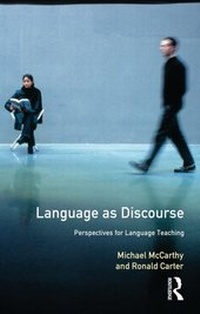
Language as Discourse
Perspectives for Language Teaching
1st Edition
Published on 22. July 2014
248 pages
978-1-317-89672-2 (ISBN)
Description

In this book Michael McCarthy and Ronald Carter describe the discoursal properties of language and demonstrate what insights this approach can offer to the student and teacher of language. The authors examine the relationship between complete texts, both spoken and written, and the social and cultural contexts in which they function. They argue that the functions of language are often best understood in a discoursal environment and that exploring language in context compels us to revise commonly-held understandings about the forms and meanings of language. In so doing, the authors argue the need for language teachers, syllabus planners and curriculum organisers to give greater attention to language as discourse.
More details
Series
Language
English
Place of publication
London
United Kingdom
Publishing group
Taylor & Francis Ltd
Target group
College/higher education
File size
8,46 MB
ISBN-13
978-1-317-89672-2 (9781317896722)
Copyright in bibliographic data and cover images is held by Nielsen Book Services Limited or by the publishers or by their respective licensors: all rights reserved.
Schweitzer Classification
Other editions
Additional editions
Book
06/2016
1st Edition
Routledge
€207.40
Shipment within 10-20 days
Book
11/1993
1st Edition
Longman
€108.50
Shipment within 10-20 days
Persons
Michael McCarthy, Ronald Carter
Content
General Editor's Preface
Introduction
Acknowledgements
1. Dividing the world of discourse
1.0 Introduction
1.1 Speech and writing
1.2 Frameworks for classifying spoken and written modes
1.3 Applying and refining frameworks
1.4 Monologue and dialogue
1.5 Text typologies
1.6 Genres
1.7 Conclusion
2. Observing and exploiting patterns
2.0 Introduction
2.1 Common core patterns of clause relations
2.2 Teaching suggestions
2.3 Embedded patterns
2.4 Openings an closings
2.5 The developing discourse
2.6 Thematic development
2.7 Conclusion
3. Linking and levels: grammar, lexis and discourse
3.0 Introduction
3.1 Grammar and discourse management
3.2 Tense, aspect and voice
3.3 Modality
3.4 Patterns and vocabulary
3.5 Naturalness
4. Literature, culture and language as discourse
4.0 Introduction
4.1 Conversational analysis: paragmatics and style
4.2 Analysing narratives
4.3 Repetition and rhetoric
4.4 Situations across cultures
4.5 Text and ideology
4.6 Teaching literature with a small 'l'
4.7 Discourse and cultural awareness: implications for the language learner
4.8 Teaching texts: curricular principles
4.9 Learning about language: some questions for discourse analysis
5. Designing the course syllabus
5.0 Introduction
5.1 The notion of 'discourse competence'
5.2 Analysis and classification
5.3 Analysis and the precursor of tasks
5.4 Putting analysis into the learner context
5.5 Analysis and materials evaluation
5.6 Refining and realizing the syllabus
Bibliography
Index
Introduction
Acknowledgements
1. Dividing the world of discourse
1.0 Introduction
1.1 Speech and writing
1.2 Frameworks for classifying spoken and written modes
1.3 Applying and refining frameworks
1.4 Monologue and dialogue
1.5 Text typologies
1.6 Genres
1.7 Conclusion
2. Observing and exploiting patterns
2.0 Introduction
2.1 Common core patterns of clause relations
2.2 Teaching suggestions
2.3 Embedded patterns
2.4 Openings an closings
2.5 The developing discourse
2.6 Thematic development
2.7 Conclusion
3. Linking and levels: grammar, lexis and discourse
3.0 Introduction
3.1 Grammar and discourse management
3.2 Tense, aspect and voice
3.3 Modality
3.4 Patterns and vocabulary
3.5 Naturalness
4. Literature, culture and language as discourse
4.0 Introduction
4.1 Conversational analysis: paragmatics and style
4.2 Analysing narratives
4.3 Repetition and rhetoric
4.4 Situations across cultures
4.5 Text and ideology
4.6 Teaching literature with a small 'l'
4.7 Discourse and cultural awareness: implications for the language learner
4.8 Teaching texts: curricular principles
4.9 Learning about language: some questions for discourse analysis
5. Designing the course syllabus
5.0 Introduction
5.1 The notion of 'discourse competence'
5.2 Analysis and classification
5.3 Analysis and the precursor of tasks
5.4 Putting analysis into the learner context
5.5 Analysis and materials evaluation
5.6 Refining and realizing the syllabus
Bibliography
Index
