

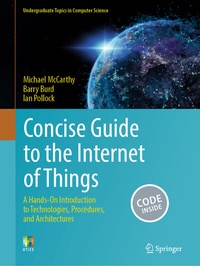
Concise Guide to the Internet of Things
Description

Traditional products are becoming smart products, and smart products are becoming connected. From smart homes to smart cities to smart farms, this trend in product design and development is likely to accelerate and will have a profound impact on the future.
This accessible textbook/reference focuses on using the Internet of Things (IoT) to foster sustainability. It guides readers in a step-by-step manner through the creation of example applications designed to promote a clean and healthy environment. Additionally, the book serves as a lesson in systems design, taking the view that the IoT is best understood as an extension of the World Wide Web. Therefore, the exposition examines how the Web was designed and how its principles can be applied to IoT design.
The book engages readers with modern IoT technologies, standards, and platforms. It connects sensors and actuators to the cloud, but in a way that is based on sound architectural principles.
Topics and features:
· Combines principles of computer science with hands-on exercises and programming
· Includes the Particle Photon 2 microcontroller, and uses Node.js and Node-RED
· Covers cryptocurrencies, machine learning, and identification technologies
· Examines sensing and actuation using The Photon 2 and MQTT
· Leverages large language models in exercises
The IoT has countless applications, making this textbook/reference appealing to a wide variety of readers. In particular, those pursuing or interested in computer science, internet technologies, product design, city planning, sensor networks, or software design will find the book intriguing and useful.
Dr. Barry Burd is a Professor at Drew University. Mr. Michael McCarthy is an Associate Teaching Professor at Carnegie Mellon University, and Mr. Ian Pollock is an Associate Professor at California State University, East Bay.
More details
Other editions
Additional editions
Persons
Mr. Michael McCarthy is an Associate Teaching Professor at Carnegie Mellon University.
Mr. Ian Pollock is an Associate Professor at California State University, East Bay.
Content
Overview .- Setting Up Your System .- Securing the Internet of Things .- Networking and APIs .- Designing Smart, Connected Products .- Networking with MQTT .- Sensors and Actuators .- Hyperlocal References and Proximity Beacons .- Mesh Network.
