

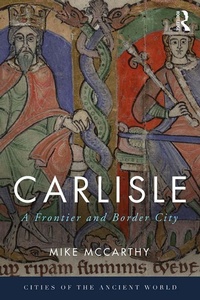
Carlisle
A Frontier and Border City
Published on 20. July 2017
254 pages
978-1-317-52531-8 (ISBN)
Description

Carlisle charts the city's emergence as an urban centre under the Romans and traces its vicissitudes over subsequent centuries until the high Middle Ages. Arguably, the most important theme that differentiates its development from many other towns is its position as a 'border' city. The characteristics of the landscape surrounding Carlisle gave it special significance as a front-line element in the defence of the Roman province of Britannia and later at the frontier of two emerging kingdoms, England and Scotland. In both cases, it occupied the only overland route in the west between these two kingdoms, emphasising the importance of understanding its landscape setting.
This volume sheds light on the processes of urbanization under the Romans beginning with a fort, developing into a major nodal hub, and ending as the capital city of the local tribe, the Carvetii. The story continues with the collapse of Roman rule and the city's re-emergence first as a monastic centre, then as a proto-town in the period of Anglo-Scandinavian settlement. Finally, the Norman Conquest confirmed Carlisle's importance with the establishment of a castle, a diocese, and an Augustinian Priory, as well as the granting of specific rights to the citizens. Carlisle uses a combination of archaeological discoveries and historical data to explore the history and legacy of this fascinating city.
This volume sheds light on the processes of urbanization under the Romans beginning with a fort, developing into a major nodal hub, and ending as the capital city of the local tribe, the Carvetii. The story continues with the collapse of Roman rule and the city's re-emergence first as a monastic centre, then as a proto-town in the period of Anglo-Scandinavian settlement. Finally, the Norman Conquest confirmed Carlisle's importance with the establishment of a castle, a diocese, and an Augustinian Priory, as well as the granting of specific rights to the citizens. Carlisle uses a combination of archaeological discoveries and historical data to explore the history and legacy of this fascinating city.
Reviews / Votes
Mike McCarthy is widely considered the doyen of Carlisle's archaeology and this book is a product of dedicated fieldwork endeavours there over decades. His work not only calls into question conventional periodisation but outlines pre-urban trajectories, assesses hinterland impacts and finally shows why this frontier settlement matters to its present day inhabitants. A stimulating description of a unique place.- Steve Roskams, University of York, UK
More details
Series
Language
English
Place of publication
London
United Kingdom
Publishing group
Taylor & Francis Ltd
Target group
College/higher education
Illustrations
31 s/w Photographien bzw. Rasterbilder, 2 Farbfotos bzw. farbige Rasterbilder, 39 s/w Zeichnungen
39 Line drawings, black and white; 2 Halftones, color; 31 Halftones, black and white
File size
8,10 MB
ISBN-13
978-1-317-52531-8 (9781317525318)
Copyright in bibliographic data and cover images is held by Nielsen Book Services Limited or by the publishers or by their respective licensors: all rights reserved.
Schweitzer Classification
Other editions
Person
Mike McCarthy, FSA is Emeritus Senior Lecturer in Archaeology at the University of Bradford, UK. From 1977 to 2001, he was Director of the Carlisle Archaeological Unit.
Content
List of figures
Preface
Acknowledgements
1 The setting
2 An emerging frontier
3 Luguvalium: fabric and townscape
4 Luguvalium: people and economy
5 Late Roman Carlisle to the kingdom of Northumbria
6 Carlisle and an emerging new frontier
7 The Norman takeover
8 A border city
9 Conclusions
Index
Bibliography
Preface
Acknowledgements
1 The setting
2 An emerging frontier
3 Luguvalium: fabric and townscape
4 Luguvalium: people and economy
5 Late Roman Carlisle to the kingdom of Northumbria
6 Carlisle and an emerging new frontier
7 The Norman takeover
8 A border city
9 Conclusions
Index
Bibliography
