

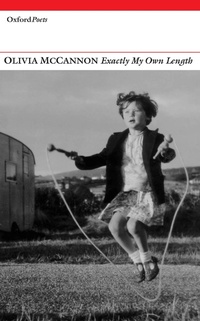
Exactly My Own Length
Published on 26. October 2012
64 pages
978-1-84777-700-3 (ISBN)
Description

Winner of the 2012 Fenton Aldeburgh First Collections Prize
Olivia McCannon's first collection explores life on the edge of possibility: in one moment the familiar is blown open, we plunge into the unknown. A chance meeting seals a lifetime; a girl leaps from a window, away from safety - 'she wanted to see what can happen'. From families improvising a living space in Cairo's City of the Dead, to a veteran of the Normandy landings coming home to the peaceful reparation of 'glueing, welding, soldering', life is luminous, and resolutely seized. The closing sequence follows the last months of the poet's mother's life. A journey into grief and loss, it pays tribute to the courage of refusing false comfort, the strength that in the end enables us to live 'between the lines / of tombs'.
Olivia McCannon's first collection explores life on the edge of possibility: in one moment the familiar is blown open, we plunge into the unknown. A chance meeting seals a lifetime; a girl leaps from a window, away from safety - 'she wanted to see what can happen'. From families improvising a living space in Cairo's City of the Dead, to a veteran of the Normandy landings coming home to the peaceful reparation of 'glueing, welding, soldering', life is luminous, and resolutely seized. The closing sequence follows the last months of the poet's mother's life. A journey into grief and loss, it pays tribute to the courage of refusing false comfort, the strength that in the end enables us to live 'between the lines / of tombs'.
Reviews / Votes
Olivia McCannon's 'City of the Dead' is typical of the beautifully crafted rhyming poem found in Exactly My Own Length. Its power seems to 'live between the lines' in a kind of sonic memory. The ways of memory or commemoration are explored within formal boundaries ('the past, the present and the future/ held in the space between four walls'). McCannon is particularly interested in taking a single object, and yoking the minds of separate people to it. 'Barometer' delicately handles parentheses, or pseudo-parentheses, to gesture at the muted irrelevence hanging over the instrument (a piece of seaweed). McCannon's tone is deadeningly controlled: 'The first girl knows' that 'it responds because of Physics, not volition-/ she finds that interesting', while 'the other is sure she won't go back...she keeps it alive remembering'. Perhaps, fittingly for such a musically accomplished poet, the object is elsewhere done away with altogether in favour of its narrative ('not so much the people or the blood/ as the talking, the telling, the making').The danger for this poet is a slide into aphoristic neatness, though McCannon always seems to stop just short of that ('I'm afraid. How can your absence/ Be imagined except as pain?'; 'there is nothing afterwards/ You won't be fobbed off with eternity'). These lines come from a run of touching poems written for and about a dying mother. Although 'dying is a fragile domain/ to be entered with caution', McCannon's formal talents work effectively to create the sweeping panoramas of flight ('A Request to the Cranes'), a somnambulant mind fading in and out of consciousness ('Vigil'), and despairing lists of pointless tasks ('Nothing I Can Do'). Cheery pragmatism is rendered helpless ('I'm just a helpless pair of hands'), though hands elsewhere allow a delicate sharing of different strengths between the poem's characters: 'I hold your bruised hand/. as tightly as it can bear'. Announced on 2 November at the Aldeburgh Poetry Festival, the winner of this year's Fenton Aldeburgh First Collection Prize is Olivia McCannon for Exactly My Own Length (Carcanet). Olivia wins GBP2,000, a week's paid writing time and a paid invitation to read at nect year's Aldeburgh Poetry Festival.
'In a very close field, what we valued in Olivia McCannon's book was the judged authenticity of her voice. Her collection has a subtle craftsmanship, and her clean and precise language rewards several re-readings revealing new layers of connection and meaning. Exactly My Own Length is surprising without ever being showy, feelingful without overplaying its sentiment, and universal without being predictable,' said chair of judges Robert Seatter.
The shortlist for the prize was: Bee Journal, Sean Borodale (Cape); Loudness, Judy Brown (Seren); Exactly My Own Length, Olivia McCannon (Carcanet); Misadventure, Richard Meier (Picador), and Breaking Silence, Jacob Sam-La Rose (Bloodaxe). Olivia McCannon's Exactly My Own Length deservedly won the Aldeburgh First Collection Prize; it's full of beautifully crafted poems built carefully from compassion and empathy, whether they're remembering (and half-imagining) an intimate past, 'Into Number Three they poured / The past, the present and the future / Held in the space between four walls. // The past tied up in the deposit / The present in the sum paid out each week / The future in someone else's pocket' ('No. 3'), or detailing in heartbreaking stanzas the fading away of a parent: 'I know you can hear and every day now / we are living through the horror / Of the one-sided conversation.' ('Conversation'). In the best possible way this is a self-help book, a collection that underlines the role that the heightened language of poetry can play as we try to make sense of our changing lives. She writes 'Each page so busy and thronging / We won't see the digits changing.' ('Book of Hours'). Except we will, because McCannon has pointed those changes out to us. Quietly Visionary
Olivia Mccannon, Exactly My Own Length (Carcanet) GBP9.95
In a year of many strong debut collections Olivia McCannon's Exactly My Own Length has been awarded the 2012 Fenton Aldeburgh First Collection Prize, in addition to an earlier nomination for the Seamus Heaney Centre Prize for Poetry. As its title suggests, this is a book of beautiful exactitude, thoughtful, acute and inventive, interested in intricate harmonic effects, in pinning down the largest-scale moments of all: 'You gave me life / At 1 a.m. / It weighed 6 pounds 11 ounces' ('The Weight of Life'), '... a narrow gap in a smooth rock / Your own length, the fit exact / And soft enough to give up thought for sleep' ('Exactly My Own Length').
Like others of her generation McCannon is an international citizen, a literary translator living in both London and Paris from where she writes the arc of her close family's history - Liverpool, Cairo, Normandy, Kiel - always with a dramatist's sense of scale, apprehending lives simultaneously in their most historic and private manifestations:
Hope went into flowers that outgrew borders
Ambition into the hammering in the shed
Happiness into gaps so small it had to bow its head...
('No. 3')
Hope, together with the rejection of its inverse, false hope, is a powerful presiding spirit in the book ('Hope Street 1966' stands as a key poem imagining her parents' first meeting), and not least in the marvellous title poem: 'Hope is allowed - while we talk - / I hope for you one of those coffins / Found in evening light on a summer walk'. In addition to her work as a translator McCannon collaborates with musicians on lyrics and libretti, and she has a very finely tuned ear, as skilled at barely audible echo and cross-rhyme as at more formally obvious patterning. The most subtle and moving harmonic work comes in the sequence of poems addressed to her late mother which constitutes the second half of the collection:
Be watchful - she's weak now
And may falter. Keep her awake
lift her up with thermal breezes
Always fly in daylight zones
('A Request to the Cranes')
McCannon handles the transformative action of elegy with moving subtlety, her deliberate light tread, the mode in which she apprehends the world and recreates it, pushing with a very precise pressure on her material. Her imaginative delicacy is a determined one, pressing with powerful effect always to an exact dynamic point: 'I hold your bruised hand / As tightly as it can bear' ('What To Do With a Baby').
Like the speaker in 'City of the Dead' ('I live in the shadow of the Sultan's tomb / ... I listen at dawn / For the voices of his retinue') McCannon's imagination operates 'between the lines // Of tombs'. Here she feels most able to act upon the world, recall and reinvent it, consider her place in it. The poems in Exactly My Own Length are often quietly visionary, but their inventions are honest inventions, circling always back to the truth and ground-root of experience, its detail and limit, and all the more powerful for it.
More details
Edition
New ed.
Language
English
Place of publication
Manchester
United Kingdom
Publishing group
Carcanet Press Ltd
File size
0,30 MB
ISBN-13
978-1-84777-700-3 (9781847777003)
Copyright in bibliographic data and cover images is held by Nielsen Book Services Limited or by the publishers or by their respective licensors: all rights reserved.
Schweitzer Classification
Other editions
Additional editions
Olivia McCannon
Exactly My Own Length
Book
11/2011
OxfordPoets
€21.00
Article exhausted; check different version
Person
Olivia McCannon was born on Merseyside and lives in Harlesden, London. Her collection Exactly My Own Length (Carcanet/Oxford Poets, 2011) was shortlisted for the Seamus Heaney Centre Prize and won the 2012 Fenton Aldeburgh First Collection Prize.
She lived for nine years in France - eight years in Belleville, Paris - and her translations from French include Balzac's Old Man Goriot (Penguin Classics, 2011), modern poetry in Poetry of Place: Paris (Eland, 2013) and contemporary plays for the Royal Court theatre in London. She also writes short fiction, lyrics and libretti.
She lived for nine years in France - eight years in Belleville, Paris - and her translations from French include Balzac's Old Man Goriot (Penguin Classics, 2011), modern poetry in Poetry of Place: Paris (Eland, 2013) and contemporary plays for the Royal Court theatre in London. She also writes short fiction, lyrics and libretti.
Content
Liverpool Echo
City of the Dead
Dust
Mirror
Map
Cohabitation
Paper Tiger
Jubilee Portraits
No. 3
Probability
Argyle Street, 1983
Barometer
Unborn
Light-Stone
The Offer
Ironing
Map of the Moor
Hope Street, 1966
Retirement
Month of Herons
Exactly My Own Length
Book of Hours
Laughter
Sick World
At the Door
Honouring the Dead
You Said This
The Weight of Life
The Lovelace Place
No More Fields
Stewed Fruit
A Request to the Cranes
Landing Light
Vigil
What To Do With a Baby
Fragile Domain
Conversation
Nothing I Can Do
All Souls' Day
Memorial
Last and First
City of the Dead
Dust
Mirror
Map
Cohabitation
Paper Tiger
Jubilee Portraits
No. 3
Probability
Argyle Street, 1983
Barometer
Unborn
Light-Stone
The Offer
Ironing
Map of the Moor
Hope Street, 1966
Retirement
Month of Herons
Exactly My Own Length
Book of Hours
Laughter
Sick World
At the Door
Honouring the Dead
You Said This
The Weight of Life
The Lovelace Place
No More Fields
Stewed Fruit
A Request to the Cranes
Landing Light
Vigil
What To Do With a Baby
Fragile Domain
Conversation
Nothing I Can Do
All Souls' Day
Memorial
Last and First
