

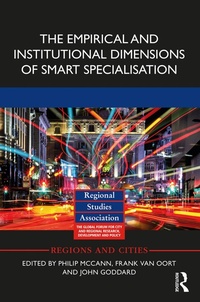
The Empirical and Institutional Dimensions of Smart Specialisation
Published on 25. November 2016
234 pages
978-1-315-52620-1 (ISBN)
Description

Smart specialisation is the new policy approach to the development of regional innovation systems across Europe and it involves fostering innovative and entrepreneurial initiatives which are well tailored to the local context. The different technologies, skills profiles, business activities, institutions and sectors which reflect a region's economic strengths and potential are to be fostered and encouraged to diversify in ways which also exploit the region's linkages with broader global value-chains.
Yet, the ideas contained in the smart specialisation agenda have until now been primarily conceptual in nature. The Empirical and Institutional Dimensions of Smart Specialisation draws together some of the leading regional economists and scientists in Europe to analyse how smart specialisation is working in practice. This book investigates different dimensions of the agenda as it is developing across parts of Europe from both quantitative and qualitative perspectives. The quantitative analysis examines the nature of the diversification processes undertaken by regions and the interplay between the chosen local regional development priorities and the wider global value-chain impacts of these choices. Meanwhile, the qualitative analysis examines the institutional opportunities and challenges facing policy makers and the key elements most likely to provide the underpinnings of a workable set of policy settings.
The book is aimed both at academic researchers interested in the interface between economic geography and regional innovation systems as well as at policy makers making public policy decisions related to regional development at the local, city, regional or national levels.
Yet, the ideas contained in the smart specialisation agenda have until now been primarily conceptual in nature. The Empirical and Institutional Dimensions of Smart Specialisation draws together some of the leading regional economists and scientists in Europe to analyse how smart specialisation is working in practice. This book investigates different dimensions of the agenda as it is developing across parts of Europe from both quantitative and qualitative perspectives. The quantitative analysis examines the nature of the diversification processes undertaken by regions and the interplay between the chosen local regional development priorities and the wider global value-chain impacts of these choices. Meanwhile, the qualitative analysis examines the institutional opportunities and challenges facing policy makers and the key elements most likely to provide the underpinnings of a workable set of policy settings.
The book is aimed both at academic researchers interested in the interface between economic geography and regional innovation systems as well as at policy makers making public policy decisions related to regional development at the local, city, regional or national levels.
Reviews / Votes
'A timely and highly valuable addition to the discourse around smart specialisation and regional development' - Louis Brennan, Professor in Business Studies, Business & Administrative Studies , Trinity College Dublin, IrelandMore details
Series
Language
English
Place of publication
London
United Kingdom
Publishing group
Taylor & Francis Ltd
Target group
College/higher education
Professional and scholarly
Illustrations
19 Tables, black and white; 33 Line drawings, black and white; 33 Illustrations, black and white
File size
12,44 MB
ISBN-13
978-1-315-52620-1 (9781315526201)
Copyright in bibliographic data and cover images is held by Nielsen Book Services Limited or by the publishers or by their respective licensors: all rights reserved.
Schweitzer Classification
Other editions
Additional editions
Philip McCann | Frank van Oort | John Goddard
The Empirical and Institutional Dimensions of Smart Specialisation
Book
12/2019
1st Edition
Routledge
€68.30
Shipment within 15-20 days
Philip McCann | Frank van Oort | John Goddard
The Empirical and Institutional Dimensions of Smart Specialisation
Book
11/2016
1st Edition
Routledge
€243.30
Shipment within 10-20 days
Persons
Philip McCann holds the University of Groningen Endowed Chair of Economic Geography at the University of Groningen and is also the Tagliaferri Research Fellow in the Department of Land Economy, University of Cambridge.
Frank van Oort is Professor of Urban and Regional Economics at Erasmus University Rotterdam and at Utrecht University.
John Goddard is Emeritus Professor in the Centre for Urban and Regional Development Studies (CURDS) at Newcastle University.
Frank van Oort is Professor of Urban and Regional Economics at Erasmus University Rotterdam and at Utrecht University.
John Goddard is Emeritus Professor in the Centre for Urban and Regional Development Studies (CURDS) at Newcastle University.
Content
1 Introduction to the Empirical and Institutional Dimensions of Smart Specialisation
Philip McCann, Frank van Oort and John Goddard
2 The Intellectual and Practical Bases of the Application of RIS3 within EU Cohesion Policy
Philip McCann and Raquel Ortega-Argiles
3 Regional Diversification and Smart Specialization Policy
Ron Boschma
4 Local Industry Structure as a Resource-Base for Entrepreneurship: Implications for Smart Specialization Strategies
Martin Andersson and Sierdjan Koster
5 Regional Innovation and the Network Structure of University-Industry Links
Robert Huggins and Daniel Prokop
6 Good Growth, Bad Growth: A Wake-up Call of Smart Specialisation
Mark Thissen, Frank van Oort and Olga Ivanova
7 New Measures of Regional Competitiveness in a Globalizing World
Bart Los, Maureen Lankhuizen and Mark Thissen
8 The Co-Evolution of Regional Innovation Domains and Institutional Arrangements: Smart Specialisation Through Quadruple Helix Relations?
Paul Vallance
9 Smart Specialisation and Local Economic Development in Eastern Europe
Teodora Dogaru, Frank van Oort and Nicola Cortinovis
10 From Plan to Process: Exploring the Human Element in Smart Specialisation Governance
Mari Jose Aranguren, Mikel Navarro and James R. Wilson
11 Entrepreneurship, Networks and Recombinant Open Innovation: Lessons for Regional Policy
Robert Huggins
Philip McCann, Frank van Oort and John Goddard
2 The Intellectual and Practical Bases of the Application of RIS3 within EU Cohesion Policy
Philip McCann and Raquel Ortega-Argiles
3 Regional Diversification and Smart Specialization Policy
Ron Boschma
4 Local Industry Structure as a Resource-Base for Entrepreneurship: Implications for Smart Specialization Strategies
Martin Andersson and Sierdjan Koster
5 Regional Innovation and the Network Structure of University-Industry Links
Robert Huggins and Daniel Prokop
6 Good Growth, Bad Growth: A Wake-up Call of Smart Specialisation
Mark Thissen, Frank van Oort and Olga Ivanova
7 New Measures of Regional Competitiveness in a Globalizing World
Bart Los, Maureen Lankhuizen and Mark Thissen
8 The Co-Evolution of Regional Innovation Domains and Institutional Arrangements: Smart Specialisation Through Quadruple Helix Relations?
Paul Vallance
9 Smart Specialisation and Local Economic Development in Eastern Europe
Teodora Dogaru, Frank van Oort and Nicola Cortinovis
10 From Plan to Process: Exploring the Human Element in Smart Specialisation Governance
Mari Jose Aranguren, Mikel Navarro and James R. Wilson
11 Entrepreneurship, Networks and Recombinant Open Innovation: Lessons for Regional Policy
Robert Huggins
