


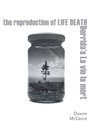
The Reproduction of Life Death
Derrida's La Vie La Mort
Published on 2. July 2019
224 pages
978-0-8232-8393-4 (ISBN)
Description

During the 1975-76 academic year, Jacques Derrida delivered a seminar, La vie la mort (Life Death), at the Ecole normale superieure, in Paris. Based on archival translations of this untapped but soon-to-be-published seminar, The Reproduction of Life Death offers an unprecedented study of Derrida's engagement with molecular biology and genetics, particularly the work of the biologist Francois Jacob.
Structured as an itinerary of "three rings," each departing from and coming back to Nietzsche, Derrida's seminar ties Jacob's logocentric account of reproduction to the reproductive program of teaching that characterizes the academic institution, challenging this mode of teaching as auto-reproduction along with the concept of "academic freedom" on which it is based. McCance also brings Derrida's critique of Jacob's theory of auto-reproduction together with his reading of reproductivity, the tendency to repeat-reproduce, that is theorized and enacted in Freud's Beyond the Pleasure Principle. The book further shows how Derrida's account of life death relates to his writings on autobiography and the signature and to such later concerns as the question of the animal.
McCance brings extensive archival research together with a deep knowledge of Derrida's work a background in genetics to offer a fascinating new account of an encounter between philosophy and the hard sciences that will be of interest to theorists in a wide range of disciplines concerned with the question of life.
Structured as an itinerary of "three rings," each departing from and coming back to Nietzsche, Derrida's seminar ties Jacob's logocentric account of reproduction to the reproductive program of teaching that characterizes the academic institution, challenging this mode of teaching as auto-reproduction along with the concept of "academic freedom" on which it is based. McCance also brings Derrida's critique of Jacob's theory of auto-reproduction together with his reading of reproductivity, the tendency to repeat-reproduce, that is theorized and enacted in Freud's Beyond the Pleasure Principle. The book further shows how Derrida's account of life death relates to his writings on autobiography and the signature and to such later concerns as the question of the animal.
McCance brings extensive archival research together with a deep knowledge of Derrida's work a background in genetics to offer a fascinating new account of an encounter between philosophy and the hard sciences that will be of interest to theorists in a wide range of disciplines concerned with the question of life.
More details
Edition
New edition
Language
English
Place of publication
NY
United States
Target group
Professional and scholarly
Edition type
New edition
Illustrations
4, 4 s/w Abbildungen
4
File size
3,00 MB
ISBN-13
978-0-8232-8393-4 (9780823283934)
Copyright in bibliographic data and cover images is held by Nielsen Book Services Limited or by the publishers or by their respective licensors: all rights reserved.
Schweitzer Classification
Other editions
Additional editions
Book
07/2019
Fordham University Press
€32.00
Shipment within 10-20 days
Person
Dawne McCance is Distinguished Professor at the University of Manitoba. Her books include Critical Animal Studies: An Introduction and Derrida On Religion.
Content
Abbreviations of Works by Jacques Derrida ix
Introduction 1
1. Double Helix 9
2. Schools of Life 33
3. Institutions of the "Yes" 51
4. Speaking into a Dead Man's Ear 74
5. Life Worth More Than Life 97
6. The Movement of a Pas 125
7. Rhythmos 147
Acknowledgments 151
Notes 153
Works Cited 177
Index 187
Introduction 1
1. Double Helix 9
2. Schools of Life 33
3. Institutions of the "Yes" 51
4. Speaking into a Dead Man's Ear 74
5. Life Worth More Than Life 97
6. The Movement of a Pas 125
7. Rhythmos 147
Acknowledgments 151
Notes 153
Works Cited 177
Index 187
