

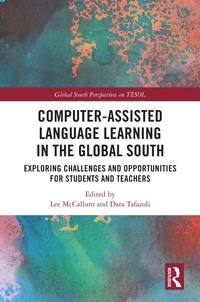
Computer-Assisted Language Learning in the Global South
Exploring Challenges and Opportunities for Students and Teachers
1st Edition
Published on 16. December 2024
230 pages
978-1-040-27278-7 (ISBN)
Description

This cross-cultural edited volume presents a rich tapestry of experiences, challenges, and innovations, focusing on assessment, course and curriculum design, approaches to pedagogy and teacher professional development in computer-assisted language learning (CALL) in the Global South.
Comprising chapters from a broad swathe of international contexts, the book presents varied themes in CALL such as inclusion and social justice, artificial intelligence, barriers to online language teaching, skills-based practices, and professional development. By shedding light on the underrepresented research contexts in the Global South, a number of current innovations in these contexts at theoretical and empirical levels are showcased, resulting in a highly novel and cutting-edge volume that gives voice to perspectives on the implementation of CALL in less-privileged countries.
Providing comparative research and innovative ways in which CALL can be harnessed in less-privileged contexts despite lack of resources in some cases, this book will appeal to scholars, researchers, and postgraduate students in the fields of technology in education, language and linguistics, as well as open and distance education and eLearning. CALL and TESOL educators may also benefit from the book.
Comprising chapters from a broad swathe of international contexts, the book presents varied themes in CALL such as inclusion and social justice, artificial intelligence, barriers to online language teaching, skills-based practices, and professional development. By shedding light on the underrepresented research contexts in the Global South, a number of current innovations in these contexts at theoretical and empirical levels are showcased, resulting in a highly novel and cutting-edge volume that gives voice to perspectives on the implementation of CALL in less-privileged countries.
Providing comparative research and innovative ways in which CALL can be harnessed in less-privileged contexts despite lack of resources in some cases, this book will appeal to scholars, researchers, and postgraduate students in the fields of technology in education, language and linguistics, as well as open and distance education and eLearning. CALL and TESOL educators may also benefit from the book.
Reviews / Votes
"It is inspiring to see a collection of innovative papers that put the Global South front and centre, where it belongs. The editors and authors have done a fabulous job in offering an inclusive perspective on the role of technology in language education."Hayo Reinders, Professor of Applied Linguistics, King Mongkut's University of Technology Thonburi (KMUTT), Thailand
"The book "Computer-Assisted Language Learning in the Global South: Exploring Challenges and Opportunities for Students and Teachers" is an important compilation that illuminates the unique hurdles and possibilities within technology-enhanced language education in developing regions in the south. Through detailed case studies and reflective insights from countries like Iran, Sri Lanka, Indonesia, Vietnam, and Chile, the book thoroughly examines barriers such as infrastructural limitations and policy misalignments, while also highlighting innovative solutions and pedagogical strategies. This volume is an invaluable resource for language educators, policymakers, and researchers dedicated to bridging educational divides and fostering inclusive, effective language learning environments globally."
Qing MA, Associate Professor of Applied Linguistics, The Education University of Hong Kong, Hong Kong "It is inspiring to see a collection of innovative papers that put the Global South front and centre, where it belongs. The editors and authors have done a fabulous job in offering an inclusive perspective on the role of technology in language education."
Hayo Reinders, Professor of Applied Linguistics, King Mongkut's University of Technology Thonburi (KMUTT), Thailand
"The book Computer-Assisted Language Learning in the Global South: Exploring Challenges and Opportunities for Students and Teachers is an important compilation that illuminates the unique hurdles and possibilities within technology-enhanced language education in developing regions in the south. Through detailed case studies and reflective insights from countries like Iran, Sri Lanka, Indonesia, Vietnam, and Chile, the book thoroughly examines barriers such as infrastructural limitations and policy misalignments, while also highlighting innovative solutions and pedagogical strategies. This volume is an invaluable resource for language educators, policymakers, and researchers dedicated to bridging educational divides and fostering inclusive, effective language learning environments globally."
Qing MA, Associate Professor of Applied Linguistics, The Education University of Hong Kong, Hong Kong
More details
Series
Edition
1. Auflage
Language
English
Place of publication
London
United Kingdom
Publishing group
Taylor & Francis Ltd
Target group
College/higher education
Professional and scholarly
Illustrations
9 Tables, black and white; 12 Line drawings, black and white; 1 Halftones, black and white; 13 Illustrations, black and white
File size
13,52 MB
ISBN-13
978-1-040-27278-7 (9781040272787)
Copyright in bibliographic data and cover images is held by Nielsen Book Services Limited or by the publishers or by their respective licensors: all rights reserved.
Schweitzer Classification
Other editions
Additional editions
Lee McCallum | Dara Tafazoli
Computer-Assisted Language Learning in the Global South
Exploring Challenges and Opportunities for Students and Teachers
Book
05/2026
1st Edition
Routledge
€56.00
Shipment within 10-20 days
Lee McCallum | Dara Tafazoli
Computer-Assisted Language Learning in the Global South
Exploring Challenges and Opportunities for Students and Teachers
Book
12/2024
1st Edition
Routledge
€197.40
Shipment within 10-20 days
Persons
Lee McCallum is Lecturer in Assessment and Feedback, Edinburgh Napier University, UK.
Dara Tafazoli is Research Officer, The University of Newcastle, Australia.
Dara Tafazoli is Research Officer, The University of Newcastle, Australia.
Content
Preface
PART I: Challenges and Opportunities in CALL Implementation
Chapter 1: Key barriers to and enablers of integrating technology into online language teaching
Chapter 2: Challenges in integrating computer-assisted language learning: Self-reflective insights from an ESL practitioner in Sri Lanka
Chapter 3: Navigating slow Internet connection in CALL classes: Insights from Indonesia
Chapter 4: Pedagogical efforts for inclusion and social justice: Integrating multimodal resources in multilingual and multicultural classrooms in Chile
PART II: Challenges and Opportunities of Innovative Technologies
Chapter 5: Opportunities and challenges of using artificial intelligence in language education: Perspectives from Vietnam
Chapter 6: A Systematic Review of the Use of Metaverse in L2 English Education
Chapter 7: Unravelling Indonesian EFL students' reluctance to use social media for speaking activities
Chapter 8: Bridging the gaps in language learning through language Massive Open Online Courses (MOOCs) in the Global South: Perspectives from Thailand and Colombia
PART III: Challenges and Opportunities in CALL Leadership and Professional Development of Pedagogical Approaches
Chapter 9: Making the case for micro-level leadership in CALL integration in Vietnam
Chapter 10: Continuing professional development for CALL teacher trainers in Vietnam: A gap between policy and practice
Chapter 11: Transforming and empowering Global South teacher education
PART IV: Conclusion and Future Directions
Chapter 12: Conclusion: Achievements and future potential for CALL in the Global South
PART I: Challenges and Opportunities in CALL Implementation
Chapter 1: Key barriers to and enablers of integrating technology into online language teaching
Chapter 2: Challenges in integrating computer-assisted language learning: Self-reflective insights from an ESL practitioner in Sri Lanka
Chapter 3: Navigating slow Internet connection in CALL classes: Insights from Indonesia
Chapter 4: Pedagogical efforts for inclusion and social justice: Integrating multimodal resources in multilingual and multicultural classrooms in Chile
PART II: Challenges and Opportunities of Innovative Technologies
Chapter 5: Opportunities and challenges of using artificial intelligence in language education: Perspectives from Vietnam
Chapter 6: A Systematic Review of the Use of Metaverse in L2 English Education
Chapter 7: Unravelling Indonesian EFL students' reluctance to use social media for speaking activities
Chapter 8: Bridging the gaps in language learning through language Massive Open Online Courses (MOOCs) in the Global South: Perspectives from Thailand and Colombia
PART III: Challenges and Opportunities in CALL Leadership and Professional Development of Pedagogical Approaches
Chapter 9: Making the case for micro-level leadership in CALL integration in Vietnam
Chapter 10: Continuing professional development for CALL teacher trainers in Vietnam: A gap between policy and practice
Chapter 11: Transforming and empowering Global South teacher education
PART IV: Conclusion and Future Directions
Chapter 12: Conclusion: Achievements and future potential for CALL in the Global South
