

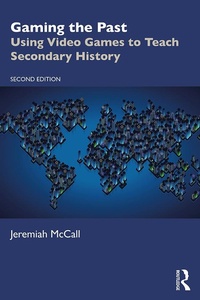
Gaming the Past
Using Video Games to Teach Secondary History
2nd Edition
Published on 11. November 2022
210 pages
978-1-000-77953-0 (ISBN)
Description

Gaming the Past is a complete handbook to help pre-service teachers, current teachers, and teacher educators use historical video games in their classes to develop critical thinking skills. It focuses on practical information and specific examples for integrating critical thinking activities and assessments using video games into classes. Chapters cover the core parts of planning, designing, and implementing lessons and units based on historical video games.
Topics include:
Talking to administrators, parents, and students about the educational value of teaching with historical video games.
Selecting games that are aligned to curricular goals by considering the genres of historical games.
Planning and implementing game-based history lessons ranging from whole class exercises, to individual gameplay, to analysis in groups.
Employing instructional strategies to help students learn to play and engage in higher level analysis
Identifying and avoiding common pitfalls when incorporating games into the history class.
Developing activities and assessments that facilitate interpreting and creating established and new media.
Gaming the Past also includes sample unit and lesson plans, worksheets and assessment questions, and a list of historical games currently available, both commercial and freely available Internet games.
Topics include:
Talking to administrators, parents, and students about the educational value of teaching with historical video games.
Selecting games that are aligned to curricular goals by considering the genres of historical games.
Planning and implementing game-based history lessons ranging from whole class exercises, to individual gameplay, to analysis in groups.
Employing instructional strategies to help students learn to play and engage in higher level analysis
Identifying and avoiding common pitfalls when incorporating games into the history class.
Developing activities and assessments that facilitate interpreting and creating established and new media.
Gaming the Past also includes sample unit and lesson plans, worksheets and assessment questions, and a list of historical games currently available, both commercial and freely available Internet games.
Reviews / Votes
Jeremiah McCall does an excellent job of honoring the personal meanings students find in video games while pushing them to perceive their possible academic resonances. The concrete strategies he articulates in the second edition of Gaming the Past are sure to be valuable for teachers looking for creative ways to integrate video games into their classrooms. While McCall focuses on practical concerns for harnessing the power of games toward demonstrable learning, his work is deeply rooted in the scholarship on historical games studies. As such, this volume serves as a map with plenty of suggested sidequests for those interested in exploring this burgeoning field further.Lisa Gilbert, Ph.D., Department of Education, Washington University in St. Louis
Gaming the Past is essential reading for anyone in game studies, media studies, or history education. McCall's deep knowledge of both history and games and decades of experience teaching with them yields a book of unparalleled depth. McCall's framework is vital for educators re-examining how history is conceptualized and taught. Gaming the Past shows how we can go beyond simple political or ideological arguments and help students dig into the assumptions behind historical games. This book is the perfect tool for helping students unpack meanings and ideologies in games and makes a great teaching resource at the collegiate level as well. Jeremiah McCall is the pre-eminent history game educator.
Kurt Squire, Professor, Informatics and Game Design and Interactive Media, Co-director, Games + Learning + Society, University of California Irvine
Jeremiah McCall is one of the preeminent thinkers at the intersection of games and history education. As a dedicated classroom teacher, McCall keeps the insights offered in this book anchored in the real world, making this an ideal volume for teachers, teacher educators, administrators, and anyone yearning to know more about teaching and learning history with v0ideogames. To this second edition McCall has added his Historical Problem Space Framework, an invaluable addition that bridges theory and practice for a diverse audience.
Taylor M. Kessner, Assistant Professor of Social Studies Education, College of Education, The University of Texas at Arlington
More details
Edition
2nd edition
Language
English
Place of publication
London
United Kingdom
Publishing group
Taylor & Francis Ltd
Target group
College/higher education
Professional and scholarly
Product notice
Reflowable
Illustrations
12 Tables, black and white; 8 Line drawings, black and white; 12 Halftones, black and white; 20 Illustrations, black and white
ISBN-13
978-1-000-77953-0 (9781000779530)
Copyright in bibliographic data and cover images is held by Nielsen Book Services Limited or by the publishers or by their respective licensors: all rights reserved.
Schweitzer Classification
Other editions
Additional editions
Book
11/2022
2nd Edition
Routledge
€60.00
Shipment within 10-20 days
Book
11/2022
2nd Edition
Routledge
€185.90
Shipment within 10-20 days
Person
Jeremiah McCall is a high school history teacher at Cincinnati Country Day School, a historian of the ancient world, and a historical game studies scholar.
Content
Introduction: The Power of Historical Video Games; 1 Why Play and Study Historical Games?; 2 How Do Historical Games Represent the Past?: Historical Games as Historical Problem Spaces; 3 Genres of Historical Games and Academic Standards of History and Social Studies; 4 Instructional Strategies for Purposeful Play: Gameplay and Analysis in the Classroom; 5 The Real Historical Learning: Assignments and Assessments for Historical Game Analysis; 6 Putting it All Together: Lesson and Unit Plans for Historical Game Studies; Appendix: Profiles of Historical Video Games
