

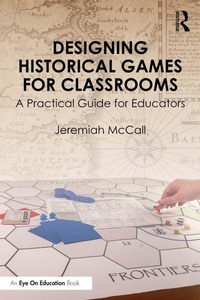
Designing Historical Games for Classrooms
A Practical Guide for Educators
1st Edition
Will be published approx. on 17. August 2026
358 pages
978-1-040-50021-7 (ISBN)
Description

Designing Historical Games for Classrooms: A Practical Guide for Educators is a complete introductory guide for designing analog games and interactive choice-based historical texts for history classes. It is designed to support educators who want to design games or who want to guide and assess student game-making projects in history class.
The chapters in this book lead the educator designer through a range of topics, including the core features of historical games, the educational power of using historical games to study history, and the role of playing and designing analog games and choice-based texts in the classroom. It also shows how to design historical analog games (such as boardgames, card games, roleplaying games, and choice-based historical text games designed with Twine) using the Historical Problem
Space Framework as a practical design guide to structure, teach, guide, manage, and assess student-designed historical game projects, both analog games and choice-based texts. This book provides sample plans, guidelines, and rubrics for fully implementing student-designed historical game projects, and detailed examples throughout this text-from tabletop and choice-based text games-provide practical help for teachers and students.
This applied guidebook will be essential reading for pre-service and in-service teachers of Social Studies and History Education. It is a guide for any educator who is looking to design historical games for classroom learning or have their students engage in the critical learning of historical game design.
The chapters in this book lead the educator designer through a range of topics, including the core features of historical games, the educational power of using historical games to study history, and the role of playing and designing analog games and choice-based texts in the classroom. It also shows how to design historical analog games (such as boardgames, card games, roleplaying games, and choice-based historical text games designed with Twine) using the Historical Problem
Space Framework as a practical design guide to structure, teach, guide, manage, and assess student-designed historical game projects, both analog games and choice-based texts. This book provides sample plans, guidelines, and rubrics for fully implementing student-designed historical game projects, and detailed examples throughout this text-from tabletop and choice-based text games-provide practical help for teachers and students.
This applied guidebook will be essential reading for pre-service and in-service teachers of Social Studies and History Education. It is a guide for any educator who is looking to design historical games for classroom learning or have their students engage in the critical learning of historical game design.
More details
Edition
1. Auflage
Language
English
Place of publication
London
United Kingdom
Publishing group
Taylor & Francis Ltd
Target group
College/higher education
Professional and scholarly
Illustrations
1 Tables, black and white; 29 Line drawings, black and white; 3 Halftones, black and white; 32 Illustrations, black and white
File size
11,65 MB
ISBN-13
978-1-040-50021-7 (9781040500217)
Copyright in bibliographic data and cover images is held by Nielsen Book Services Limited or by the publishers or by their respective licensors: all rights reserved.
Schweitzer Classification
Other editions
Additional editions
Book
approx. 08/2026
1st Edition
Routledge
€37.50
Not yet published

Book
approx. 08/2026
1st Edition
Routledge
€192.50
Not yet published
Person
Jeremiah McCall is a high school history teacher at Cincinnati Country Day School, a historian of the ancient world, a historical game studies scholar, and a game designer.
Content
Preface and Acknowledgments 1. Historical Games: What are They and Why Make Them in History Classes? 2. The Historical Problem Space Framework for Historical Game Analysis and Design 3. The Historical Game Design Process: A Brief Overview 4. Modeling Historical Problem Spaces in Boardgame Mechanics: Gameworld space and Action Choices 5. Modeling Historical Problem Space Action-Choices with Gameworld Elements in Boardgame Mechanics 6. Guiding, Supporting, and Assessing Student Historical Boardgame Design 7. Introduction to Choice Based History Texts and the Basic Design Loop 8. Designing Choice-Based History Texts with a Historical Problem Space Blueprint 9. Guiding, Supporting, and Assessing Student Choice-Based History Projects Appendix A. Historical Tabletop Roleplaying Games and Solo Journaling Games Appendix B. Videogame Design in the History Class Appendix C. Resources for Going further with Twine Coding Appendix D. Designing Games based on other Academic Areas -- The Agential Problem Space Framework
