

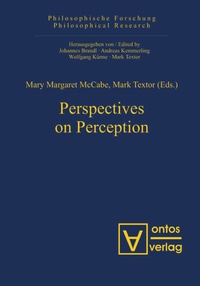
Perspectives on Perception
Description

Perception and its puzzles have given rise to philosophical reflection from antiquity to recent times: What do we perceive? How do we talk about what we perceive? What is the nature of our subjective experience? How can we talk about our subjective experience? In this book a distinguished group of philosophers addresses questions like these by drawing on historical and contemporary sources, illuminating the intersections between historical and contemporary philosophical discussion. They ask about the way things look; about how we can perceive a particular object (and no other); about self-perception; and about the nature and explanation of our phenomenal experience, and our talk about it. The book provides important new work in a central philosophical area.
More details
Other editions
Additional editions
Content
2 - List of Contributo [Seite 8]
3 - Preface [Seite 10]
4 - A bit of autobiography Alan Lacey [Seite 12]
5 - A puzzle about how things look R. M. Sainsbury [Seite 16]
6 - The problem of consciousnessand the innerness of the mindJim Hopkins [Seite 28]
7 - Seeing an individual* Keith Hossack [Seite 56]
8 - Seeing something and believing IN it Mark Textor [Seite 74]
9 - Phenomenal conceptsare not demonstrative David Papineau [Seite 96]
10 - Kant on the a priori content ofperceptual experience [Seite Kant on the a priori content ofperceptual experience ]
Anthony Savile - 120 [Seite 120]
11 - Self-awareness Richard Sorabji [Seite 140]
12 - Perceiving that we see and hear: Aristotle onPlato on judgement and reflection Mary Margaret McCabe [Seite 152]
