

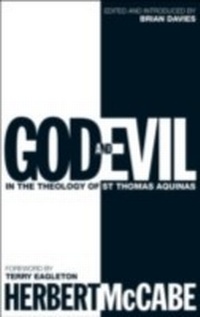
God and Evil
In the Theology of St Thomas Aquinas
1st Edition
Published on 26. February 2010
224 pages
978-1-4411-1156-2 (ISBN)
Description

Herbert McCabe was one of the most original and creative theologians of recent years. Continuum has published numerous volumes of unpublished typescripts left behind by him following his untimely death in 2001. This book is the sixth to appear. McCabe was deeply immersed in the philosophical theology of St Thomas Aquinas and was responsible in part for the notable revival of interest in the thought of Aquinas in our time.
Here he tackles the problem of evil by focusing and commenting on what Aquinas said about it. What should we mean by words such as 'good', 'bad', 'being', 'cause', 'creation', and 'God'? These are McCabe's main questions. In seeking to answer them he demonstrates why it cannot be shown that evil disproves God's existence. He also explains how we can rightly think of evil in a world made by God. McCabe's approach to God and evil is refreshingly unconventional given much that has been said about it of late. Yet it is also very traditional. It will interest and inform anyone seriously interested in the topic.
Here he tackles the problem of evil by focusing and commenting on what Aquinas said about it. What should we mean by words such as 'good', 'bad', 'being', 'cause', 'creation', and 'God'? These are McCabe's main questions. In seeking to answer them he demonstrates why it cannot be shown that evil disproves God's existence. He also explains how we can rightly think of evil in a world made by God. McCabe's approach to God and evil is refreshingly unconventional given much that has been said about it of late. Yet it is also very traditional. It will interest and inform anyone seriously interested in the topic.
Reviews / Votes
Mentioned in Church Times, March 2010 Edited vesion of Terry Eagleton's Foreword printed in The Tablet, 12th June 2010. '[McCabe was] a highly creative and insightful thinker, who had vivid sense of what was of enduring human importance beneath the technical tangles of philosophical and theological debate.' The Tablet 'McCabe was ... a highly creative and insightful thinker, who had a vivid sense of what was of enduring human importance beneath the technical tangles of philosophical and theological debate ... Disarmingly honest ... this impressive work ... does not offer any final answer to the problem of evil; but is does ... enhance our understanding of what is involved in adopting a religious view of the world.' The Tablet Reviewed in Church Times 20th August, (UK) 'As interpretation of Aquinas, as well as an approach to the problem of evil, this book is obviously controversial' The book is mentioned in an article on Terry Eagleton, who wrote the foreword. 'Pithy, and with a way of putting things that often seems singularly insightful... this is a welcome addition to the McCabe corpus... McCabe had a rich and fertile mind, and his stature is such that it is valuable and instructive to be helped to trace his development and occasional lapses.' One of the distinct pleasures of studying the work of Herbert McCabe . . . is the brilliant wit and insight with which McCabe takes us from theological muddle to the blinding light of mystery. . . . For the student who wants to uncover the deep structure of McCabe's Thomistic theology, the present volume is invaluable. Reviewed in Notre Dame Philosophical Reviews.More details
Edition
1. Auflage
Language
English
Place of publication
New York
United States
ISBN-13
978-1-4411-1156-2 (9781441111562)
Copyright in bibliographic data and cover images is held by Nielsen Book Services Limited or by the publishers or by their respective licensors: all rights reserved.
Schweitzer Classification
Other editions
Additional editions
Book
02/2010
Continuum International Publishing Group Ltd.
€28.50
Shipment within 15-20 days
Person
Herbert McCabe was a Dominican Friar and theologian of outstanding originality who died in 2001. He was deeply influential on philosophers such as Anthony Kenny and Alasdair MacIntyre and poets and writers like Terry Eagleton and Seamus Heaney.
Content
Introduction by Professor Brian Davies \ 1. The Statement of the Problem \ 2. Metaphysical preliminaries \ 3. Good and Evil \ 4. The Creator and Evil \ 5. The Cause of Evil
