

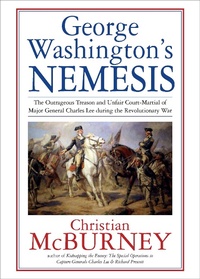
George Washington's Nemesis
The Outrageous Treason and Unfair Court-Martial of Major General Charles Lee during the Revolutionary War
Published on 8. January 2021
336 pages
978-1-61121-466-6 (ISBN)
Description

This biography attempts to set the record straight for a misunderstood military figure from the American Revolution.
Historians and biographers of Charles Lee have treated him as either an enemy of George Washington or a defender of American liberty. Neither approach is accurate; objectivity is required to fully understand the war's most complicated general. In George Washington's Nemesis, author Christian McBurney uses original documents (some newly discovered) to combine two dramatic stories to create one balanced view of one of the Revolutionary War's most fascinating personalities.
General Lee, second in command in the Continental Army led by George Washington, was captured by the British in December, 1776. While imprisoned, he gave his captors a plan on how to defeat Washington's army as quickly as possible. This extraordinary act of treason was not discovered during his lifetime. Less well known is that throughout his sixteen months of captivity and even after his release, Lee continued communicating with the enemy, offering to help negotiate an end to the rebellion.
After Lee rejoined the Continental Army, he was given command of many of its best troops together with orders from Washington to attack British general Henry Clinton's columnnear Monmouth, New Jersey. But things did not go as planned for Lee, leading to his court-martial for not attacking and for retreating in the face of the enemy. McBruney argues the evidence clearly shows Lee was unfairly convicted and had, in fact, done something beneficial. But Lee had insulted Washington, which made the matter a political contest between the army's two top generals-only one of whom could prevail.
Historians and biographers of Charles Lee have treated him as either an enemy of George Washington or a defender of American liberty. Neither approach is accurate; objectivity is required to fully understand the war's most complicated general. In George Washington's Nemesis, author Christian McBurney uses original documents (some newly discovered) to combine two dramatic stories to create one balanced view of one of the Revolutionary War's most fascinating personalities.
General Lee, second in command in the Continental Army led by George Washington, was captured by the British in December, 1776. While imprisoned, he gave his captors a plan on how to defeat Washington's army as quickly as possible. This extraordinary act of treason was not discovered during his lifetime. Less well known is that throughout his sixteen months of captivity and even after his release, Lee continued communicating with the enemy, offering to help negotiate an end to the rebellion.
After Lee rejoined the Continental Army, he was given command of many of its best troops together with orders from Washington to attack British general Henry Clinton's columnnear Monmouth, New Jersey. But things did not go as planned for Lee, leading to his court-martial for not attacking and for retreating in the face of the enemy. McBruney argues the evidence clearly shows Lee was unfairly convicted and had, in fact, done something beneficial. But Lee had insulted Washington, which made the matter a political contest between the army's two top generals-only one of whom could prevail.
More details
Other editions
Additional editions
Christian McBurney
George Washington's Nemesis
The Outrageous Treason and Unfair Court-Martial of Major General Charles Lee During the American Revolution
Book
01/2020
Savas Beatie
€31.00
Shipment within 3-4 weeks
Person
Christian McBurney has written five books on the American Revolutionary War, including 'Kidnapping the Enemy: The Special Operations to Capture Generals Charles Lee & Richard Prescott'. His published articles include one in MHQ: The Journal of Military History, on the British attempt to abduct George Washington, which was nominated by the U.S. Army Historical Foundation as best magazine article for 2017. He also publishes Rhode Island's leading history blog (www.smallstatebighistory.com). He is an attorney in Washington, D.C.
Content
- Intro
- Title
- Copyright
- Dedication
- Table of Contents
- Introduction
- Chapter 1: Charles Lee Turns Traitor
- Chapter 2: Did Lee Commit Treason?
- Chapter 3: Who Was Charles Lee And What Were His Motivations?
- Chapter 4: Did Lee Try to Trick Howe?
- Chapter 5: Lee's Continued Efforts to Negotiate a Peace
- Chapter 6: Lee Rejoins the Continental Army
- Chapter 7: The Road to Monmouth Court House
- Chapter 8: Lee in Command
- Chapter 9: The Court-Martial
- Chapter 10: Did Lee Disobey Orders to Attack the Enemy?
- Chapter 11: Did Lee Conduct an Unnecessary and Sometimes Disorderly Retreat?
- Chapter 12: Did Lee Show Disrespect to the Commander in Chief? Did His Punishment Fit the Verdicts?
- Chapter 13: Congress Approves the Sentence
- Chapter 14: Duels, Disgrace and Death
- Appendix: The Probable Locations of the Proceedings of Charles Lee's Court-Martial
- Bibliography
- Acknowledgments
