

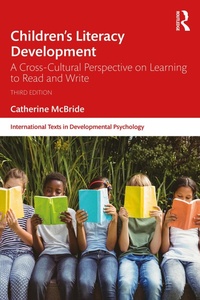
Children's Literacy Development
A Cross-Cultural Perspective on Learning to Read and Write
3rd Edition
Published on 16. July 2025
296 pages
978-1-040-36426-0 (ISBN)
Description

In the updated third edition of this unique book, Catherine McBride looks at reading and writing development and impairment across a range of languages, scripts, and contexts. This new edition highlights multiliteracy and multilingualism and broadly explores the science of reading.
A timely and important contribution to our understanding of literacy around the world, the book includes a new chapter covering the impact of digital technology on children's literacy development, and covers other issues including:
The importance of phonological sensitivity for learning to read and to write
The first units, or building blocks, of literacy learning in different scripts such as Chinese, English, Korean Hangul, Hindi and Arabic
The role of visual processing in reading and writing skills
How the latest research can inform the teaching of reading and writing
An overview of of dyslexia and dysgraphia, including recent neuroscientific research
The developmental process of becoming biliterate
What is special about writing for beginners and later for comprehensive writing
Basics of reading comprehension
Written by an eminent scholar in the field, it provides an overview of how children learn to read and write and is essential reading for students and scholars of Developmental Psychology, Educational Psychology, Psycholinguistics and Speech Therapy.
A timely and important contribution to our understanding of literacy around the world, the book includes a new chapter covering the impact of digital technology on children's literacy development, and covers other issues including:
The importance of phonological sensitivity for learning to read and to write
The first units, or building blocks, of literacy learning in different scripts such as Chinese, English, Korean Hangul, Hindi and Arabic
The role of visual processing in reading and writing skills
How the latest research can inform the teaching of reading and writing
An overview of of dyslexia and dysgraphia, including recent neuroscientific research
The developmental process of becoming biliterate
What is special about writing for beginners and later for comprehensive writing
Basics of reading comprehension
Written by an eminent scholar in the field, it provides an overview of how children learn to read and write and is essential reading for students and scholars of Developmental Psychology, Educational Psychology, Psycholinguistics and Speech Therapy.
Reviews / Votes
"The author provides state-of-the-art insights into cultural, linguistic, and educational contexts in which children succeed in (or indeed struggle with) learning to read and write worldwide. She has a profound understanding of the Science of Reading and gives a multitude of illustrative examples. The book is highly informative to students and practitioners who are interested in literacy development."Karin Landerl, Professor of Developmental Psychology, University of Graz, Austria
"I am thrilled that Dr McBride has updated her text on children's reading development. I've long used it in my undergraduate teaching and as an introductory text for my own graduate students. It has always provided comprehensible and readable introductions to the core factors that determine reading development, and it has done so in an international context, covering research across a range of languages. This new edition has updated reviews on those classic predictors, and also incorporated reviews on current topics, such as the influence of both COVID-19 pandemic and digitalization on reading development. I'm excited to be able to use this new text in my teaching and mentoring!"
S. Helene Deacon, University Distinguished Research Professor, Department of Psychology & Neuroscience, Dalhousie University, Canada
"This book is an invaluable resource for those seeking to understand the foundational aspects of literacy skill development. It provides a comprehensive review of literature across diverse languages and writing systems, recognizing the richness and complexity of developing literacy skills."
Young-Suk Grace Kim, Professor, School of Education, University of California-Irvine
"This is a uniquely important book that combines an insightful and superbly informed analysis of both reading and writing across languages and scripts. It is a tremendous resource for professionals and families alike."
Richard K. Wagner, Robert O. Lawton Distinguished Professor of Psychology, Florida State University
More details
Series
Edition
3rd edition
Language
English
Place of publication
London
United Kingdom
Publishing group
Taylor & Francis Ltd
Target group
College/higher education
Professional and scholarly
Illustrations
3 Tables, black and white; 22 Line drawings, black and white; 22 Illustrations, black and white
File size
13,53 MB
ISBN-13
978-1-040-36426-0 (9781040364260)
Copyright in bibliographic data and cover images is held by Nielsen Book Services Limited or by the publishers or by their respective licensors: all rights reserved.
Schweitzer Classification
Other editions
Additional editions
Catherine McBride
Children's Literacy Development
A Cross-Cultural Perspective on Learning to Read and Write
Book
07/2025
3rd Edition
Routledge
€72.80
Shipment within 10-20 days
Catherine McBride
Children's Literacy Development
A Cross-Cultural Perspective on Learning to Read and Write
Book
07/2025
3rd Edition
Routledge
€208.10
Shipment within 10-20 days
Person
Catherine McBride is a Distinguished Professor in the Department of Human Development and Family Science, Purdue University, Indiana, US. She has served as President of the international Society for the Scientific Study of Reading and Founding President of the Association for Reading and Writing in Asia. Her research focuses on learning to read and write from a developmental perspective, across cultures, languages, and scripts.
Content
1. An ecological approach to literacy development 2. The development of sound, phonological sensitivity, and language for reading and writing 3. Building blocks of reading 4. The role of morphological awareness in learning to read and to write (spell) 5. Visual and orthographic skills in reading and writing 6. Dyslexia 7. Reading comprehension 8. Writing: spelling and higher-order processes 9. Approaches to teaching reading 10. Multiliteracy and Multilingualism 11. The impact of digital technology on children's literacy development 12. Where do we go from here?
