

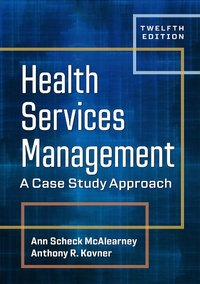
Health Services Management: A Case Study Approach, Twelfth Edition
Description

Health Services Management: A Case Study Approach provides an overview of management and organizational behavior theory by inviting readers to analyze and respond to common managerial predicaments. The book includes a mix of vignette-style and data-driven cases, each of which enables readers to hone their management skills by navigating challenges that, just as in real life, do not have a single "right" answer.
This 12th edition contains 54 cases, 18 of which are new and address timely issues such as the following:
Managing virtual team membersConfronting racism and disparities in careLaunching diversity, equity, and inclusion initiativesAdapting to crises such as the COVID-19 pandemicSustaining a population health improvement programAddressing employee burnout and turnover
This updated edition arranges its cases into five parts: one section focusing on the fundamentals of becoming a healthcare manager and four sections highlighting values and culture, organizational focus, performance evaluation, and authority and responsibility. Each part begins with a discussion of the management theories and principles that are presented in the ensuing cases.
More details
Other editions
Additional editions
Content
- Intro
- Title Page
- Copyright
- Brief Contents
- Detailed Contents
- Preface to the 12th Edition
- Reflections on the 12th Edition: An Interview with Anthony R. Kovner
- Introduction to the Case Study Approach
- A Short History of the Case Method of Teaching
- Learning Through the Case Method
- Searching the Literature of Health Services Management
- Evidence-Based Management
- Overview: Managerial Predicaments
- Dedication
- Foundations: Becoming a Manager: Who Am I?
- Introduction to Cases
- Case 1. The First Day
- Case 2. Now What?
- Case 3. What Then?
- Case 4. Facing Reality in a New Job
- Part I-Values and Culture: Who Are We?
- Introduction to Cases
- Case 5. Confronting Racism at Franklinville Regional Medical Center
- Case 6. Disparities in Care at Southern Regional Health System
- Case 7. Scratching the Surface: Increasing Diversity and Inclusion at Midwest General
- Case 8. What's in a Name?
- Case 9. Doing the Right Thing When the Financials Do Not Support Palliative Care
- Case 10. Managed Care Cautionary Tale: A Case Study in Risk Adjustment and Patient Dumping
- Case 11. Herding CATS: Virtual Work and Its Impact on Culture
- Case 12. Reflections on a Conference on the Future of Health Services Management Education
- Case 13. Patients and Data Privacy
- Case 14. Saving Primary Care in Vancouver
- Case 15. Challenges for Mammoth Health System: Becoming the Best Around
- Case 16. Moving the Needle: Managing Safe Patient Flow at Yale New Haven Hospital
- Case 17, Part 1: What More Evidence Do You Need?
- Case 17, Part 2: More Evidence-The Example of Inappropriate Admissions
- Case 18. Implementing the Office of Patient and Customer Experience at Northwell Health
- Part II-Focus: What Game Are We Playing?
- Introduction to Cases
- Case 19. Shoes for the Shoemaker
- Case 20. The Art of Being Nimble: Pivoting from Pediatric Care to Adult Care in Response to the COVID-19 Pandemic
- Case 21. A New Look?
- Case 22. Patient Exodus at Sycamore Health: Working with Patient and Family Advisory Councils
- Case 23. What Benefits the Community?
- Case 24. Refocusing the Community Health Needs Assessment
- Case 25. Who Should Be Part of the Team? Considering the Inclusion of Family Caregivers
- Case 26. Doctors and the Capital Budget
- Case 27. Where the Rubber Hits the Road: Physician-Perkins Hospital Relationships
- Case 28. The Complaining Doctor and Ambulatory Care
- Case 29. Food-for-All: How Can a Pilot Project Lead to a Sustainable Population Health Improvement Program?
- Case 30. Engaging Physicians in a Value-Based Contracting Decision at Bay City Clinic
- Case 31. Measuring Systematic Change Across One Health Economy in London
- Part III-Performance Assessment: How Are We Doing?
- Introduction to Cases
- Case 32. Should XYZ Healthcare Organization Make the Baldrige Journey?
- Case 33. Letter to the CEO
- Case 34. When Innovation Leads to Crisis
- Case 35. Sharing Information at Tenson County Health Department: Creating and Implementing a Dashboard
- Case 36. Whose Performance?
- Case 37. Financial Reporting to the Board
- Case 38. The Mission of MercyCare
- Case 39. Whose Hospital?
- Case 40. CEO Compensation: How Much Is Too Much?
- Case 41. Reducing Healthcare-Associated Infections at Academic Medical Center: The Role of High-Performance Work Practices
- Case 42. Coordination of Cancer Care: Notes from a Pancreatic Cancer Patient
- Case 43. Dr. Fisher's Patient
- Case 44. Public Enemy Number One: COVID-19 at Spanish Trail Hospital
- Part IV-Authority/Responsibility: Who Decides?
- Introduction to Cases
- Case 45. Conflict in the Office
- Case 46. The Search Begins for the Next Faculty Practice Administrator for the Department of Surgery
- Case 47. Burnout at Dakota Hospital South
- Case 48. The Associate Director and the Controllers
- Case 49. More Changes to Consider: Returning to Work After a Pandemic
- Case 50. Annual Performance Evaluation: Can You Coach Kindness?
- Case 51. Reimagining Primary Care at Northcoast
- Case 52. Matrix or Mess? The Matrix Management Challenge
- Case 53. Improving Organizational Development in Health Services
- Case 54. Controlling Revolution Health: Management Ownership
- Index
- About the Editors
- About the Contributors
- Back Cover
