

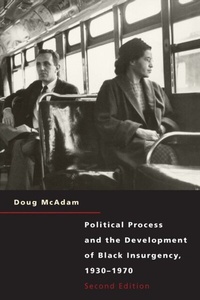
Political Process and the Development of Black Insurgency
1930-1970
2nd Edition
Published on 31. May 2024
303 pages
978-0-226-55555-3 (ISBN)
Description

In this classic work of sociology, Doug McAdam presents a political-process model that explains the rise and decline of the black protest movement in the United States. Moving from theoretical concerns to empirical analysis, he focuses on the crucial role of three institutions that foster protest: black churches, black colleges, and Southern chapters of the NAACP. He concludes that political opportunities, a heightened sense of political efficacy, and the development of these three institutions played a central role in shaping the civil rights movement. In his new introduction, McAdam revisits the civil rights struggle in light of recent scholarship on social movement origins and collective action.
"[A] first-rate analytical demonstration that the civil rights movement was the culmination of a long process of building institutions in the black community."-Raymond Wolters, Journal of American History
"A fresh, rich, and dynamic model to explain the rise and decline of the black insurgency movement in the United States."-James W. Lamare, Annals of the American Academy of Political and Social Science
"[A] first-rate analytical demonstration that the civil rights movement was the culmination of a long process of building institutions in the black community."-Raymond Wolters, Journal of American History
"A fresh, rich, and dynamic model to explain the rise and decline of the black insurgency movement in the United States."-James W. Lamare, Annals of the American Academy of Political and Social Science
All prices
More details
Other editions
Additional editions
Book
11/1999
University of Chicago Press
€34.00
Shipment within 10-20 days

Book
11/1985
University of Chicago Press
€21.71
Article exhausted; check different version
Person
Please fill in author biography
Content
- Intro
- Contents
- Introduction, 1999
- Preface
- Introduction
- 1. The Classical Model of Social Movements Examined
- 2. Resource Mobilization: A Deficient Alternative
- 3. The Political Process Model
- 4. The Empirical Implications of Various Models of Social Movements
- 5. The Historical Context of Black Insurgency, 1876-1954
- 6. The Generation of Black Insurgency, 1955-60
- 7. The Heyday of Black Insurgency, 1961-65
- 8. The Decline of Black Insurgency, 1966-70
- 9. Political Process and Black Insurgency
- Appendix 1: Methodology and Presentation of Coding Manual
- Appendix 2: Chronology of Sit-in Demonstrations, February 1- March 31, 1960
- Appendix 3: Estimated Total External Income for Five Major Movement Organizations, 1948-70
- Appendix 4: List of Indigenous Protest Leaders, 1955-60
- Appendix 5: Indigenous Protest Leaders and Their Later Organizational Affiliations within the Movement
- Notes
- Bibliography
- Index

