

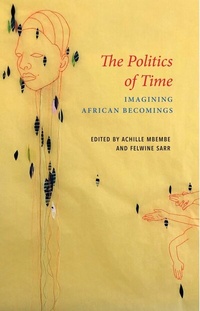
The Politics of Time
Description

As we enter the third decade of the twenty-first century, the world is undergoing a major historical shift: Africa, and the Global South more generally, is increasingly becoming a principal theatre in which the future of the planet plays itself out. But not only this: Africa is at the same time emerging as one of the great laboratories for novel forms of social, economic, political, intellectual, cultural, and artistic life. Often arising in unexpected places, these new forms of life materialize in practices that draw deeply from collective memory while simultaneously assuming distinctly contemporary, even futuristic, guises.
In November 2017, the second session of the Ateliers de la pensée - Workshops of Thought - was held in Dakar, Senegal. Fifty African and diasporic intellectuals and artists participated and their debates unfolded along numerous thematic lines, approached from the standpoints of many different disciplines. This volume is the result of that encounter. Among the many topics discussed were the concurrence and entanglement of multiple temporalities, the politics of life in the Anthropocene, the project of decolonization, and the preservation and transmission of different ways of knowing. At a time when the world is haunted by the specter of its own end, the contributors to this volume ask whether one can, by taking Africa as a point of departure, seize hold of other options for the future - not only for Africa, but for the world.
The Politics of Time and its companion volume, To Write the Africa World, will be indispensable works for anyone interested in Africa - its past, present, and future - and in the new forms of critical thought emerging from Africa and the Global South.
More details
Other editions
Additional editions
Persons
Felwine Sarr is Professor of Romance Studies at Duke University
Content
Achille Mbembe and Felwine Sarr
I
From Thinking Identity to Thinking African Becomings
Souleymane Bachir Diagne
Notes for a Maroon Feminism.
From the 'Body Double' to the Body as such
Hourya Bentouhami
Weaving, A Craft for Thought.
Writing and Thinking in Africa, or the Knot of the World's Great Narrative
Jean-Luc Raharimanana
II
Africa and the New Western Figures of Personal Status Law
Abdoul Aziz Diouf
Rethinking Islam,
Or, the Oxymoron of "Secular Theocracy"
Rachid Id Yassine
The Impossible Meeting.
A Free Interpretation of J. M. Coetzee's Disgrace
Hemley Boum
III
Circulations
Achille Mbembe
On the Return.
The Political Practices of the African Diaspora
Nadia Yala Kisukidi
Reopening Futures
Felwine Sarr
IV
Un/learning.
Rethinking Teaching in Africa
Françoise Vergès
The Bewitchment of History:
Mohammed Dib's Who Remembers the Sea
Soraya Tlatli
Currency, Sovereignty, Development.
Revisiting the Question of the CFA Franc
Ndongo Samba Sylla
V
Memories of the World, Memory-World
Séverine Kodjo-Grandvaux
Cum patior Africa: The Political Production of Regimes of 'the Nigh'
Nadine Machikou
The Sahara: A Space of Connection within an Emergent Africa,
From the Anthropocene to the Spring of Geo-Cultural Life
Benaouda Lebdai
Migrations, Narrations, the Refugee Condition
Dominic Thomas
VI
Humanity and Animality: (Re)thinking Anthropocentrism
Bado Ndoye
The Tree Frogs' Distress
Lionel Manga
To Speak and Betray Nothing?
Rodney Saint-Éloi
The Paths of the Voice
Ibrahima Wane
Notes
Index
