

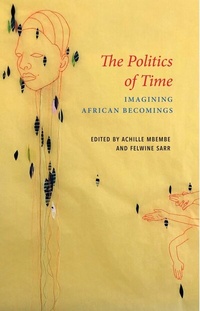
The Politics of Time
Description

In November 2017, the second session of the Ateliers de la pensée - Workshops of Thought - was held in Dakar, Senegal. Fifty African and diasporic intellectuals and artists participated and their debates unfolded along numerous thematic lines, approached from the standpoints of many different disciplines. This volume is the result of that encounter. Among the many topics discussed were the concurrence and entanglement of multiple temporalities, the politics of life in the Anthropocene, the project of decolonization, and the preservation and transmission of different ways of knowing. At a time when the world is haunted by the specter of its own end, the contributors to this volume ask whether one can, by taking Africa as a point of departure, seize hold of other options for the future - not only for Africa, but for the world.
The Politics of Time and its companion volume, To Write the Africa World, will be indispensable works for anyone interested in Africa - its past, present, and future - and in the new forms of critical thought emerging from Africa and the Global South.
More details
Other editions
Additional editions
Persons
Felwine Sarr is Professor of Romance Studies at Duke University
Content
Achille Mbembe and Felwine Sarr
I
From Thinking Identity to Thinking African Becomings
Souleymane Bachir Diagne
Notes for a Maroon Feminism.
From the 'Body Double' to the Body as such
Hourya Bentouhami
Weaving, A Craft for Thought.
Writing and Thinking in Africa, or the Knot of the World's Great Narrative
Jean-Luc Raharimanana
II
Africa and the New Western Figures of Personal Status Law
Abdoul Aziz Diouf
Rethinking Islam,
Or, the Oxymoron of "Secular Theocracy"
Rachid Id Yassine
The Impossible Meeting.
A Free Interpretation of J. M. Coetzee's Disgrace
Hemley Boum
III
Circulations
Achille Mbembe
On the Return.
The Political Practices of the African Diaspora
Nadia Yala Kisukidi
Reopening Futures
Felwine Sarr
IV
Un/learning.
Rethinking Teaching in Africa
Françoise Vergès
The Bewitchment of History:
Mohammed Dib's Who Remembers the Sea
Soraya Tlatli
Currency, Sovereignty, Development.
Revisiting the Question of the CFA Franc
Ndongo Samba Sylla
V
Memories of the World, Memory-World
Séverine Kodjo-Grandvaux
Cum patior Africa: The Political Production of Regimes of 'the Nigh'
Nadine Machikou
The Sahara: A Space of Connection within an Emergent Africa,
From the Anthropocene to the Spring of Geo-Cultural Life
Benaouda Lebdai
Migrations, Narrations, the Refugee Condition
Dominic Thomas
VI
Humanity and Animality: (Re)thinking Anthropocentrism
Bado Ndoye
The Tree Frogs' Distress
Lionel Manga
To Speak and Betray Nothing?
Rodney Saint-Éloi
The Paths of the Voice
Ibrahima Wane
Notes
Index
From Thinking Identity to Thinking African Becomings
Souleymane Bachir Diagne
Souleymane Bachir Diagne is Professor of Philosophy and of Francophone Studies at Columbia University in New York. His recent works include: Bergson postcolonial: l'élan vital dans la pensée de Léopold Sédar Senghor et Mohamed Iqbal (Paris: CNRS Éditions, 2011); L'encre des savants: réflexions sur la philosophie en Afrique (Paris: Présence africaine & CODESRIA, 2013); Comment philosopher en islam (Paris: Philippe Rey / Jimsaan, 2014); Philosopher en islam et en christianisme (with Philippe Capelle-Dumont) (Paris: Cerf, 2016); En quête d'Afrique(s): universalisme et pensée décoloniale (with Jean-Loup Amselle) (Paris: Albin Michel, 2018); and La controverse (with Rémi Braque) (Paris: Stock, 2019).
[W]hat matters is not philosophy as such but critical thought. It is such thinking that we must develop today ., to imagine the possible beyond the real, to make sure that the platitudes of the present do not become the measure of all things but are themselves measured, relativized, put in their proper place, ranked in order and made subordinate to other demands, that they are weighed against norms that push us forward and that free us from conformism and resignation.
Paulin Hountondji1
Africa is, like all the other continents, multiple, diverse; there one thinks a thousand different things in more than a thousand different languages. Were one, nonetheless, to attempt to sum up in a single word (an impossible task, to be sure) contemporary African thought - as it is presented in the works of authors as different from one another as Paulin Hountondji of Benin; Felwine Sarr, Animata Diaw-Cissé, or Ramatoulaye Diagne of Senegal; Achille Mbembe of Cameroon; Tanella Boni of the Ivory Coast; Kwasi Wiredu or Kwame Appiah of Ghana; Charles Bowao or Abel Kouvouama of the Congo; Abdou Filali-Ansary of Morocco . - one could argue that African thought has passed from yesterday's thinking of identity, which was part of the struggle against colonialism, to today's thinking of becomings. What will happen to African existence in its various iterations, and to its weight in a world grown finite, confined by financial, economic, human, electronic, and cultural flows - that is, by the different facets of globalization? What is happening and what will happen to the weight - or, rather, to the value - of what we are, to our ways of being in the world, to these African faces bearing witness to the human adventure? Such questions were already part of the response to colonial negation. At the time, the answers provided were, among others, negritude, the African personality, the Arab renaissance - in other words, incarnations of political and cultural nationalism, expressions of identity that we had hoped would all one day converge upon the realization of a Pan-African ideal. Today, where do these responses and that ideal stand? Put differently - what are the responses today? What are they in a world no longer structured by an opposition to Africa's negation - even though that negation sometimes re-emerges in comments, seemingly of another time, by politicians from former colonial powers who come out saying that Africans have yet to fully enter history, or that colonization represented nothing but the desire to share the metropole's culture. I will consider here the movement whereby the meaning of African existence and "presence" ceases to denote the resistance, defense, and illustration of an identity and turns into a question of pluralism and becomings. It will be argued that we have moved from the reactive, mass Africanity [africanité] that was the appropriate response to colonial negation toward a system of thought adapted to a situation that obliges Africanity to understand itself as open and diverse and to attend to the problem of cultural and religious pluralism - a problem whose urgency is indicated by the tragedies that Africa is once more experiencing today, at the very moment that it plainly represents the continent of the future.
For this reason, I trust one will excuse me for occasionally speaking in the first person plural (for saying "we") and for at times being prescriptive (for saying "we must"): I do so because, when it comes to this movement of thinking becomings, I am one of the interested parties.
Against Negation: Saying Who and What We Are
Who and what are we?
Admirable question.
Aimé Césaire2
In the immediate postwar period, in 1947, Alioune Diop, a Senegalese intellectual, founded a journal with the title Présence africaine in Paris, at the heart of the Latin Quarter. "Présence africaine" was also the name of the publishing house that followed shortly after the creation of the journal. The very site that became - and today still is - the location of Présence africaine, 25 bis rue des Écoles, was a symbol in and of itself. A presence of Africa had affirmed itself alongside the temples that one of its colonizers had dedicated to Knowledge: next to the Sorbonne, a stone's throw away from the École polytechnique on the rue de la Montagne-Sainte-Geneviève, not far from the École normal supérieure on the rue d'Ulm. A little farther away, at Les Deux Magots and the Café de Flore by Saint-Germain-des-Prés, the intellectual history of the postwar period was also being written. In this environment, Présence became a meeting place for intellectuals, writers, and students coming from Africa or living in diaspora, as well as for progressive French intellectuals. The mission that Présence had given itself was the production of knowledge: knowledge of Africa, knowledge of oneself through Africa, knowledge for Africans .
Independence was in the air. The year 1947 was when India and Pakistan acquired sovereignty. The 1948 publication of the Anthologie de la nouvelle poésie nègre et malgache de langue française by Senghor, with Jean-Paul Sartre's preface, Black Orpheus [Orphée noir], an existentialist celebration of the power of human emancipation wielded by Africa, was one of Présence's two major achievements at the hour of its birth. The other was the publication of Bantu Philosophy [La philosophie bantou] by the Franciscan friar Placide Tempels. For the first time, Tempels's book associated African culture with what was taken to be the quintessence and very spirit of European civilization - that which set it apart from the rest of humanity: philosophy. Indeed, as Husserl had declared not too long before, in 1933,3 it was on account of this spirit that India would do well to Europeanize as much as possible; whereas a Europe that had attained full self-consciousness and a perfect understanding of its own telos would know that it had no reason to Indianize itself [s'indianiser] in any way whatsoever.
Ten years later, in 1957, Présence published Nations nègres et cultures [translated in abridged form as The African Origin of Civilization: Myth or Reality], the work in which Cheikh Anta Diop made the case for an African presence at the origins of human civilizations. In the field of history, the publication of Diop's book marked a crucial date and an essential contribution to the project of deconstructing the Hegelian pretense that the History of Spirit was a telos which belonged to a particular form of humanity. In the same year, 1957, Ghana acquired independence, an independence that its first president, Kwame Nkrumah, understood as a simple step in the greater march toward the organic unity of a free Africa, the sine qua non for the affirmation of an African presence in the world. Behind this march, behind the self-affirmation that was both its condition and its objective, Nkrumah discerned a philosophy based on the consciousness of a unity that waited to be forged, of a reconstructed identity to be realized as a "new harmony" - one which would see Africanity integrate Christian and Islamic interpretations into itself not as disruptions but as contributions: consciencism [consciencisme] was thus expected to illuminate the forward march of the continent.
Africa is not only the Sub-Saharan region of the continent - what Hegel thought he could call "Africa proper." In its northern regions, the discourse had also been - in a manner analogous to what we have just seen - one of the nahda, the re-birth (in Arabic) that was meant to answer the colonial negation and whose claims were an essential component of the identitarian discourse of African Arabness. In one guise or another, the external shock of Europe's colonization of the Arab world had prompted a question that one could formulate in the following way: what has happened to our identity so that now, in our current condition under European domination, we observe our former greatness reduced to nothing? Posed in this manner, the question implied a return to what had constituted that greatness: Islam. As a consequence, being reborn to oneself, to one's own identity, meant returning to the fundamental principles of a golden...
