

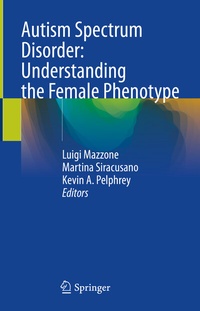
Autism Spectrum Disorder: Understanding the Female Phenotype
Description

This book provides a comprehensive overview of the current state of knowledge on autism in females, in order to help understand and clarify gender implications in the autistic female phenotype. Despite the reported higher risk of developing autism in males than in females, few studies have investigated the gender differences at the clinical and neurobiological level. Possible genetic protective factors, as well as differing neurobiological brain trajectories, could be responsible for the male/female discrepancy in prevalence rates (4:1). Moreover, a different clinical phenotype regarding the onset of symptoms, behavioral features and social motivation often skews diagnosis in women. Specifically, the phenomenon of camouflaging or hiding symptoms in high functioning females, due to behavioral coping strategies, contributes to incorrect or delayed diagnosis.
In addition to addressing an important gap in the literature, this book provides concrete and specific diagnostic recommendations and intervention strategies. In addition, a dedicated chapter presents clinical case reports and shares the personal experiences of autistic women. Given its scope, the book will appeal to clinicians and practitioners, as well as researchers and students in the fields of child and adult psychiatry, psychology and neuropsychiatry.
More details
Other editions
Additional editions
Persons
Luigi Mazzone,
MD, PhD, Full Professor in Child Neuropsychiatry. He is currently the Chief of the Child and Adolescent Psychiatry Division and the Director of the Medical Residency School of the University of Rome Tor Vergata, Italy. Several are the international fellowships he experienced during his academic career: the National Institute of Mental Health (NIMH), Bethesda, MD, USA; the Pediatric Brain Imaging Laboratory at Columbia University, NY, USA. Luigi Mazzone has focused his research and clinical activity both on the study of neurobiological substrates and on the characterization of the clinical phenotype of neurodevelopmental disorders such as autism spectrum disorder and ADHD. To date, he has published more than 150 articles in peer reviewed international scientific journals. He has already published with Springer the volume "Psychiatric Symptoms and Comorbidities in Autism Spectrum Disorder" in 2016.
Martina Siracusano
, MD, PhD, is currently a Clinical Researcher at the Department of Biomedicine and Prevention of the University of Rome Tor Vergata (Italy) and carries out her main clinical activity in the Child and Adolescent Psychiatry Division of the Rome Tor Vergata University Hospital. Her primary research and clinical topic of interest is on autism spectrum disorder (early diagnosis, identification of biomarkers, medical comorbidities, genetic syndromes). She is actually involved in several research projects granted by the Italian National Health System focused on these themes.
Kevin Pelphrey , a neuroscientist and expert on child brain development, is the Harrison-Wood Professor of Neurology at the University of Virginia, USA. As a cognitive neuroscientist, his research investigates the brain basis of autism and related neurodevelopmental disorders. His multidisciplinary team seeks to understand the causes of autism to help get the right treatment to the right individual at the right time. Kevin is the Principal Investigator of the NIH Autism Center for Excellence-Neurogenetics of Females with Autism Network. His contributions to science have been recognized by receipt of a NIH Scientist Career Development Award, the John Merck Scholars Award, the Microsoft Corporation's Breakthrough Award, and the American Psychological Association's Boyd McCandless Award for distinguished early career theoretical contributions to Developmental Psychology. As a father and advocate, he serves by appointment of the United States Secretary of Health and Human Services as a member of the Federal Interagency Autism Coordinating Committee, USA.
Content
Part I: Autistic Female Phenotype: Gender Differences from Infancy to Adulthood.- 1. Autism Spectrum Disorder: Prevalence and Symptoms' Onset.- 2. Female Autism Phenotype.- 3. Cognition and Neuropsychological Profiles.- 4. Adulthood: Do the Sex Differences in Autistic Phenotype Persist in Adult Life?.- Part II: Neurogenetics of Female Autism.- 5. Neurogenetics of Female Autism.- Part III: Psychiatric & Other Medical Comorbidities.- 6. Internalizing Disorders.- 7. Externalizing Disorders.- 8. Epilepsy & Other Medical Comorbidities.- Part IV: Treatment.- 9. Treatment Strategies in Autism Spectrum Disorder.- 10. Pharmacological Intervention.- Part V: Quality of Life for Transition Age Youth.- 11. The Intersection of Gender Diversity and LGBTQ Identities with the Autism Spectrum.- 12. Evaluation of sexual and socio-emotional wellbeing in persons affected by ASD: are we ready?.- 13. Independent Living and Employment Options.- Part VI: Case Reports.- 14. Clinical Case Reports.
