

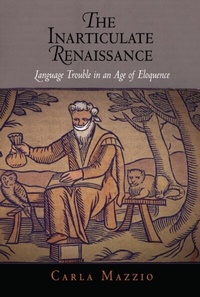
The Inarticulate Renaissance
Language Trouble in an Age of Eloquence
1st Edition
Published on 8. January 2016
360 pages
978-0-8122-9340-1 (ISBN)
Description

The Inarticulate Renaissance explores the conceptual potential of the disabled utterance in the English literary Renaissance. What might it have meant, in the sixteenth-century "age of eloquence," to speak indistinctly; to mumble to oneself or to God; to speak unintelligibly to a lover, a teacher, a court of law; or to be utterly dumfounded in the face of new words, persons, situations, and things? This innovative book maps out a "Renaissance" otherwise eclipsed by cultural and literary-critical investments in a period defined by the impact of classical humanism, Reformation poetics, and the flourishing of vernacular languages and literatures.
For Carla Mazzio, the specter of the inarticulate was part of a culture grappling with the often startlingly incoherent dimensions of language practices and ideologies in the humanities, religion, law, historiography, print, and vernacular speech. Through a historical analysis of forms of failed utterance, as they informed and were recast in sixteenth-century drama, her book foregrounds the inarticulate as a central subject of cultural history and dramatic innovation. Playwrights from Nicholas Udall to William Shakespeare, while exposing ideological fictions through which articulate and inarticulate became distinguished, also transformed apparent challenges to "articulate" communication into occasions for cultivating new forms of expression and audition.
For Carla Mazzio, the specter of the inarticulate was part of a culture grappling with the often startlingly incoherent dimensions of language practices and ideologies in the humanities, religion, law, historiography, print, and vernacular speech. Through a historical analysis of forms of failed utterance, as they informed and were recast in sixteenth-century drama, her book foregrounds the inarticulate as a central subject of cultural history and dramatic innovation. Playwrights from Nicholas Udall to William Shakespeare, while exposing ideological fictions through which articulate and inarticulate became distinguished, also transformed apparent challenges to "articulate" communication into occasions for cultivating new forms of expression and audition.
Reviews / Votes
"Carla Mazzio's erudite and nuanced The Inarticulate Renaissance explores the other face of the era's preoccupation with rhetorical eloquence, suggesting an entire counter-history of linguistic disorder and disjunction, of aphasia and the profusion of tongues. . . . It is rare to find [this] degree of conceptual force and interpretive finesse coupled to such scholarly reach. This is a thoroughly compelling book, one that will extend the purview of the field." (Renaissance Quarterly) "Uncommonly abundant in annotation, always sophisticated in theory, this learned book belongs in every collection." (Choice) "Carla Mazzio's important and beautifully written book charts the 'unjointing' of articulate speech in an age conventionally known for its rhetorical eloquence. She investigates the shadow side of early modern communication, the forms of utterance suppressed and occluded by traditional celebrations of the period's rhetorical fluency: mumbling, stuttering, sensation that hovers at the interface of language and the body, utterances that exist between silence and speech, emotion that overwhelms words, linguistic incoherence, syntactical confusion. These interstices of language reveal the cultural workings of religion and politics, law and revenge, and desire and the body. . . . Her brilliant reading of Hamlet makes new sense of a play that is simultaneously 'words, words, words,' and that anatomizes those places in the human heart that defy language." (Elizabeth Harvey, University of Toronto) "Mazzio discovers the glossolalia that is the startling corollary to the Renaissance passion for eloquence. Her analysis of a range of speech disorders-from mumbling to solecisms to gaffes to incoherence-demonstrates the need to expand our criteria for what counts as expressive and affecting language. Historically and rhetorically astute, this splendidly luminous book enlarges and enriches our reading of even the most familiar Renaissance texts." (Margreta de Grazia, University of Pennsylvania) "Mazzio opens up a conversation that scholarly readers and their students are ready to join. She has followed the theoretical dialectic of the past quarter century closely and locates her book just on the edge of change." (Bruce R. Smith, University of Southern California)More details
Language
English
Place of publication
Pennsylvania
United States
Target group
College/higher education
Illustrations
5 illus.
5 illus.
ISBN-13
978-0-8122-9340-1 (9780812293401)
Copyright in bibliographic data and cover images is held by Nielsen Book Services Limited or by the publishers or by their respective licensors: all rights reserved.
Schweitzer Classification
Other editions
Additional editions
Book
01/2009
University of Pennsylvania Press
€74.50
Shipment within 10-20 days
Person
Carla Mazzio is Associate Professor of English at the University at Buffalo, SUNY.
Content
- Cover
- The Inarticulate Renaissance
- Title
- Copyright
- CONTENTS
- LIST OF ILLUSTRATIONS
- NOTE ON THE TEXT
- INTRODUCTION
- CHAPTER ONE The Renaissance of Mumbling: Latinity, Reformation Polemic, and the Mother Tongue
- CHAPTER TWO From Fault to Figure: The Case of Madge Mumblecrust in Ralph Roister Doister
- CHAPTER THREE Disarticulating Community: Nation, Law, History, and The Spanish Tragedy
- CHAPTER FOUR Acting in the Passive Voice: Love's Labour's Lost and the Melancholy of Print
- CHAPTER FIVE Feeling Inarticulate: On Communal Vulnerability and the Sense of Touch in Lingua and Hamlet
- NOTES
- SELECTED BIBLIOGRAPHY
- INDEX
- ACKNOWLEDGMENTS
