

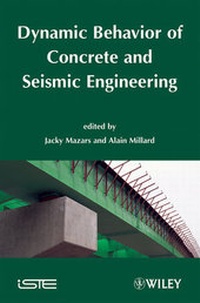
Dynamic Behavior of Concrete and Seismic Engineering
Description

Reviews / Votes
"Begins by presenting the most frequently used experimentaltechniques in the study of the dynamic behavior of concrete."(AECCafé.com, 16 March 2011)More details
Other editions
Additional editions
Persons
Jacky Mazars is a Professor at the National Polytechnic Institute of Grenoble, France. He is an expert in mechanical behavior and durability of civil engineering structures.
Content
Preface . xi
Chapter 1. Dynamic Behavior of Concrete: Experimental Aspects 1 François Toutlemonde and Gérard Gary
1.1. Introduction 1
1.2. Tests in which the transient rate has little influence 10
1.3. Tests with transient phase conditioned interpretations 20
1.4. Other tests 29
1.5. Synthesis of the experimental data on concrete and associated materials 33
1.6. Conclusion 46
1.7. Bibliography 47
Chapter 2. Dynamic Behavior of Concrete: Constitutive Models 55 Patrice Bailly
2.1. Dynamics of concrete structures 55
2.2. Fast dynamics applied to concrete 62
2.3. Scabbing 68
2.4. Effect of a shock wave on the structure of materials 69
2.5. Modeling types 70
2.6. Models 76
2.7. Conclusion 90
2.8. Bibliography 92
Chapter 3. Seismic Ground Motion 95 Pierre-Yves Bard
3.1. Introduction 95
3.2. Measuring seismic motions 96
3.3. Quantitative characterization of seismic movements 98
3.4. Factors affecting seismic motions 108
3.5. Conclusions 120
3.6. Bibliography 121
Chapter 4. Soil Behavior: Dynamic Soil-Structure Interactions 125 Alain Pecker
Introduction 125 4.1. Behavior of soils under seismic loading 126
4.2. Modeling soil behavior 131
4.3. Linear soil-structure interactions 143
4.4. Non-linear soil-structure interactions 158
4.5. Bibliography 161
Chapter 5. Experimental Methods in Earthquake Engineering 165 Alain Millard, Pierre Pegon and Jean-Claude Queval
Introduction 165
5.1. The pseudo-dynamic method 167
5.2. The conventional pseudo-dynamic method 170
5.3. Continuous pseudo-dynamic method 178
5.4. Final comments 183
5.5. Shaking table tests 184
5.6. Laws of similarity 193
5.7. Instrumentation 194
5.8. Loading 195
5.9. Conclusion 196
5.10. Bibliography 197
Chapter 6. Experiments on Large Structures 201 Patrick Paultre and Jean Proulx
Introduction 201
6.1. Instrumentation 202
6.2. Dynamic loads 205
6.3. Data processing 206
6.4. Application to buildings 208
6.5. Bridge application 213
6.6. Application to large dams 220
6.7. Conclusion 230
6.8. Acknowledgements 230
6.9. Bibliography 230
Chapter 7. Models for Simulating the Seismic Response of Concrete Structures 233 Didier Combescure, Nicolas Ile, Jacky Mazars and Jean-Marie Reynouard
7.1. Introduction 233
7.2. Different discretization families 234
7.3. Behavior laws for concrete 240
7.4. A few examples with their validation through experiments 250
7.5. Conclusions 269
7.6. Bibliography 270
Chapter 8. Seismic Analysis of Structures: Improvements Due to Probabilistic Concepts 273 Jean-René Gibert
8.1. Introduction 273
8.2. The modal method 274
8.3. Criticism of the modal method 279
8.4. A few reminders about random processes 280
8.5. Improvements to the modal method 292
8.6. Direct calculation of the floor spectra 297
8.7. Creation of synthetic signals and direct numerical integration 301
8.8. Seismic analysis of non-linear behavior structures 304
8.9. Conclusion 323
8.10. Bibliography 323
Chapter 9. Engineering Know-How: Lessons from Earthquakes and Rules for Seismic Design 327 Philippe Bisch
9.1. Introduction 327
9.2. Lessons from earthquakes 327
9.3. The aims of anti-seismic protection standards 336
9.4. General design 344
9.5. Behavior coefficients 349
9.6. Designing and dimensioning reinforced concrete structure elements 353
9.7. Conclusions 366 9.8. Bibliography 366
List of Authors 369
Index 373
