

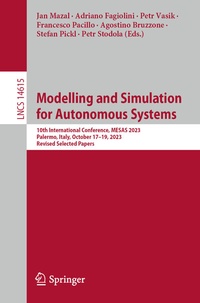
Modelling and Simulation for Autonomous Systems
Description

This volume LNCS 14615 constitutes the refereed proceedings of the 10th International Conference on Modelling and Simulation for Autonomous Systems, MESAS 2023, in October 17-19, 2023, in Palermo, Italy.
The 21 full papers presented together with 4 short papers were carefully reviewed and selected from 49 submissions. The conference focuses to to unite the Modelling and Simulation and the Autonomous Systems/Robotic communities, creating a space for the exchange of innovative ideas and concept development.
More details
Other editions
Additional editions
Content
.- M&S of Intelligent Systems - R&D and Application .
.- Comparison of Frequency Cepstral Coefficients in Impulse Acoustic Events Detection.
.- Modelling and Simulation of hypersonic missile in VR-Forces environment.
.- Atlas Fusion 2.0 - A ROS2 Based Real-Time Sensor Fusion Framework.
.- UAS Flight Path Optimization Model for Effective Monitoring and Surveillance of the Buffer Zone in the UNFICYP Peacekeeping Mission.
.- A Model-Based Design Approach for a System of Systems based on an Integrated UAV Platform.
.- Practical applicability of tree spacing passability analysis on vehicle path planning.
.- Where to go and how to get there: Tactical terrain analysis for military unmanned ground-vehicle mission planning.
.- A Survey of Trajectory Planning Algorithms for Off-road Uncrewed Ground Vehicles.
.- Multi-physics and Multi-spectral Sensors Simulator for Autonomous Flight Functions Development.
.- Future Challenges of Advanced M&S Technology.
.- Conceptual Aspects of Counter-UAS Modelling and Simulation.
.- Challenges Associated with the Deployment of Autonomous Reconnaissance Systems on Future Battlefields.
.- The Key Challenges of SBAD M&S.
.- Development of Geoprocessing Tool for Wet Gap Crossing in Military Operations.
.- Digital Twin Modeling for Machine Vision Testing in Autonomous Systems.
.- A Situation Analysis Process in Computer-Generated Forces Team Behavior within Air Combat Simulations under Risk and Uncertainty: Concept and First Implementations.
.- A Tactical Planning Process in Computer-Generated Forces Team Behavior within Air Combat Simulations: Concept and First Implementations.
.- Survey on Sensing, Modelling and Reasoning Aspects in Military Autonomous Systems.
.- AxS/AI in Context of Future Warfare and Security Environment .
.- Camera based AI models used with lidar data for improvement of detected object parameters.
.- The Analysis of Point Cloud Registration Methods for Natural Environment in Autonomous Driving.
.- Hyperspectral Data Dimensionality Reduction: a Comparative Study between PCA and Autoencoder methods.
.- Utilizing a CNN for Automatic Detection of Military Reconnaissance and Surveillance Objects in Aerial Images: Concept and Challenges.
.- Multimodal Earth Observation Modeling using AI.
.- Statistical Evaluation of Simulation Study Data.
.- Mission: COMANND. Conceptualizing an AI Assistant for Decision-Making.
.- Using Only Synthetic Images to Train a Drogue Detector for Aerial Refueling.
