

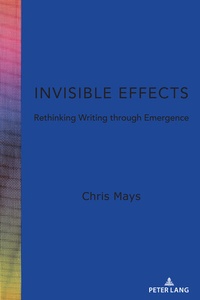
Invisible Effects
Description

Invisible Effects directly engages systems and complexity theory to reveal how the effects of writing and writing instruction work in deferred, disguised, and unexpected ways. The book explains how writing and language that exist in "writing systems" can indirectly (though powerfully) affect people and environments in sometimes distant contexts. In so doing, the book takes on a question central to rhetoric and writing throughout its long history but perhaps even more pressing today: how do we recognize and measure the e?ects of writing when those effects are so tangled up with our complex material and discursive environments? The surprisingly powerful effects explored here suggest new ways of thinking about and teaching writing and the applications, lessons, and examples in the text precisely model what this thinking and teaching might look like.
This book is primed to serve as an important addition to reading lists of scholars and graduate students in Writing Studies and Rhetoric and should appear on many syllabi in courses on writing and writing instruction and on rhetoric, both introductory and advanced. As well, the book's advocacy for the unrecognized potential impact of writing instruction makes it appealing for writing program directors and any potential university faculty, administrators, and non-academics interested in the importance and the efficacy of writing instruction. This book is also a useful resource for scholars and graduate students specializing in Writing Across the Curriculum, as the text provides a useful way to shift the conversation and communicate about writing across disciplines.
More details
Other editions
Additional editions


Person
Chris Mays received his Ph.D. in English Studies with a specialization in Rhetoric and Composition from Illinois State University. His co-edited collection is entitled Kenneth Burke + The Posthuman.
Content
List of Illustrations - Acknowledgments - Introduction. Writing Effects, Complex Systems, and Emergence - Writing Effects, Where No One Notices - Nonlinear Effects in and of the Classroom - Systems Theory, Non-dualism, and the Emergent Commonplace - Complexity and Reduction: Teaching Writing as a Complex System - Conclusion. Systems and (Un)Certainty - Index.
