

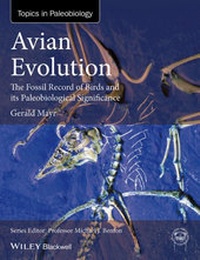
Avian Evolution
Description

More details
Other editions
Additional editions
Person
Gerald Mayr is a German paleontologist who is Curator of Ornithology at the Senckenberg Research Institute in Frankfurt am Main, Hesse. He has published extensively on fossil birds, especially the Paleogene avifauna of Europe. He is an expert on the Eocene fauna of the Messel pit.
Content
Foreword ix
Preface xi
Acknowledgments xiii
Chapter 1 An Introduction to Birds, the Geological Settings of Their Evolution, and the Avian Skeleton 1
Birds Are Evolutionarily Nested within Theropod Dinosaurs 2
The Geological Settings of Avian Evolution in a Nutshell 4
Characteristics of the Avian Skeleton 6
Chapter 2 The Origin of Birds 18
Archaeopteryx: The German "Urvogel" and Its Bearing on Avian Evolution 19
The Closest Maniraptoran Relatives of Birds 22
Feather Evolution 32
The Origin of Avian Flight 37
Chapter 3 The Mesozoic Flight Way towards Modern Birds 43
Jeholornithids: Early Cretaceous Long-Tailed Birds 44
Confuciusornis, Sapeornis, and Kin: Basal Birds with a Pygostyle 45
Ornithothoraces and the Origin of Sustained Flapping Flight Capabilities 50
The Ornithuromorpha: Refinement of Modern Characteristics 55
Ornithurae and the Origin of Modern Birds 59
Chapter 4 Mesozoic Birds: Interrelationships and Character Evolution 64
The Interrelationships of Mesozoic Birds: Controversial Phylogenetic Placements and Well-Supported Clades 65
Character Evolution in Mesozoic Birds 68
Ontogenetic Development of Mesozoic Birds 81
Chapter 5 The Interrelationships and Origin of Crown Group Birds (Neornithes) 84
Phylogenetic Interrelationships of Neornithine Birds 85
The Mesozoic Fossil Record of Neornithine-Like and Neornithine Birds 88
Chapter 6 Palaeognathous Birds (Ostriches, Tinamous, and Allies) 94
The Interrelationships of Extant Palaeognathae 95
Early Cenozoic Palaeognathous Birds of the Northern Hemisphere 95
Long-Winged Ostriches, Rheas, and Tinamous 97
Short-Winged Palaeognathous Birds 101
Biogeography: A Textbook Example of Gondwanan Vicariance Has Been Dismantled 105
Chapter 7 Galloanseres: "Fowl" and Kin 107
Galliformes: From Herbivorous Forest Dwellers to Seed Eaters of Open Landscapes 108
The Waterfowl 113
Gastornithids: Giant Herbivorous Birds in the Early Paleogene of the Northern Hemisphere 118
Dromornithids (Mihirungs or Thunderbirds): Gastornis-Like Birds from Australia 120
Pelagornithids: Bony-Toothed Birds 121
Chapter 8 The "Difficult-to-Place Groups": Biogeographic Surprises and Aerial Specialists 125
The Columbiform Birds: Doves, Sandgrouse, ... and Mesites? 126
The Hoatzin: A South American Relict Species 127
Turacos and Cuckoos 129
Bustards 131
The "Wonderful" Mirandornithes, or How Different Can Sister Taxa Be? 132
Strisores: The Early Diversification of Nocturnal Avian Insectivores 136
Chapter 9 Shorebirds, Cranes, and Relatives 147
Charadriiformes: One of the Most Diverse Groups of Extant Birds 148
From Rail to Crane 156
Chapter 10 Aequornithes: Aquatic and Semi-Aquatic Carnivores 161
Loons: Foot-Propelled Divers of the Northern Hemisphere 162
Pelagic Tubenoses and Albatrosses 164
Penguins: More Than 60 Million Years of Flightlessness 168
The Polyphyletic "Pelecaniformes" and "Ciconiiformes" 174
Late Cenozoic Turnovers in Marine Avifaunas 187
Chapter 11 Cariamiforms and Diurnal Birds of Prey 189
Seriemas and Allies: Two Species Now, Many More in the Past 190
Diurnal Birds of Prey: Multiple Cases of Convergence among Raptorial Birds 197
Chapter 12 The Cenozoic Radiation of Small Arboreal Birds 204
The Courol and Mousebirds: Two African Relict Groups 205
The Long Evolutionary History of Owls 210
Parrots and Passerines: An Unexpected Sister Group Relationship and Its Potential Evolutionary Implications 212
Trogons, Rollers, and Woodpeckers: Cavity-Nesters with Diverse Foot Morphologies 223
Chapter 13 Insular Avifaunas Now and Then, on Various Scales 233
Islands and Isolated Continents as Refugia 234
The Evolution of Flightlessness in Predator-Free Environments 235
Insular Gigantism and Islands as Cradles of Unusual Morphologies 241
Glossary 245
References 248
Index 289
Chapter 1
An Introduction to Birds, the Geological Settings of Their Evolution, and the Avian Skeleton
What is a bird? Just by looking at the extant world, this question is easily answered: a bird is a bipedal, feathered animal without teeth, which, with very few exceptions, is capable of flight. These and numerous other avian characteristics were, however, sequentially acquired in the more than 160 million years of avian evolution. As a result, the distinction between birds and their closest relatives becomes more blurred the further one goes back in time.
With about 10,000 living species, birds are the second most species-rich group of extant vertebrates, outnumbered only by teleost fishes. Owing to the constraints of their aerial way of life, most extant birds have quite a uniform appearance. Whereas the morphological diversity of mammals spans extremes like bats and whales, all present-day birds have two wings, two legs, and an edentulous beak, with most major external differences concerning plumage traits, neck and limb proportions, as well as beak shapes. This alikeness of bird shapes notwithstanding, their skeletons show a high diversity of morphological details. In this chapter, the reader is introduced to some of the main features of the avian skeleton. In addition, general terms and the geological setting of avian evolution are briefly outlined to aid understanding of the subsequent accounts.
Birds are Evolutionarily Nested within Theropod Dinosaurs
An understanding of avian evolution hinges on a robust phylogenetic framework, with a knowledge of the interrelationships of the studied groups being central to many evolutionary and paleobiological questions arising from the fossil record. The most rigorous method of reconstructing evolutionary trees is called phylogenetic systematics, or cladistics, and aims at identification of monophyletic groups or clades (readers who are not acquainted with phylogenetic terminology are referred to Figure 1.1 and the glossary at the end of this book, which explains words highlighted in the text). Organisms can be remarkably different from their closest relatives and the results of phylogenetic reconstructions are sometimes counterintuitive. Overall similarities may be misleading, because they are often based on the retention of primitive features (plesiomorphies) that were inherited from a common ancestor. Closely related organisms, on the other hand, can become profoundly different if they are on disparate evolutionary trajectories.
Figure 1.1 Illustration of some general phylogenetic terms used in this book. Phylogenetic systematics aims at identification of monophyletic groups (clades), which include an ancestral species and all of its descendants and are characterized by shared derived characters (apomorphies). Depicted is a hypothetical clade A with extant and extinct species, the latter being denoted by daggers. Character X is an apomorphy of this clade, whereas character Y represents an apomorphy of the subclade B. Groups are polyphyletic if they consist of only distantly related taxa, and paraphyletic if they do not include all of the taxa that descended from their last common ancestor. The white field marks the crown group of clade A, whereas all taxa in the dark and light gray areas are stem group representatives of this clade.
Birds are one of those animal groups that underwent particularly pronounced morphological transformations in their evolutionary history, and as a result their anatomy strongly departs from that of their closest living relatives. Even so, unanimous consensus exists that birds belong to the Archosauria. This clade also includes crocodilians and all non-avian dinosaurs and is characterized by a number of derived characters (apomorphies), such as teeth sitting in sockets of the jaw bones, a skull with an opening (antorbital fenestra) between the orbits and the nostrils, and a four-chambered heart.
In the 19th century some scientists already assumed that the closest archosaurian relatives of birds are to be found among bipedal theropod dinosaurs. In its modern form, this hypothesis goes back to Ostrom (1976), who proposed an avian origin from one particular theropod clade, the Coelurosauria. At one time vigorously contested, a theropod ancestry for birds is now widely accepted. For space constraints and because an extensive literature already exists, these largely settled debates are not reviewed here (see, e.g., Prum 2002; Chiappe 2007; Makovicky and Zanno 2011; Xu et al. 2014).
Likewise, it is now generally appreciated that, within coelurosaurs, birds belong to the Maniraptora, which also include dromaeosaurs, troodontids, oviraptorosaurs, and a few other coelurosaurian theropods, such as ornithomimosaurs and therizinosaurs (Figure 1.2). Aside from features also present in some more distantly related dinosaurs (e.g., bipedal locomotion and a highly pneumatized skeleton), maniraptoran theropods are characterized by greatly elongated hands with only three fingers, a semilunate carpal bone, a bowed ulna, and thin radius, as well as an avian-like eggshell structure (Gauthier 1986; Makovicky and Zanno 2011). Most current phylogenetic analyses recognize oviraptorosaurs, dromaeosaurs, and troodontids as the closest avian relatives. Oviraptorosaurs are placed outside a clade formed by dromaeosaurs, troodontids, and birds for which the term Paraves was introduced (e.g., Makovicky and Zanno 2011; Turner et al. 2012).
Figure 1.2 Phylogenetic interrelationships of birds and their closest theropod relatives, with some key apomorphies characterizing major groups (after Makovicky and Zanno 2011; Turner et al. 2012). The asterisked characters are absent in Archaeopteryx and the Troodontidae.
A clade including oviraptorosaurs, dromaeosaurs, troodontids, and birds is robustly supported in most analyses, but, as will be detailed later, the jury may still be out on the exact interrelationships between these groups. Not only do various analyses show conflicting results, but some new findings from the Early Cretaceous of China exhibit unexpected character mosaics, which challenge current phylogenetic hypotheses.
Aves, Avialae, or what constitutes a "bird"
Extant birds are classified in the taxon Aves, which is one of the traditional higher categories of vertebrates. If fossils are also considered, the content of Aves is a matter of considerable debate and depends on the underlying definition, which varies among current authors.
In phylogenetic discussions of groups, which include both fossil and extant species, it is import to distinguish between the crown group of a certain taxon and its stem group (Figure 1.1). At times when only a few Mesozoic birds were known, Aves was defined as the least inclusive clade comprising the earliest known bird, Archaeopteryx, as well as all extant species (i.e., the crown group), which were designated Neornithes. This terminology is still used by many authors and is also employed here. Following Gauthier (1986), who restricted the use of Aves to the crown group, the clade including Archaeopteryx and crown group birds is nowadays often termed "Avialae." This renders the well-established term Neornithes redundant and conflicts with common practice in paleontology, where crown group taxa are expanded to encompass fossil stem group representatives (e.g., in the case of Equidae, the clade including fossil and extant horses, or Homo, the taxonomic category for archaic and modern humans).
Restriction of the term Aves to the crown group would furthermore lead to the awkward classification of all Mesozoic birds outside the crown group as "non-avian avialans," no matter how similar to modern birds these may be, and would result in a discrepancy between the contents of the terms "avian" and "bird-like." As this is more counterintuitive than recognizing the avian affinities of aberrant fossil stem group taxa, Aves is used for the clade including Archaeopteryx and extant birds throughout this book.
The Geological Settings of Avian Evolution in a Nutshell
The known history of birds spans more than 160 million years, from the Late Jurassic until now. Avian evolution therefore extended over two geological eras, the Mesozoic and the Cenozoic, which showed profound differences in their paleogeographic, paleoenvironmental, and climatic regimes. Most readers of this book will probably have a basic acquaintance with these facts, so only some of the major geological settings are briefly summarized in the following (Figure 1.3).
Figure 1.3 Time chart showing geological periods relevant for avian evolution and the stratigraphic position of some important fossil localities.
Geological eras are subdivided into periods, epochs, and stages. The Mesozoic era includes three periods, of which only the last two, the Jurassic and the Cretaceous, yielded avian fossils, with controversial reports of a Triassic "Protoavis" (Chatterjee 2015) being dismissed by most current researchers. All of the few Jurassic avian or avian-like fossils stem from the latest epoch of this period; that is, the Late Jurassic. Until recently, Jurassic birds were solely represented by the Archaeopteryx specimens from the Solnhofen limestone in southern Germany, which was deposited in the Tithonian stage, 150 million years ago (mya). In the past decade, however, a diverse array of somewhat earlier avian-like theropods was...
