

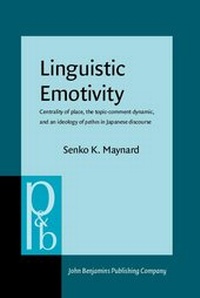
Linguistic Emotivity
Centrality of place, the topic-comment dynamic, and an ideology of pathos in Japanese discourse
1st Edition
Published on 26. July 2002
XIV, 481 pages
978-90-272-9737-2 (ISBN)
Description

Linguistic Emotivity explores expressive and emotive meanings in Japanese from the perspective of the Place of Negotiation theory. The Place of Negotiation theory provides a framework for understanding how linguistic signs function in the place of communication (in cognitive, emotive, and interactional places). The theory finds the indexicality of a sign fundamental and views meanings as being negotiated among interactants who share not only information but, more significantly, feelings.
Using analytical tools recognized in conversation and discourse analyses, the book analyzes emotive topics (vocatives, emotive nominals, quotative topics, etc.) and emotive comments (da and ja-nai, interrogatives, stylistic shifts, etc.) in contemporary Japanese discourse. It argues for the importance of emotivity in Japanese, in the context of the Japanese culture of pathos. Linguistic Emotivity challenges the traditional view of language that privileges logos, form, information, and abstraction, and instead, it proposes a philosophical shift toward pathos, expression, emotion, and linguistic event/action.
Using analytical tools recognized in conversation and discourse analyses, the book analyzes emotive topics (vocatives, emotive nominals, quotative topics, etc.) and emotive comments (da and ja-nai, interrogatives, stylistic shifts, etc.) in contemporary Japanese discourse. It argues for the importance of emotivity in Japanese, in the context of the Japanese culture of pathos. Linguistic Emotivity challenges the traditional view of language that privileges logos, form, information, and abstraction, and instead, it proposes a philosophical shift toward pathos, expression, emotion, and linguistic event/action.
More details
Other editions
Additional editions
Senko K. Maynard
Linguistic Emotivity
Centrality of place, the topic-comment dynamic, and an ideology of pathos in Japanese discourse
Book
07/2002
John Benjamins Publishing Co
€137.80
Shipment within 10-15 days
Person
Content
- Linguistic Emotivity
- Editorial page
- Title page
- LCC data
- Dedication
- Contents
- Preface and acknowledgments
- Part 1: Preliminaries
- Chapter 1: Introduction
- Chapter 2: Background
- Part 2: Theory
- Chapter 3: The Place of Negotiation theory
- Chapter 4: The (re-)turn to place
- Chapter 5: Locating and interpreting emotive meanings
- Chapter 6: Topic-comment, futaku, and the Rhetoric of Pathos
- Part 3: Emotive topics
- On data for analysis
- Chapter 7: Vocatives and topics
- Chapter 8: Emotive nominals
- Chapter 9: Quotative topics
- Chapter 10: Emotive nan(i) 'what'
- Part 4: Emotive comments
- Chapter 11: Da and ja-nai as commentary strategies
- Chapter 12: Interrogatives as emotive comments
- Chapter 13: Commenting through stylistic shifts
- Part 5: Pathos in Japanese discourse
- Chapter 14: Analyzing expressions of pathos in Oda Nobunaga
- Chapter 15: Rhetoric of Pathos in Mini-Jihyoo newspaper articles
- Chapter 16: Playing with pathos
- Part 6: Reflections
- Chapter 17: Linguistic emotivity and the culture of pathos
- Chapter 18: Language, linguistic theory, and ideology
- Appendix
- Notes
- References
- Data references
- Author index
- Subject index
- Pragmatics and Beyond New Series
