

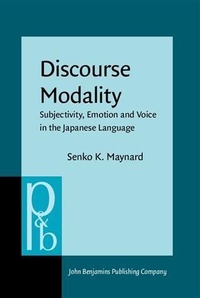
Discourse Modality
Subjectivity, Emotion and Voice in the Japanese Language
1st Edition
Published on 21. April 1993
X, 315 pages
978-90-272-8584-3 (ISBN)
Description

The emotional aspects of language have so far not received the attention they deserve. This study focuses on nonpropositional, i.e. expressive and interactional meanings of Japanese signs, with special emphasis on understanding their cognitive, psychological and social meanings. It shows how the Japanese language is richly endowed to express personal voice and emotive nuances, and confronts the theoretical issues related to this. The author proposes a new theoretical framework for Discourse Modality, a primary concern for Japanese speakers, to analyze the 'expressiveness' of language.
More details
Other editions
Additional editions
Book
04/1993
John Benjamins Publishing Co
€121.90
Shipment within 10-15 days
Person
Content
- DISCOURSE MODALITY
- Editorial page
- Title page
- Copyright page
- Table of contents
- Acknowledgments
- Part 1. Analytical Framework
- CHAPTER 1. Introduction
- 1. Introductory Remarks
- 2. Modal Characteristics of Language
- 2.1. Language as Social Interaction--Interactionality
- 2.2. Language as Subjective Expression--Subjectivity
- 2.3. Between Interactionality and Subjectivity--Constructing the Non-autonomous Self
- 2.4. Language as Discourse--Textuality
- 2.5. Modality-centered View of Language--Emotionality and Personal Voice
- 3. Data
- 4. Organization of the Study
- CHAPTER 2. From Modality to Discourse Modality
- 1. Concept of Modality
- 1.1. Modality--Japanese View
- 1.2. Modality--Western View
- 2. Concept of Discourse Modality
- 2.1. Toward a Concept of Discourse Modality
- 2.2. Defining Discourse Modality
- 2.3. Discourse Modality as Scene
- 2.4. The Concept of Place in Linguistics and Philosophy
- 3. Discourse Modality Indicators
- 4. Aspects of Discourse Modality
- 4.1. Information Qualification
- 4.1.1. Perspective
- 4.1.2. Information Status
- 4.1.3. Epistemic Modality
- 4.1.4. Discourse Cohesion
- 4.2. Speech Action Declaration and Qualification
- 4.3. Participatory Control
- 4.3.1. Exchange Structure
- 4.3.2. Designing Speaker Turns
- 4.4. Interactional Appeal
- 4.4.1. Personal Emotion
- 4.4.2. Sociolinguistic Style
- 5. Modal Contextualization: Its Process
- 6. Methodological Issues
- Part 2. Analysis of DM Indicators
- CHAPTER 3. Discourse Connectives Dakara and Datte
- 1. Introduction
- 2. Dakara
- 2.1. Dakara and the Concept of Causality
- 2.2. Dakara in Casual Conversation
- 2.3. Dakara in Dialogues of Fiction
- 2.4. The Semantic Source of Dakara: Signaling Cause/Result and Explanation Sequences
- 2.5. Interactional Functions of Dakara
- 2.6. Functions of Dakara and Discourse Types
- 2.7. Dakara as a Discourse Modality Indicator
- 3. Datte
- 3.1. Distributional Characteristics of Datte
- 3.2. The Semantic Source of Datte: Declaring Self-justification
- 3.3. Discourse Functions of Datte
- 3.4. Interactional Functions of Datte
- 3.5. Datte as a Discourse Modality Indicator
- 4. Dakara and Datte in Contrast
- CHAPTER 4. Modal Adverts Yahari/Yappari and Doose
- 1. Introduction
- 2. Background
- 3. Yahari/Yappari
- 3.1. Distributional Characteristics of Yahari/Yappari
- 3.2. The Semantic Source of Yahari/Yappari: Recognizing Realized Expectations
- 3.3. Discourse Functions of Yahari/Yappari
- 3.4. Interactional Functions of Yahari/Yappari
- 3.5. Yahari/Yappari as a Discourse Modality Indicator
- 4. Doose
- 4.1. Distributional Characteristics of Doose
- 4.2. The Semantic Source of Doose: Expressing a Fatalistic Speculation
- 4.3. Doose as a Discourse Modality Indicator
- CHAPTER 5. Style as Discourse Modality: Da and Desu/Masu Verb Forms
- 1. Introduction
- 2. Background
- 3. The Da and Desu/Masu Mixture in Casual Conversation
- 4. The Da and Desu/Masu Mixture in Dialogues of Fiction
- 5. The Da and Desu/Masu Mixture in Literary Essay
- 6. Ontological Basis for the Verb Morphology
- 7. Style as Discourse Modality
- CHAPTER 6. Interactional Particles Yo and Ne
- 1. Introduction
- 2. Background
- 3. Distributional Characteristics of Yo and Ne and Relative Information Accessibility and/or Possessorship
- 4. Relative Information Accessibility and/or Possessorship and Related Concepts
- 5. Functional Sources of Yo and Ne: Manipulating Information versus Interaction Focus
- 6. Mixture of Yo and Ne and Conversation Management
- 7. Particles Yo and Ne as Devices for Discourse Modality Manipulation
- CHAPTER 7. To Yuu in the Clause-Noun Combination
- 1. Introduction
- 2. Background
- 2. Distributional Characteristics of To Yuu
- 4. To Yuu as a Bridge between "Saying" and "Describing
- 5. To Yuu and the Narrative Voice
- 6. Discourse Functions of To Yuu
- 7. Interpersonal Functions of the Variants of To Yuu
- 8. To Yuu as a Device for Discourse Modality Manipulation
- Part 3. Reflections
- CHAPTER 8. Discourse Modality in Perspective
- 1. Subjectivity, Emotion and Voice in Language
- 2. Sources and the Nature of Emotionality and Interactionality
- 3. Personalization of Discourse and the Structure of the Japanese Language
- 4. Discourse Modality in Cross-cultural Communication
- 5. Concluding Remarks
- Appendix 1
- Notes
- CHAPTER 1
- CHAPTER 2
- CHAPTER 3
- CHAPTER 4
- CHAPTER 5
- CHAPTER 6
- CHAPTER 7
- CHAPTER 8
- References
- Data References
- Author Index
- Subject Index
- The series Pragmatics & Beyond New Series
