

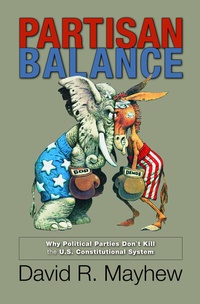
Partisan Balance
Why Political Parties Don't Kill the U.S. Constitutional System
1st Edition
Published on 19. November 2018
240 pages
978-1-4008-3841-7 (ISBN)
Description

How partisan balance between the U.S. presidency and Congress is essential to successful government
With three independent branches, a legislature divided into two houses, and many diverse constituencies, it is remarkable that the federal government does not collapse in permanent deadlock. Yet, this system of government has functioned for well over two centuries, even through such heated partisan conflicts as the national health-care showdown and Supreme Court nominations. In Partisan Balance, noted political scholar David Mayhew examines the unique electoral foundations of the presidency, Senate, and House of Representatives in order to provide a fresh understanding for the government's success and longstanding vitality.
Focusing on the period after World War II, and the fate of legislative proposals offered by presidents from Harry Truman to George W. Bush, Mayhew reveals that the presidency, Senate, and House rest on surprisingly similar electoral bases, with little difference in their partisan textures as indexed by the presidential popular vote cast in the various constituencies. Both congressional chambers have tilted a bit Republican, and while White House legislative initiatives have fared accordingly, Mayhew shows that presidents have done relatively well in getting their major proposals enacted. Over the long haul, the Senate has not proven much more of a stumbling block than the House. Arguing that the system has developed a self-correcting impulse that leads each branch to pull back when it deviates too much from other branches, Mayhew contends that majoritarianism largely characterizes the American system. The wishes of the majority tend to nudge institutions back toward the median voter, as in the instances of legislative districting, House procedural reforms, and term limits for presidents and legislators.
With three independent branches, a legislature divided into two houses, and many diverse constituencies, it is remarkable that the federal government does not collapse in permanent deadlock. Yet, this system of government has functioned for well over two centuries, even through such heated partisan conflicts as the national health-care showdown and Supreme Court nominations. In Partisan Balance, noted political scholar David Mayhew examines the unique electoral foundations of the presidency, Senate, and House of Representatives in order to provide a fresh understanding for the government's success and longstanding vitality.
Focusing on the period after World War II, and the fate of legislative proposals offered by presidents from Harry Truman to George W. Bush, Mayhew reveals that the presidency, Senate, and House rest on surprisingly similar electoral bases, with little difference in their partisan textures as indexed by the presidential popular vote cast in the various constituencies. Both congressional chambers have tilted a bit Republican, and while White House legislative initiatives have fared accordingly, Mayhew shows that presidents have done relatively well in getting their major proposals enacted. Over the long haul, the Senate has not proven much more of a stumbling block than the House. Arguing that the system has developed a self-correcting impulse that leads each branch to pull back when it deviates too much from other branches, Mayhew contends that majoritarianism largely characterizes the American system. The wishes of the majority tend to nudge institutions back toward the median voter, as in the instances of legislative districting, House procedural reforms, and term limits for presidents and legislators.
More details
Edition
Course Book
Language
English
Place of publication
Princeton, NJ
United States
Publishing group
De Gruyter
Target group
Professional and scholarly
Edition type
Digital original
Illustrations
4 line illus. 20 tables.
File size
4,33 MB
ISBN-13
978-1-4008-3841-7 (9781400838417)
Schweitzer Classification
Other editions
Additional editions
Book
07/2013
Princeton University Press
€31.50
Shipment within 10-20 days
Person
David R. Mayhew is Sterling Professor of Political Science at Yale University. His books include Congress and Electoral Realignments.
Content
List of Illustrations ix
Acknowledgments xi
Introduction xiii
CHAPTER 1: The Electoral Bases 1
CHAPTER 2: President and Congress 34
CHAPTER 3: House and Senate I 80
CHAPTER 4: House and Senate II 121
CHAPTER 5: Reform 165
APPENDIX: Sources for Presidential Proposals 191
Index 215
Acknowledgments xi
Introduction xiii
CHAPTER 1: The Electoral Bases 1
CHAPTER 2: President and Congress 34
CHAPTER 3: House and Senate I 80
CHAPTER 4: House and Senate II 121
CHAPTER 5: Reform 165
APPENDIX: Sources for Presidential Proposals 191
Index 215
