

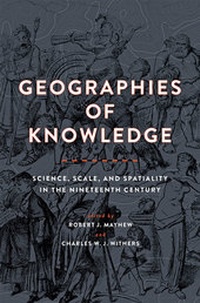
Geographies of Knowledge
Science, Scale, and Spatiality in the Nineteenth Century
Published on 13. October 2020
272 pages
978-1-4214-3855-9 (ISBN)
Description

A path-breaking exploration of how space, place, and scale influenced the production and circulation of scientific knowledge in the nineteenth century.
Over the past twenty years, scholars have increasingly questioned not just historical presumptions about the putative rise of modern science during the long nineteenth century but also the geographical contexts for and variability of science during the era. In Geographies of Knowledge, an internationally distinguished array of historians and geographers examine the spatialization of science in the period, tracing the ways in which scale and space are crucial to understanding the production, dissemination, and reception of scientific knowledge in the nineteenth century.
Engaging with and extending the influential work of David Livingstone and others on science's spatial dimensions, the book touches on themes of empire, gender, religion, Darwinism, and much more. In exploring the practice of science across four continents, these essays illuminate the importance of geographical perspectives to the study of science and knowledge, and how these ideas made and contested locally could travel the globe.
Dealing with everything from the local spaces of the Surrey countryside to the global negotiations that proposed a single prime meridian, from imperial knowledge creation and exploration in Burma, India, and Africa to studies of metropolitan scientific-cum-theological tussles in Belfast and in Confederate America, Geographies of Knowledge outlines an interdisciplinary agenda for the study of science as geographically situated sets of practices in the era of its modern disciplinary construction. More than that, it outlines new possibilities for all those interested in knowledge's spatial characteristics in other periods.
Contributors: John A. Agnew, Vinita Damodaran, Diarmid A. Finnegan, Nuala C. Johnson, Dane Kennedy, Robert J. Mayhew, Mark Noll, Ronald L. Numbers, Nicolaas Rupke, Yvonne Sherratt, Charles W. J. Withers
Over the past twenty years, scholars have increasingly questioned not just historical presumptions about the putative rise of modern science during the long nineteenth century but also the geographical contexts for and variability of science during the era. In Geographies of Knowledge, an internationally distinguished array of historians and geographers examine the spatialization of science in the period, tracing the ways in which scale and space are crucial to understanding the production, dissemination, and reception of scientific knowledge in the nineteenth century.
Engaging with and extending the influential work of David Livingstone and others on science's spatial dimensions, the book touches on themes of empire, gender, religion, Darwinism, and much more. In exploring the practice of science across four continents, these essays illuminate the importance of geographical perspectives to the study of science and knowledge, and how these ideas made and contested locally could travel the globe.
Dealing with everything from the local spaces of the Surrey countryside to the global negotiations that proposed a single prime meridian, from imperial knowledge creation and exploration in Burma, India, and Africa to studies of metropolitan scientific-cum-theological tussles in Belfast and in Confederate America, Geographies of Knowledge outlines an interdisciplinary agenda for the study of science as geographically situated sets of practices in the era of its modern disciplinary construction. More than that, it outlines new possibilities for all those interested in knowledge's spatial characteristics in other periods.
Contributors: John A. Agnew, Vinita Damodaran, Diarmid A. Finnegan, Nuala C. Johnson, Dane Kennedy, Robert J. Mayhew, Mark Noll, Ronald L. Numbers, Nicolaas Rupke, Yvonne Sherratt, Charles W. J. Withers
More details
Series
Language
English
Place of publication
Baltimore
United States
Target group
Professional and scholarly
Illustrations
4 s/w Photographien bzw. Rasterbilder
4 Halftones, black and white
File size
4,54 MB
ISBN-13
978-1-4214-3855-9 (9781421438559)
DOI
10.1353/book.77109
Copyright in bibliographic data and cover images is held by Nielsen Book Services Limited or by the publishers or by their respective licensors: all rights reserved.
Schweitzer Classification
Other editions
Additional editions
Robert J. Mayhew | Charles W. J. Withers
Geographies of Knowledge
Science, Scale, and Spatiality in the Nineteenth Century
Book
10/2020
Johns Hopkins University Press
€59.00
Shipment within 10-20 days
Persons
Robert J. Mayhew is a professor of historical geography and intellectual history at the University of Bristol. He is the author of Malthus: The Life and Legacies of an Untimely Prophet. Charles W. J. Withers is professor emeritus at the University of Edinburgh and Geographer Royal for Scotland. He is the author of Zero Degrees: Geographies of the Prime Meridian.
Content
Contributors
Preface
Introduction: Thinking Geographically about Science in the Nineteenth Century
Part I. Locale Studies
1. Locating Malthus's Essay: Localism and the Construction of Social Science, 1798-1826
2. Revisiting Belfast: Tyndall, Science, and the Plurality of Place
Part II. National Studies
3. Henry Hotze in Place: Religion, Science, Confederate Propaganda, and Race
4. "Made in America": The Politics of Place in Debates over Science and Religion
5. Putting the Structuralist Theory of Evolution in Its Place
Part III. Global Studies
6. Science, Sites, and Situated Practice: Debating the Prime Meridian in the International Geographical Congress, 1871-1904
7. Illustrating Nature: Exploration, Natural History, and the Travels of Charlotte Wheeler-Cuffe in Burma
8. Climate, Environment, and the Colonial Experience
9. Lost in Place: Two Expeditions Gone Awry in Africa
Afterword
Index
Preface
Introduction: Thinking Geographically about Science in the Nineteenth Century
Part I. Locale Studies
1. Locating Malthus's Essay: Localism and the Construction of Social Science, 1798-1826
2. Revisiting Belfast: Tyndall, Science, and the Plurality of Place
Part II. National Studies
3. Henry Hotze in Place: Religion, Science, Confederate Propaganda, and Race
4. "Made in America": The Politics of Place in Debates over Science and Religion
5. Putting the Structuralist Theory of Evolution in Its Place
Part III. Global Studies
6. Science, Sites, and Situated Practice: Debating the Prime Meridian in the International Geographical Congress, 1871-1904
7. Illustrating Nature: Exploration, Natural History, and the Travels of Charlotte Wheeler-Cuffe in Burma
8. Climate, Environment, and the Colonial Experience
9. Lost in Place: Two Expeditions Gone Awry in Africa
Afterword
Index
