

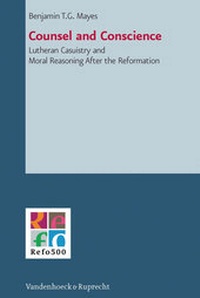
Counsel and Conscience
Lutheran Casuistry and Moral Reasoning after the Reformation
1st Edition
Published on 17. August 2011
250 pages
978-3-647-55027-5 (ISBN)
Description

In Lutheran Germany of the post-Reformation era (ca. 1580-1750), a genre of pastoral, ethical writings arose that consisted in casuistry and in topically or thematically related theological counsels. In this first volume of the new Refo500 series Mayes shows that this casuistry literature was intended to instruct and comfort the consciences of Christians. Lutheran casuistry, related to but also distinct from Roman Catholic and Reformed counterparts, arose especially as pastors looked within Holy Scripture, the medieval tradition, and the writings of Martin Luther and other Lutheran authorities for answers to ethical problems and doctrinal disputes, and then catalogued their findings. As an extensive example from this genre Mayes examines the Thesaurus Consiliorum Et Decisionum, published in 1671 by Georg Dedekenn and Johann Ernst Gerhard. This Thesaurus was an anthology of wise advice from Lutheran theologians and jurists, published to encourage readers to avoid individualistic ethical choices and instead to engage in an "aristocratic" process of moral decision making in which one would consult the wise men of the past and present. The counsels included in the Thesaurus address inter-confessional disputes, intra-Lutheran disputes, sacraments, church government, pastoral ministry, social ethics, marriage, sexual ethics, and many other topics. The topics of divorce and remarriage, especially, show the different ways in which Lutherans reasoned about moral matters. The author shows that in the Thesaurus the Lutheran casuistry literature, which has been overlooked in most scholarship of the 20th and 21st centuries, was in bloom. It arose to meet the needs of people who had doubts, and it continued to instruct and console Christian consciences for many generations.
More details
Other editions
Additional editions
Benjamin T. G. Mayes
Counsel and Conscience
Lutheran Casuistry and Moral Reasoning after the Reformation
Book
08/2011
1st Edition
Vandenhoeck & Ruprecht
€100.00
Article exhausted; check different version
Person
Content
- Cover
- Title Page
- Copyright
- Table of Contents
- Body
- Tables
- Acknowledgments
- Abstract
- 1 Casuistry
- 1.1 Post-Reformation Lutheran Ethics
- 1.2 What Is "Casuistry"?
- 1.3 Anglican and Reformed Casuistry
- 1.4 Roman Catholic Moral Theology and the Debate Surrounding Probabilism
- 1.5 Lutheran Adaptation of Medieval Models
- 1.6 The Rise of Lutheran Casuistry
- 1.7 Lutheran Casuistry as Tyrannical or Pastoral?
- 1.8 Conscience-Theology
- 2 The Wisdom of Lutheran Orthodoxy in Print
- 2.1 Information on the Compilers
- 2.1.1 Georg Dedekenn (1564-1628)
- 2.1.2 Johann Ernst Gerhard (1621-68)
- 2.1.3 Christian Grübel (1642-1715)
- 2.2 Physical Configuration of the Treasury
- 3 The Method of Moral Reasoning
- 3.1 Dedekenn's Dedicatory Epistle for Volume One (1623)
- 3.1.1 "Aristocratic Moral Reasoning"
- 3.1.2 Deciding Cases of Conscience
- 3.2 Preface by the Leipzig Theological Faculty (1623)
- 3.3 Preface by the Greifswald Theological Faculty (1623)
- 3.4 Preface by the Wittenberg Theological Faculty (1623)
- 3.5 Dedekenn's Dedicatory Epistle for Volume Two (1623)
- 3.6 Dedekenn's Dedicatory Epistle for Volume Three (1623)
- 3.7 Dedekenn's Dedicatory Epistle for the Appendix Volume (1623) . .
- 3.8 Dedicatory Epistle for Volume One (1671)
- 3.9 Prefaces by Leipzig, Greifswald, and Wittenberg Theological Faculties (1671)
- 3.10 Dedicatory Epistle for Volume Two (1671)
- 3.11 Dedicatory Epistle for Volume Three (1671)
- 3.12 Grübel's Dedicatory Epistle for the Appendix Volume (1671)
- 3.13 Conclusions
- 4 A Treasury of Cases of Conscience
- 4.1 The Contents of the Treasury
- 4.2 Sources of the Treasury
- 4.3 Inter-Confessional Disputes
- 4.4 Sacraments
- 4.5 Church Government and Pastoral Ministry
- 4.6 Questions Regarding Public Life
- 4.7 Questions Regarding Marriage and Sexual Ethics
- 4.8 Christian Grübel's Focus
- 4.8.1 New Disputes within the Lutheran Church
- 4.8.2 Helmstedt Theology
- 4.8.3 Inter-Confessional Disputes
- 4.8.4 Privileges of the Ministerium
- 4.9 Conclusions
- 5 Case in Point: Divorce and Remarriage
- 5.1 Lutheran Divorce and Remarriage: A Lax Practice?
- 5.2 The Legitimate Causes for Divorce
- 5.2.1 Adultery
- 5.2.2 Malicious Desertion
- 5.2.3 Inability of Bodies for the Use of Matrimony (Impotence) .
- 5.2.4 Error
- 5.2.5 Violence
- 5.2.6 Impiety
- 5.2.7 Hemmingsen's Arguments and Position within the Treasury
- 5.2.8 Cases by Brenz and Others
- 5.2.9 Illegitimate Causes of Divorce
- 5.3 Impotence and Refusal of Conjugal Obligation
- 5.3.1 Impotence
- 5.3.2 Refusing Conjugal Obligation
- 5.4 Violence
- 5.5 Differing Religions
- 5.6 Remarriage for Whom?
- 5.7 Conclusions
- 6 Outcome and Conclusion
- Abbreviations
- Bibliography
- Index
- Tables Table 1: Gerhard's expansion of Dedekenn's section 1.2.3.2
- Table 2: Contents of 1671 Treasury, vol. 1-3
- Table 3: Largest sections in 1671 Treasury, vol. 1-3
- Table 4: Contents of Grübel's New Appendix
- Table 5: Largest sections in Grübel's New Appendix
- Back Cover
