

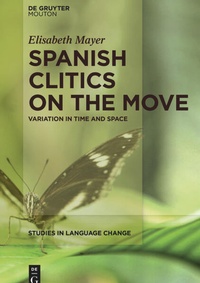
Spanish Clitics on the Move
Description

This volume explores the complex relationship between primary agreement by means of object marking or differential object marking (DOM), and secondary agreement through clitics in non-standardized variation data from Limeño Spanish contact varieties (LSCV). As such it is concerned with diachronic as well as synchronic morphosyntactic variation of the third person object pronoun paradigm, so called clitics, as used in Standard Spanish and non-standardized Spanish contact dialects. The argumentation as well as the data presented cross diachronic and synchronic boundaries.
More details
Other editions
Additional editions
Person
Elisabeth Mayer , Australian National University, Australia.
Content
- Intro
- Acknowledgments
- Table of contents
- List of tables
- Abbreviations
- 1 Introduction
- 1.1 Clitics and argument marking
- 1.2 Variability and innovations in argument marking
- 1.2.1 Differential object marking
- 1.2.2 Clitic doubling
- 1.3 Variability in clitic systems
- 1.4 The corpus of fieldwork data
- 1.5 Sociohistory
- 1.5.1 Data background
- 1.5.2 Migration, contact and bilingualism
- 1.6 Contact and change
- 1.7 Variability in language
- 1.8 Theoretical framework
- 1.9 Organisation of the book
- 2 The nature of clitics
- 2.1 Background
- 2.2 Romance clitichood: bound or free forms
- 2.3 Dative clitic vs. accusative clitic
- 2.4 Specific lo (la) environments
- 2.4.1 Lo as propositional anaphoric topic marker
- 2.4.2 Determiner cliticization
- 2.4.3 An attempt at accommodating determiner clitics
- 2.5 Clitic placement and alignment constraints
- 2.5.1 Surface constraints
- 2.5.2 The Person-Case Constraint
- 2.5.3 Markedness constraints
- 2.6 Summary
- 3 Objects, case and clitic doubling
- 3.1 Objects and casemarking
- 3.2 Clitic doubling
- 3.2.1 Dialectal variability and evolving clitic doubling sections
- 3.2.2 Agreement and crossreferencing
- 3.3 Referential categories
- 3.3.1 Definiteness vs. specificity
- 3.3.2 Animacy
- 3.3.3 Differential object marking, specificity and clitic doubling
- 3.4 A Lexical-Functional Grammar view of clitic doubling
- 3.4.1 From constituent structure to functional structure
- 3.4.2 Grammatical functions
- 3.4.3 Optional PRED PRO
- 3.5 Summary
- 4 From syntax to information structure
- 4.1 The concept of differential object marking
- 4.2 Two-dimensional differential object marking
- 4.3 Differential object marking, topicality and clitic doubling
- 4.3.1 Optionality
- 4.3.2 Non-specificity
- 4.3.3 Extended differential object marking
- 4.4 Clitic evolution by reanalysis
- 4.4.1 Drivers of change - gender and number
- 4.4.2 Morphological simplification in Limeño Spanish contact varieties
- 4.5 Summary of argument thus far
- 4.6 Differential object marking and information structure
- 4.7 The notion of secondary topic
- 4.7.1 Previous accounts for Spanish
- 4.8 Correlation of case marking and information structure
- 4.8.1 Topic vs. focus
- 4.8.2 Topic and secondary topic
- 4.9 Anaphora and topic/object drop
- 4.9.1 Morphological blocking
- 4.10 Summary
- 5 Variation and continuity in time and space
- 5.1 Agreement in time and space
- 5.1.1 Peninsular Spanish leísmo, loísmo, laísmo
- 5.1.2 Limeño Spanish contact varieties
- 5.1.3 Invariant lo
- 5.2 Leísmo/laísmo doubling
- 5.2.1 The dative-accusative alternation in contact Spanish
- 5.3 Floating agreement in clitic clusters
- 5.3.1 Person-Case Constraint and case syncretism
- 5.3.2 Clitic clusters variability
- 5.4 Object drop and anaphoric recoverability
- 5.4.1 Ecuador
- 5.4.2 Brazilian Portuguese and Paraguayan Spanish
- 5.4.3 Basque Spanish
- 5.5 Summary
- 6 Contact and change
- 6.1 Contact in Peruvian Spanish
- 6.1.1 Comparison with Basque
- 6.2 Amazonian Spanish
- 6.2.2 Contact with Brazilian Portguese
- 6.2.3 Contact with Ashaninka
- 6.2.4 Contact with Yagua
- 6.2.5 Quechua
- 6.2.6 Andean Spanish
- 6.3 The pointing effect of lo and (-ta) -qa
- 6.3.1 Topicality vs. transitivity
- 6.3.2 Primary object and secondary object marking
- 6.3.3 Semantic roles
- 6.3.4 Mapping of thematic roles to grammatical functions
- 6.3.5 Two primary objects?
- 6.3.6 Object behaviour
- 6.4 Object alternations
- 6.4.1 Disambiguation/Agency
- 6.4.2 Affectedness
- 6.4.3 Telicity
- 6.5 Double object constructions
- 6.5.1 Dative alternation
- 6.5.2 Dative vs. oblique
- 6.5.3 Ethical datives
- 6.5.4 Ethical datives in passivization
- 6.6 Summary
- 7 Conclusion
- References
- Index
