

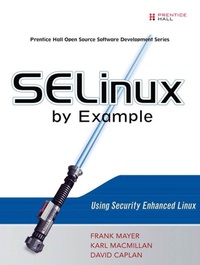
SELinux by Example
Using Security Enhanced Linux
1st Edition
Published on 19. April 2021
978-0-13-205513-0 (ISBN)
Description

This is the eBook version of the printed book. If the print book includes a CD-ROM, this content is not included within the eBook version.
SELinux: Bring World-Class Security to Any Linux Environment!
SELinux offers Linux/UNIX integrators, administrators, and developers a state-of-the-art platform for building and maintaining highly secure solutions. Now that SELinux is included in the Linux 2.6 kernel-and delivered by default in Fedora Core, Red Hat Enterprise Linux, and other major distributions-it's easier than ever to take advantage
of its benefits.
SELinux by Example is the first complete, hands-on guide to using SELinux in production environments. Authored by three leading SELinux researchers and developers, it illuminates every facet of working with SELinux, from its architecture and security object model to its policy language. The book thoroughly explains SELinux sample policies- including the powerful new Reference Policy-showing how to quickly adapt them to your unique environment. It also contains a comprehensive SELinux policy language reference and covers exciting new features in Fedora Core 5 and the upcoming Red Hat Enterprise Linux version 5.
* Thoroughly understand SELinux's access control and security mechanisms
* Use SELinux to construct secure systems from the ground up
* Gain fine-grained control over kernel resources
* Write policy statements for type enforcement, roles, users, and constraints
* Use optional multilevel security to enforce information classification and manage users with diverse clearances
* Create conditional policies that can be changed on-the-fly
* Define, manage, and maintain SELinux security policies
* Develop and write new SELinux security policy modules
* Leverage emerging SELinux technologies to gain even greater flexibility
* Effectively administer any SELinux system
SELinux: Bring World-Class Security to Any Linux Environment!
SELinux offers Linux/UNIX integrators, administrators, and developers a state-of-the-art platform for building and maintaining highly secure solutions. Now that SELinux is included in the Linux 2.6 kernel-and delivered by default in Fedora Core, Red Hat Enterprise Linux, and other major distributions-it's easier than ever to take advantage
of its benefits.
SELinux by Example is the first complete, hands-on guide to using SELinux in production environments. Authored by three leading SELinux researchers and developers, it illuminates every facet of working with SELinux, from its architecture and security object model to its policy language. The book thoroughly explains SELinux sample policies- including the powerful new Reference Policy-showing how to quickly adapt them to your unique environment. It also contains a comprehensive SELinux policy language reference and covers exciting new features in Fedora Core 5 and the upcoming Red Hat Enterprise Linux version 5.
* Thoroughly understand SELinux's access control and security mechanisms
* Use SELinux to construct secure systems from the ground up
* Gain fine-grained control over kernel resources
* Write policy statements for type enforcement, roles, users, and constraints
* Use optional multilevel security to enforce information classification and manage users with diverse clearances
* Create conditional policies that can be changed on-the-fly
* Define, manage, and maintain SELinux security policies
* Develop and write new SELinux security policy modules
* Leverage emerging SELinux technologies to gain even greater flexibility
* Effectively administer any SELinux system
More details
Edition
1. Auflage
Language
English
Place of publication
United States
Publishing group
Pearson Education (US)
Target group
Professional and scholarly
File size
4,14 MB
ISBN-13
978-0-13-205513-0 (9780132055130)
Copyright in bibliographic data and cover images is held by Nielsen Book Services Limited or by the publishers or by their respective licensors: all rights reserved.
Schweitzer Classification
Other editions
Additional editions
Book
08/2006
Prentice Hall
€45.79
Article exhausted; check different version
Persons
Frank Mayer is cofounder and Chief Technology Officer of Tresys Technology, and has 23 years of experience in the design, development, and analysis of secure oper-ating systems. He has been an active contributor to SELinux for six years, and has initiated and participated in the development of many new SELinux innovations and tools. He also chairs the annual SELinux Symposium. Frank has published many papers on secure and trustworthy operating systems, and has also explored security in parallel computing, networks, and enterprise applications.
Karl MacMillan is an active contributor in the SELinux community and has led the development of many important SELinux features. He is also a sought after speaker and consultant, and has helped many individuals and organizations under-stand and apply strong computer security with SELinux. Previous to his work on SELinux, Karl made important contributions in the fields of pattern recognition and evolutionary computing as applied to document and audio recognition, where he has numerous published papers.
David Caplan is a senior security engineer at Tresys Technology with over 20 years of experience in computer security and a wide range of other programming- and software-related areas. He has worked with SELinux for six years as a contributor to many of the SELinux-related open source projects and has led multiple efforts in analyzing and constructing SELinux policy for a variety of systems.
Karl MacMillan is an active contributor in the SELinux community and has led the development of many important SELinux features. He is also a sought after speaker and consultant, and has helped many individuals and organizations under-stand and apply strong computer security with SELinux. Previous to his work on SELinux, Karl made important contributions in the fields of pattern recognition and evolutionary computing as applied to document and audio recognition, where he has numerous published papers.
David Caplan is a senior security engineer at Tresys Technology with over 20 years of experience in computer security and a wide range of other programming- and software-related areas. He has worked with SELinux for six years as a contributor to many of the SELinux-related open source projects and has led multiple efforts in analyzing and constructing SELinux policy for a variety of systems.
Content
Front Matter i Preface xix
Chapter 1: Background 3
Chapter 2: Concepts 15
Chapter 3: Architecture 39
Chapter 4: Object Classes and Permissions 59
Chapter 5: Type Enforcement 89
Chapter 6: Roles and Users 129
Chapter 7: Constraints 149
Chapyer 8: Multilevel Security 163
Chapter 9: Conditional Policies 183
Chapter 10: Object Labeling 205
Chapter 11: Original Example Policy 239
Chapter 12: Reference Policy 265
Chapter 13: Managing an SELinux System 295
Chapter 14: Writing Policy Modules 325
Appendix A: Obtaining SELinux Sample Policies 363
Appendix B: Participation and Further Information 369
Appendix C: Object Classes and Permissions 375
Appendix D: SELinux Commands and Utilities 401
Index 409
Chapter 1: Background 3
Chapter 2: Concepts 15
Chapter 3: Architecture 39
Chapter 4: Object Classes and Permissions 59
Chapter 5: Type Enforcement 89
Chapter 6: Roles and Users 129
Chapter 7: Constraints 149
Chapyer 8: Multilevel Security 163
Chapter 9: Conditional Policies 183
Chapter 10: Object Labeling 205
Chapter 11: Original Example Policy 239
Chapter 12: Reference Policy 265
Chapter 13: Managing an SELinux System 295
Chapter 14: Writing Policy Modules 325
Appendix A: Obtaining SELinux Sample Policies 363
Appendix B: Participation and Further Information 369
Appendix C: Object Classes and Permissions 375
Appendix D: SELinux Commands and Utilities 401
Index 409
