

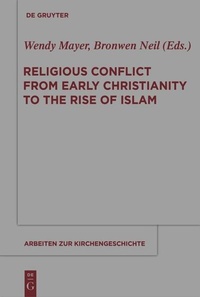
Religious Conflict from Early Christianity to the Rise of Islam
Description

Conflict has been an inescapable facet of religion from its very beginnings. This volume offers insight into the mechanisms at play in the centuries from the Jesus-movement's first attempts to define itself over and against Judaism to the beginnings of Islam. Profiling research by scholars of the Centre for Early Christian Studies at Australian Catholic University, the essays document inter- and intra-religious conflict from a variety of angles. Topics relevant to the early centuries range from religious conflict between different parts of the Christian canon, types of conflict, the origins of conflict, strategies for winning, for conflict resolution, and the emergence of a language of conflict. For the fourth to seventh centuries case studies from Asia Minor, Syria, Constantinople, Gaul, Arabia and Egypt are presented. The volume closes with examinations of the Christian and Jewish response to Islam, and of Islam's response to Christianity. Given the political and religious tensions in the world today, this volume is well positioned to find relevance and meaning in societies still grappling with the monotheistic religions of Judaism, Christianity, and Islam.
Reviews / Votes
"The Centre's interdisciplinary team of scholars put its collaborative focus and collective expertise on a further topic of current global interest, namely religious conflict (previous research projects focused on poverty and crisis management). [...] In the first essay, "Religious Conflict: Definitions, Problems and Theoretical Approaches" (1-19), Wendy Mayer provides an excellent survey of the problems involved in defining religious conflict, of various recent theoretical approaches (contemporary theories and approaches, approaches to religious conflict in the period 50-850 CE), different international research projects and of "shifting paradigms, old problems, and new questions" in the study of religious conflict. [...]
The volume testifies to the Centre's approach of bringing together the still largely separate disciplines of New Testament Studies, Patristics, and Latin Antiquity. It indicates to what extent religious conflicts of various kinds and degrees shaped the early centuries of Christianity."
Christoph Stenschke in: Ephemerides Theologica Lovanienses 91,2 (2015)
More details
Other editions
Additional editions
Persons
Content
- Intro
- Preface
- Abbreviations
- Religious Conflict: Definitions, Problems and Theoretical Approaches
- Setting the Record Straight at Galatia: Paul's Narratio (Gal 1:13-2:14) as Response to the Galatian Conflict
- Early Christian Polemic against Jews and the Persecution of Christians in Rome by Nero
- The Use of Isaiah 28:11-12 in 1 Corinthians 14:21
- Conflict in the Canon: The Pauline Literature and the Gospel of Matthew
- Rewriting: The Path from Apocryphal to Heretical
- Inter-City Conflict in the Story of St Michael of Chonai
- John Chrysostom and the Anomoeans: Shaping an Antiochene Perspective on Christology
- Media Manipulation as a Tool in Religious Conflict: Controlling the Narrative Surrounding the Deposition of John Chrysostom
- Zosimus and the Gallic Churches
- Religious Conflict between Antioch and Alexandria c. 565-630 CE
- Christian-Jewish Conflict in the Light of Heraclius' Forced Conversions and the Beginning of Islam
- The Earliest Greek Understandings of Islam: John of Damascus and Theophanes the Confessor
- Muhammad the Eschatological Prophet
- List of Contributors
- Index of Names and Places
- General Index
