

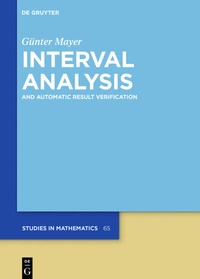
Interval Analysis
Description

Reviews / Votes
"The exposition is well structured and is written in a mathematically strict and comprehensive manner which contributes to an easy reading. As can be expected, due to volume restrictions, some of the sub-fields of interval analysis are not presented up to their recent state of the art, but this does not decrease the value of the book."
In: Zentralblatt für Mathematik
"The book is an in-depth overview of validated numerics, an emerging branch of scientific computing. Plenty of exercises and examples guide the reader from the very basics to current research topics."
Ferenc Agoston Bartha in: Mathematical Reviews Clippings (2018), MR3726854
More details
Other editions
Additional editions
Person
Content
- Intro
- Preface
- Contents
- 1 Preliminaries
- 1.1 Notations and basic definitions
- 1.2 Metric spaces
- 1.3 Normed linear spaces
- 1.4 Polynomials
- 1.5 Zeros and fixed points of functions
- 1.6 Mean value theorems
- 1.7 Normal forms of matrices
- 1.8 Eigenvalues
- 1.9 Nonnegative matrices
- 1.10 Particular matrices
- 2 Real intervals
- 2.1 Intervals, partial ordering
- 2.2 Interval arithmetic
- 2.3 Algebraic properties, ? -function
- 2.4 Auxiliary functions
- 2.5 Distance and topology
- 2.6 Elementary interval functions
- 2.7 Machine interval arithmetic
- 3 Interval vectors, interval matrices
- 3.1 Basics
- 3.2 Powers of interval matrices
- 3.3 Particular interval matrices
- 4 Expressions, P-contraction, e-inflation
- 4.1 Expressions, range
- 4.2 P-contraction
- 4.3 e-inflation
- 5 Linear systems of equations
- 5.1 Motivation
- 5.2 Solution sets
- 5.3 Interval hull
- 5.4 Direct methods
- 5.5 Iterative methods
- 6 Nonlinear systems of equations
- 6.1 Newton method - one-dimensional case
- 6.2 Newton method - multidimensional case
- 6.3 Krawczyk method
- 6.4 Hansen-Sengupta method
- 6.5 Further existence tests
- 6.6 Bisection method
- 7 Eigenvalue problems
- 7.1 Quadratic systems
- 7.2 A Krawczyk-like method
- 7.3 Lohner method
- 7.4 Double or nearly double eigenvalues
- 7.5 The generalized eigenvalue problem
- 7.6 A method due to Behnke
- 7.7 Verification of singular values
- 7.8 An inverse eigenvalue problem
- 8 Automatic differentiation
- 8.1 Forward mode
- 8.2 Backward mode
- 9 Complex intervals
- 9.1 Rectangular complex intervals
- 9.2 Circular complex intervals
- 9.3 Applications of complex intervals
- Final Remarks
- Appendix
- A Jordan normal form
- B Brouwer's fixed point theorem
- C Theorem of Newton-Kantorovich
- D The row cyclic Jacobi method
- E The CORDIC Algorithm
- F The symmetric solution set
- G INTLAB
- Bibliography
- Symbol Index
- Author Index
- Subject Index
