

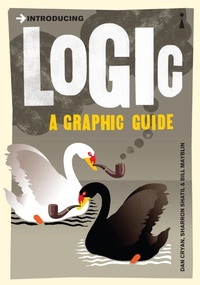
Introducing Logic
A Graphic Guide
Published on 5. June 2014
176 pages
978-1-84831-761-1 (ISBN)
Description

Logic is the backbone of Western civilization, holding together its systems of philosophy, science and law. Yet despite logic's widely acknowledged importance, it remains an unbroken seal for many, due to its heavy use of jargon and mathematical symbolism.This book follows the historical development of logic, explains the symbols and methods involved and explores the philosophical issues surrounding the topic in an easy-to-follow and friendly manner. It will take you through the influence of logic on scientific method and the various sciences from physics to psychology, and will show you why computers and digital technology are just another case of logic in action.
More details
Other editions
Additional editions
Book
09/2008
Icon Books
€11.50
Available immediately
Persons
Dan Cryan has degress in Philosophy from UCL. Sharron Shatil is a Philosophy lecturer at the Open University in Israel, and Bill Mayblin is a senior partner in the London design practice the information Design Workshop.
Content
- Intro
- Cover
- Title Page
- Copyright
- Contents
- What is Logic?
- Studying Sentences
- The Square off Oppositions
- The Syllogism
- Connective Logic
- Leibniz's Law
- The Reductio ad Absurdum
- A "New Organon"
- Frege's Quantifiers
- The Context Principle
- Propositional Calculus
- Cantor's Set Theory
- The Usefulness of Connectives
- The Russell Paradox
- The Fatal Flaw
- The Problem of Surface Grammar
- Russell's System
- Wittgenstein's Logical Pictures
- Carnap and the Vienna Circle
- The Tolerance Principle
- Hilbert's Proof Theory
- The Arrival of Gödel
- Gödel's Incompleteness Theorem
- The Connections to Proof Theory
- Wittgenstein's Table of Logical Connectives
- Wittgenstein's Truth Tables
- Discovering Tautologies
- The Logic Gates of Digital Electronics
- A Vending Machine
- Turing and the "Enigma Code"
- Euclid's Axiomatic Method
- Leibniz's Proof Method
- Abuse of Contradiction
- Rules for Connectives
- Sensitivity to Grammar
- Predicate Calculus
- Model Theoretic Semantics
- Hilbert's Recursion Model
- Finite Rules for Infinite Production
- Simple Instructions
- Proof Theory and Formal Language
- Tarski's Truth Conditions
- Formal Semantics in Practice
- Constructing a Soap Opera
- Prolog to an AI Soap Opera
- Turing's recipe for AI
- The Problem of Paradoxes
- Can Paradoxes be Avoided?
- Theory of Types
- Tarski's Solution to the Liar
- The Unexorcised Paradox
- Gödel's Incompleteness Theorem
- The Consequences of Gödel's Theorem
- The "Halting Problem"
- The Limit of Gödel's Proof
- Zeno's Movement Paradox
- An Infinite Sum
- A Convergence on Limits
- How Much is a "Heap"?
- The Challenge to Sets
- Undermining Logic
- The Fiction of Vague Words
- What Do Words "Mean"?
- Fuzzy Logic
- Fuzzy Heaps
- Can Logic Escape Paradox?
- Non-Classical Logics: Intuitionism
- The Devil's Argument
- Intuitionistic Logic
- Intuitionism versus the Reductio Method
- The Intuitionistic Fad
- Addressing Some Old Problems
- The Value of Possible
- Truth Values as Numbers
- The Possible and Non-Contradiction
- From Classical to Fuzzy Logic
- Electronic "Possible" States
- The Fuzzy Logic Search Engine
- The Fuzzy Logical Machine
- Logic in the Quantum World
- The Distributive Law of Quantum Logic
- Logic by Experiment
- Logic and Science
- The Copernican Revolution
- Galileo's Revolution
- Methods of Deduction and Induction
- Problems with Induction
- Hume's Fork
- Nomological Deduction
- Induction by Generalization
- Laws or Empirical Predictions
- The Raven Paradox
- A Problem of Cause and Effect
- Popper's Answer to Hempel
- Popper's Disconfirmation Theory
- The Probability of Viable Theory
- Quine's "Web of Belief"
- Alterations to the "Web"
- Insufficient Evidence
- Quine's Relativism
- Feyerabend's Denial of Scientific Method
- Davidson's Reply to Quine
- The Presentation of Truth
- Hard-edged Truth versus Relativism
- Cognitive Science and Logic
- Chomsky's Universal Grammar
- Noun and Verb Categories
- Recursive Rules of Grammar
- The X-bar Theory
- A Logical Theory
- Problems of Syntax and Semantics
- Complex Grammatical Structures
- Problems with "Universal" Grammar
- The Symbolic Brain Model
- Training a Neural Net
- Pattern Recognition
- The Rational Behaviour Model
- Practical Reason
- What is Consciousness?
- The Place of Logic
- Wittgenstein's Change of View
- Further Reading
- Index
