

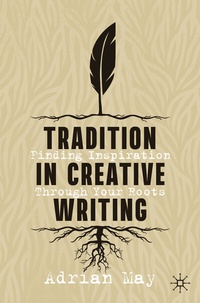
Tradition in Creative Writing
Description

Tradition in Creative Writing: Finding Inspiration Through Your Roots encourages writers to rediscover sources of creativity in the everyday, showing students how to see your writing as connected to your life. Adrian May addresses a key question for many beginning writers: Where do you get your ideas from? May argues that tradition does not mean anti-progress-but is instead a kind of hidden wealth that stems from literary and historical traditions, folk and songs, self and nature, and community. By drawing on these personal and traditional wellsprings of inspiration, writers will learn to see their writing as part of a greater continuum of influences and view their work as having innate value as part of that cultural and artistic ecology. Each chapter includes accessible discussion, literary and critical readings, creative examples, and writing exercises. While the creative examples are drawn from song lyrics and poetry, the writing exercises are appropriate for all genres. Undergraduates and practitioners will benefit from this guide to finding originality in writing through exploring sources of creative inspiration.
Reviews / Votes
"Adrian May argues passionately for innovating through tradition, from ancient myths and stories, legends, ghost stories, and ballads; he draws on a wonderfully rich array of sources and quotations, old and new, and emphasises the writing of place, its memories, customs, and rituals. Combining humour and seriousness, this manual will prove a stimulus to much creative energy-and enjoyment-in the classroom." (Dame Marina Warner, Professor of English and Creative Writing, Birkbeck College, University of London; Distinguished Fellow, All Souls College, Oxford; and President of the Royal Society of Literature, UK)"Very wise and exciting. May suggests how writing, informed by a sense of tradition, can be revolutionary (as opposed to the narcissistic and merely rebellious gesture which would devalue and discard knowledge and forms discovered, by others, in and from the past). This book provides a series of lively and approachable practical examples of imaginative alchemy: how engaging actively with tradition can generate a liberatingly prismatic sense of time and place: where the supposedly immediate linear priorities of 'here and now' can be examined more widely, in artful three-dimensional ways, to generate compelling new questions and initiatives; and thus make spaces (both personal and communal) for renewal." (David Ian Rabey, Professor of Theatre and Theatre Practice, Aberystwyth University, UK)
"This is a book I will use to reconnect myself and my Creative Writing students with the layered histories and communal spirit of storytelling. Full of original insight and useful writing inspiration for all writers at all stages of their careers, celebrating the richly entangled roots of storytelling and the pleasures of writing. A glorious and enduring way of looking at writing." (Amanda Hodgkinson, award winning novelist and Course Leader for MA Creative and Critical Writing, University of Suffolk, UK)
"Tradition is not a setof rules, archaic and out of touch, says Adrian May, but a living, breathing thing, with deep roots waiting to sustain us. Where are your roots? he asks the writer, and his new book-wise, human and persuasive-is an excellent guide to help you find them." (Norman Schwenk, poet and formerly Convenor of Creative Writing, Cardiff University, UK)
More details
Other editions
Additional editions
Person
Adrian May is Associate Fellow in Creative Writing at The University of Essex, UK. His career began as a professional folk songwriter and he has published four collections of songs and poems, as well as two previous books on creative writing: Myth and Creative Writing (2011; 2015) and The Magic of Writing (Red Globe Press 2018).
Content
INTRODUCTION: The Hidden Wealth.- Chapter 1: Modern Traditionalists.- Chapter 2: Not Just History and Ancient Inspirations.- Chapter 3:Storytelling, Myth, Folklore and Magic.- Chapter 4: Folksong and Creativity.- Chapter 5: A Songwriter in the Tradition.- Chapter 6: Protest Songs and the Comic Connection.- Chapter 7: Tradition and Locality.- Chapter 8: Self and Family Trees.- Chapter 9: An English Apple: Nature and Tradition.- Chapter 10: Work, Craft and Creativity.- Chapter 11: Church Going? Religion and Community.- Chapter 12: The Radical Tradition Today.- Conclusions and Occlusions.
