

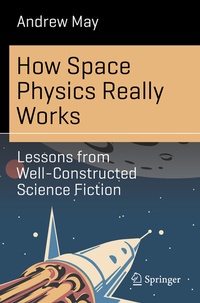
How Space Physics Really Works
Description

There is a huge gulf between the real physics of space travel and the way it is commonly portrayed in movies and TV shows. That's not because space physics is difficult or obscure - most of the details were understood by the end of the 18th century - but because it can often be bafflingly counter-intuitive for a general audience. The purpose of this book isn't to criticize or debunk popular sci-fi depictions, which can be very entertaining, but to focus on how space physics really works. This is done with the aid of numerous practical illustrations taken from the works of serious science fiction authors - from Jules Verne and Arthur C. Clarke to Larry Niven and Andy Weir - who have taken positive pleasure in getting their scientific facts right.
Reviews / Votes
"This slim book has the appealing premise of looking at the basics of space physics, from gravity through rocket science to the nature of a vacuum, by using examples from 'well-constructed science fiction'. ... a great read both for those who enjoy science fiction (or want to write it) and those wanting to know a little more of the realities of potential life in space." (Popular Science, popsciencebooks.blogspot.com, July 24, 2023)More details
Other editions
Additional editions
Person
Andrew May obtained a PhD in Astrophysics from the University of Manchester and is an experienced and versatile professional, with a career spanning academia, government and private industry. Since 2011 he has been working as a freelance writer. He has a wide range of interests and has written both authoritatively and entertainingly on the physical sciences, military technology, British history, science fiction, New Age beliefs and the paranormal. He has published with Springer: Pseudoscience and Science Fiction (2017), The Telescopic Tourist's Guide to the Moon (2017), Rockets and Ray Guns: The Sci-Fi Science of the Cold War (2018), Fake Physics: Spoofs, Hoaxes and Fictitious Science (2019) and The Science of Sci-Fi Music (2022).
Content
Chapter 1: Physics in Science Fiction.- Chapter 2: Gravity.- Chapter 3: Orbital Dynamics.- Chapter 4: Rocket Science.- Chapter 5: Living in a Vacuum.
