

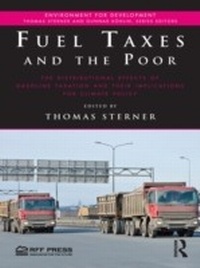
Fuel Taxes and the Poor
The Distributional Effects of Gasoline Taxation and Their Implications for Climate Policy
1st Edition
Published on 29. March 2012
320 pages
978-1-136-52172-0 (ISBN)
Description

Fuel Taxes and the Poor challenges the conventional wisdom that gasoline taxation, an important and much-debated instrument of climate policy, has a disproportionately detrimental effect on poor people. Increased fuel taxes carry the potential to mitigate carbon emissions, reduce congestion, and improve local urban environment. As such, higher gasoline taxes could prove to be a fundamental part of any climate action plan. However, they have been resisted by powerful lobbies that have persuaded people that increased fuel taxation would be regressive. Reporting on examples of over two dozen countries, this book sets out to empirically investigate this claim.
The authors conclude that while there may be some slight regressivity in some high-income countries, as a general rule, fuel taxation is a progressive policy particularly in low income countries. Rich countries can correct for regressivity by cutting back on other taxes that adversely affect poor people, or by spending more money on services for the poor. Meanwhile, in low-income countries, poor people spend a very small share of their money on fuel for transport. Some costs from fuel taxes may be passed on to poor people through more expensive public transportation and food transport. Nevertheless, in general the authors find that gasoline taxes become more progressive as the income of the country in question decreases.
This book provides strong arguments for the proponents of environmental taxation. It has immediate policy implications at the intersection of multiple subject areas, including transportation, environmental regulation, development studies, and climate change.
Published with Environment for Development initiative.
The authors conclude that while there may be some slight regressivity in some high-income countries, as a general rule, fuel taxation is a progressive policy particularly in low income countries. Rich countries can correct for regressivity by cutting back on other taxes that adversely affect poor people, or by spending more money on services for the poor. Meanwhile, in low-income countries, poor people spend a very small share of their money on fuel for transport. Some costs from fuel taxes may be passed on to poor people through more expensive public transportation and food transport. Nevertheless, in general the authors find that gasoline taxes become more progressive as the income of the country in question decreases.
This book provides strong arguments for the proponents of environmental taxation. It has immediate policy implications at the intersection of multiple subject areas, including transportation, environmental regulation, development studies, and climate change.
Published with Environment for Development initiative.
Reviews / Votes
"Sterner's book makes a strong case that arguments of fuel-tax regressivity are flawed: in most countries, fuel is a luxurious good, consumed largely by the rich... Though Sterner's meta-analysis shows that tax progressivity decreases with a country's median income, the book demonstrates that, in richer countries, the general regressivity of the tax can be alleviated through revenue recycling or tax swapping. This compilation makes it more difficult to argue against fuel taxes; policymakers should take note." - Elisheba Spiller, Bulletin of Indonesian Economic StudiesMore details
Series
Edition
1. Auflage
Language
English
Place of publication
London
United Kingdom
Publishing group
Taylor & Francis Ltd
Target group
College/higher education
File size
5,89 MB
ISBN-13
978-1-136-52172-0 (9781136521720)
Copyright in bibliographic data and cover images is held by Nielsen Book Services Limited or by the publishers or by their respective licensors: all rights reserved.
Schweitzer Classification
Other editions
Additional editions
Thomas Sterner
Fuel Taxes and the Poor
The Distributional Effects of Gasoline Taxation and Their Implications for Climate Policy
Book
10/2015
1st Edition
CRC Press
€83.50
Shipment within 10-20 days
Thomas Sterner
Fuel Taxes and the Poor
The Distributional Effects of Gasoline Taxation and Their Implications for Climate Policy
Book
12/2011
1st Edition
Resources for the Future Press (RFF Press)
€197.20
Shipment within 3-4 weeks
Person
THOMAS STERNER is a Professor of Environmental Economics at the University of Gothenburg in Sweden and a University Fellow of Resources for the Future, Washington DC. He has published a dozen books and more than 60 articles.
Content
1. Introduction 2. The Consumer Burden of a Carbon Tax on Gasoline 3. Distributional and Efficiency Impacts of Increased U.S. Gasoline Taxes 4. Estimates from a Consumer Demand System: Implications for the Incidence of Environmental Taxes 5. Fuel Tax Incidence in Costa Rica: Gasoline versus Diesel 6. The Income Distribution effects of Fuel Taxation in Mexico 7. Is Fuel Taxation Progressive or Regressive in China? 8. Are Fuel Taxes in India Regressive? 9. Is Reducing Subsidies on Vehicle Fuel Equitable? A Lesson from Indonesian Reform Experience 10. Distributional Consequences of Transport Fuel Taxes in Ethiopia 11. Political Petrol Pricing: the Distributional Impact of Ghana's Fuel Subsidies 12. Distributional Effects of Transport Fuel Taxes in Kenya: Case of Nairobi 13. Assessing the Impact of Oil Price Changes on Income Distribution in Mali: An Input-Output Approach 14. An Analysis of the Efficacy of Fuel Taxation for Pollution Control in South Africa 15. Fuel Taxation and Income Distribution in Tanzania 16. Distributional Effects in Europe 17. Who pays taxes on fuels and public transport services in the Czech Republic? Ex post and ex ante measurement 18. Distributional Effect of Reducing Transport Fuel Subsidies in Iran 19. Conclusions
