

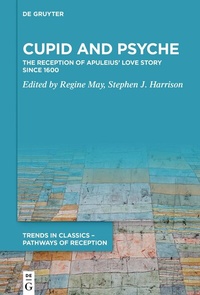
Cupid and Psyche
The Reception of Apuleius' Love Story since 1600
1st Edition
Published on 24. February 2020
XII, 466 pages
978-3-11-064158-5 (ISBN)
Description

Apuleius' tale of Cupid and Psyche has been popular since it was first written in the second century CE as part of his Latin novel
Metamorphoses
. Often treated as a standalone text, Cupid and Psyche has given rise to treatments in the last 400 years as diverse as plays, masques, operas, poems, paintings and novels, with a range of diverse approaches to the text.
Apuleius' story of the love between the mortal princess Psyche (or "Soul") and the god of Love has fascinated recipients as varied as Romantic poets, psychoanalysts, children's books authors, neo-Platonist philosophers and Disney film producers. These readers themselves produced their own responses to and versions of the story. This volume is the first broad consideration of the reception of C&P in Europe since 1600 and an adventurous interdisciplinary undertaking. It is the first study to focus primarily on material in English, though it also ranges widely across literary genres in Italian, French and German, encompassing poetry, drama and opera as well as prose fiction and art history, studied by an international team of established and young scholars.
Detailed studies of single works and of whole genres make this book relevant for students of Classics, English, Art History, opera and modern film.
Apuleius' story of the love between the mortal princess Psyche (or "Soul") and the god of Love has fascinated recipients as varied as Romantic poets, psychoanalysts, children's books authors, neo-Platonist philosophers and Disney film producers. These readers themselves produced their own responses to and versions of the story. This volume is the first broad consideration of the reception of C&P in Europe since 1600 and an adventurous interdisciplinary undertaking. It is the first study to focus primarily on material in English, though it also ranges widely across literary genres in Italian, French and German, encompassing poetry, drama and opera as well as prose fiction and art history, studied by an international team of established and young scholars.
Detailed studies of single works and of whole genres make this book relevant for students of Classics, English, Art History, opera and modern film.
More details
Other editions
Additional editions
Book
04/2025
1st Edition
De Gruyter
€159.95
Shipment within 7-9 days
Book
01/2022
1st Edition
De Gruyter
€34.95
Shipment within 7-9 days
E-Book
02/2020
1st Edition
De Gruyter
€159.95
Available for download
Persons
R. May
, University of Leeds, Leeds and
S. Harrison
, Corpus Christi College Oxford, Oxford, UK.
Content
- Intro
- Preface
- List of contributors
- Table of Contents
- Introduction
- I. Baroque and the Influence of La Fontaine
- 'Del soffrir degli affanni è dolce il fine'. Ancient myth and comic drama in G.F. Fusconi's libretto (with G.F. Loredano and P. Michiel) for F. Cavalli, Amore innamorato (1642)
- Apuleius at the court of Louis XIV. Psyché (1671, 1678) and its English version (1675)
- How to use a wallpaper. Psyché et Cupidon-notice explicative
- Psyche in the salon. French interior decoration in the eighteenth century
- II. Romanticism and Philosophy
- 'Pensive pleasures' in prose and poetry. Apuleius, Mary Tighe and eighteenth-century Ireland
- The Platonic Ass: Thomas Taylor's Cupid and Psyche in Context (1795-1822)
- Keats's 'Ode to Psyche'. Psyche as poetry and inspiration
- Sir Walter Scott's Kenilworth and Apuleius' tale of Cupid and Psyche
- Kierkegaard as a reader of Apuleius' Metamorphoses
- Robert Bridges' Eros and Psyche and its models
- III. Fin de Siècle and Psychology
- From Psyche to psyche. The interiorisation of Apuleius' fabella in D'Annunzio, Pascoli, and Savinio
- Between Symbolism and Popular Culture. Cupid and Psyche in Fin de siècle Book Illustration
- Psyche the psychotic. Cupid and Psyche in Dr. Franz Riklin's Wishfulfilment and Symbolism in Fairy Tales
- Psyche and Cupid in the Novels of Charlotte M. Yonge and Sylvia Townsend Warner
- IV. Twentieth Century and Modernism
- Eudora Welty's The Robber Bridegroom. Cupid and Psyche on the Natchez Trace
- Cupid &
- Psyche and C.S. Lewis' Till We Have Faces. A Christian-Platonic metamorphosis
- Faulkner's reception(s) of Apuleius' Cupid and Psyche in The Reivers
- 'I have tried to be blind in love'. Psyche and the quest for feminine poetic autonomy in Sylvia Plath's House of Eros
- V. New Audiences
- Cupid and Psyche for children
- Cupid and Psyche on stage in the 21⊃&st&/sup& century
- Undertones of Apuleius' Cupid and Psyche in Guillermo del Toro's Pan's Labyrinth
- Beauty and the Beast as a myth and metaphor in the contemporary world. Looking forward with Apuleius' fable of Cupid and Psyche
- List of Figures
- Index
