

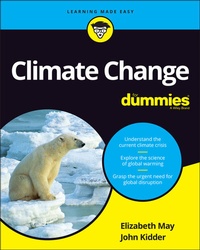
Climate Change For Dummies
Description

Master the hottest-and most chilling-topic in the world today
More and more frequent extreme weather events occur each year, and wildlife everywhere is increasingly endangered. Science fiction or science fact, most climate experts see this as our world on climate change-and, according to polls, a majority of people around the globe agree. Climate Change For Dummies allows you to investigate this hottest of hotly debated issues for yourself-examining its causes, the way it affects our lives, and what we can all do to make a difference.
This straightforward guide-cowritten by the former leader of Canada's Green Party and the Canadian Chief of Staff to the Minister of Natural Resources-sifts the fact from the fiction: Is climate change caused by human activity or by natural elements beyond our control? What contribution can clean energy make? What are our best and worst-case scenarios?
- What are the likely long- and short-term effects?
- How can human activity can impact the environment?
- Can individuals and governments help reverse the possible effects?
- Which are the best sources of cleaner energy?
With the IPCC predicting a 2.5-10°F warming over the next century, this complex subject will be making temperatures soar for years to come-on both sides of the debate. Climate Change For Dummies is the ideal tool to navigate these increasingly choppy waters-and to make an informed difference where you can.
Elizabeth May is the former leader of the Green Party of Canada. She founded and served as the Executive Director of the Sierra Club Canada from 1989 to 2006. May has been the Member of Parliament in Canada since May 2011.
John Kidder was a founding member of the Green Party in British Columbia. He has been a cowboy, miner, fisher, range management specialist, technology entrepreneur, small farmer, and governance practitioner since then.
The authors married on Earth Day 2019.
More details
Other editions
Additional editions
Persons
John Kidder was a founding member of the Green Party in British Columbia. He has been a cowboy, miner, fisher, range management specialist, technology entrepreneur, small farmer, and governance practitioner since then.
The authors married on Earth Day 2019.
Content
Chapter 1
Covering the Basics of Climate Change
IN THIS CHAPTER
Getting to know what global warming is all about
Figuring out what started climate change in the first place
Investigating the changes global warming might bring
Examining the role governments can play in fighting global warming
Finding solutions to the problem
The phrase "global warming" has been in the news since the late 1980s, but climate change, as global warming is also known, has been around much longer. In fact, it has been a constant throughout history. Earth's climate today is very different from what it was 2 million years ago, let alone 10,000 years ago. Since the beginnings of the most primitive life forms, this planet has seen many different climates, from the hot, dry Jurassic period of the dinosaurs to the bleak, frozen landscapes of the ice ages.
Today, however, the planet is experiencing something new: Its climate is experiencing rapid and dangerous changes. Scientists are certain that these changes have been caused by emissions produced by human activities. By examining previous changes in the Earth's climate, using computer models, and measuring current changes in atmospheric chemistry, they can estimate what global warming might mean for the planet, and their projections are scary.
Fortunately, Earth isn't locked into the worst-case-scenario fate yet. By banding together, people can put the brakes on global warming. In 2009, when this book was first released, we had more time to apply the brakes than now. This chapter explains the essentials of global warming and what everyone can do to achieve a greener future.
Getting a Basic Overview - Global Warming 101
When "global warming" became a household phrase, greenhouse gases (GHGs), which trap heat in the Earth's atmosphere, got a bad reputation. After all, those gases are to blame for heating up the planet. But, as we discuss in Chapter 2, GHGs in reasonable quantities aren't villains, they're heroes. They capture the sun's warmth and keep it around so that life as it's known is possible on Earth. The problem starts when the atmosphere contains too great an amount of GHGs. (In Chapter 3, we look at how scientists have determined the correlation between carbon dioxide in the atmosphere and temperature.)
Other factors, which we discuss briefly in the following sections, affect the Earth's climate. Some are short-term - mostly those are seen as variations in weather, like El Niño or El Niña. The ones that matter most, though, are those that have long-term effects on climate. When the overall temperature of the Earth and the oceans rise, that's not just a change in the weather. And it's not just a normal variation that might have been observed in the past. That's a change in the Earth's climate.
Heating things up with GHGs
Human activities - primarily, the burning of fossil fuels (which we look at in the section "Tapping the Roots of Global Warming," later in this chapter) - have resulted in growing concentrations of carbon dioxide and other GHGs in the atmosphere. As we explain in Chapter 2, these increasing quantities of GHGs are retaining more and more of the sun's heat. The heat trapped by the carbon dioxide blanket is raising temperatures all over the world - hence, global warming.
Since the beginning of the Industrial Revolution, Earth has seen a 1.4-degree Fahrenheit (1.1 degree Celsius) increase in global average temperature because of increased GHGs in the atmosphere. Temperatures in polar regions, such as the Arctic, are experiencing temperature rises that are three times the global average.
Investigating other causes of global warming
Global warming is a very complex issue that you can't totally understand without looking at the ifs, ands, or buts. Scientists have been certain for decades that the rapid changes to climate systems are due to the buildup of GHGs. With every new scientific report, they're more certain and more concerned that changes must be made to avoid the worst-case scenarios. Other elements play a role in shaping the planet's climate, however, including the following:
- Cloud cover: Clouds are connected to humidity, temperature, and rainfall. When temperatures change, so does the cloud cover - and vice versa.
- Long-term climate trends: The Earth has a history of going in and out of ice ages and warm periods. Scientific records of carbon dioxide levels in the atmosphere go back 800,000 years, but people can only give educated guesses about the climate earlier than that.
- Solar cycles: The sun goes through a cycle that brings it closer to or farther away from the Earth. This cycle ultimately affects the temperature of this planet and thus the climate. However, scientists have eliminated solar cycles as a factor in current warming.
We go over these other issues in greater detail in Chapter 3.
CLIMATE CHANGE - THE STORY IN A NUTSHELL
Earth has been around for about 5 billion years, starting as a ball of swirling gas and dust left over from the formation of the sun. In the first part of this very long time, the iron and silica that make up most of the planet separated - the hot heavy iron went down to the core and the lighter silicates came to the surface and cooled. Volcanoes belched material and gases up to the surface. Continents formed and move around on the surface of the planet. The Earth froze from pole to pole, heated, thawed, froze again. The mix of gases in the atmosphere changed as volcanoes and sun had their effects.
An overview of life on Earth
Life began and then ebbs and flows ensued:
- 3½ billion years ago: Single-celled organisms and viruses appeared.
- 2½ billion years ago: Photosynthesis began in bacteria; sunlight provided the energy to convert carbon to cellular growth and emit oxygen as waste.
- 900 million years ago: The first multi-celled organisms appeared.
- 450 to 600 million years ago: Life exploded, and plants and animals from the oceans began to colonize the land.
- 250 million years ago: The first mass extinction happens - the survivors are the early dinosaurs and mammals.
- 200 million years ago: Another mass extinction occurs - now the dinosaurs become dominant. At the same time, some little mammals become warm-blooded, with new abilities to live in varying climates.
- 150 to 100 million years ago: The first birds and flowering plants appear; large dinosaurs coexist with four distinct groups of mammals.
- 66 million years ago: An asteroid hits eastern Mexico, the cloud of dust and steam blocks the sun for years, plants die, and the dinosaurs (and all other animals weighing more than 55 pounds [25 kg]) go extinct.
- 55 million years ago: Another mass extinction happens, this one perhaps caused by a rise in greenhouse gases, that make the atmosphere a more effective insulator and causes Earth to heat past the survival limits of many species. It's a tough place to live, Earth. Nothing is certain.
- 6 million years ago: The first humans appear.
Human beings have been around in the same basic form for 6 million of the 5 billion years of Earth, one-eighth of one percent of all that time. During that (short) time, humans survived ice ages and developed tools, agriculture, writing, states and governments, music, and art. The human population grew constantly but slowly, held within the limits of what Earth and natural processes could provide, at about 0.04 percent per year, from 10,000 BC to 1700 AD. By 1700 about 600 million people lived on Earth, rising to about 1 billion by 1800.
But then things changed. Between 1800 and 1928, the human population doubled to 2 billion. From then on, the rate of increase rose rapidly until about 1968 - and population went up to 2.5 billion, to 5 billion by 1987, and 7.7 billion by 2019. The rate of increase peaked in 1968 and has been decreasing ever since, but still the population is expected to rise to a maximum of about 11 billion by 2100.
So humans have come to dominate Earth as no other life form ever has. And it's not just people - the animals that humans keep are now by far the largest part of the world's total animal biomass (biomass is the total mass of living matter in a given area).
In addition to the rising population, humans learned in the early part of the 1800s how to use the energy stored in the Earth millions of years ago. It all came from those old plants that millions of years ago used energy from the sun to grow and make their carbon tissue. When the plants died, their tissues rotted and decomposed, and over millions of years were compressed into coal and oil.
Beginning to use fossil fuels
Black or brown coal, the compressed remains of ancient plants, is a wonderful source of high-density energy. It's sometimes easy to find on the surface of the Earth, so it has been used for thousands of years for fuel (and humans had learned to make a sort of coal equivalent, charcoal, by heating wood without enough oxygen to actually burn). But most of the coal in the world is underground, not so easy to pick up and take...
