

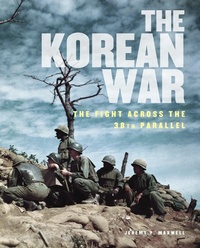
The Korean War
The Fight Across the 38th Parallel
Published on 26. April 2023
224 pages
978-1-78274-992-9 (ISBN)
Description

'The Armed Forces Security Agency responsible for ranking current threats listed Korea fifth as an area of potential danger, behind Indochina and other countries.'
So admitted US military analysts the day North Korean communist forces crossed the partition line and invaded South Korea. By 28 June 1950, Seoul had been captured by the North Korean People's Army (NKPA). However, the fall of the capital did not spell the end of the anti-communist government of Syngman Rhee, and by early July a US-led United Nations (UN) force was in place, fighting a rearguard action as NKPA forces pushed south. With UN forces trapped inside the tiny Pusan Perimeter, in mid-September the US was able to land 40,000 troops 300 kilometres to the northwest at Inchon, outflanking the North Korean advance and gaining the initiative. What followed over the next three years was the first major conflict of the Cold War era - a war that devastated the country, killed millions and displaced millions more. The fighting involved combatants from dozens of nations, with more than 20 countries sending soldiers as part of the multinational UN force. In communist North Korea, more than a million Chinese regulars fought as part of the People's Volunteer Army (PVA), while the Soviet Union supplied pilots and military hardware for the communist cause. Illustrated with 150 archival photographs, maps and illustrations, The Korean War tells the story of the three-year war from the conditions that led to the conflict to the armistice and the establishment of the demilitarized zone (DMZ) along the 38th parallel, leading to the development of the two distinct Koreas we see today.
So admitted US military analysts the day North Korean communist forces crossed the partition line and invaded South Korea. By 28 June 1950, Seoul had been captured by the North Korean People's Army (NKPA). However, the fall of the capital did not spell the end of the anti-communist government of Syngman Rhee, and by early July a US-led United Nations (UN) force was in place, fighting a rearguard action as NKPA forces pushed south. With UN forces trapped inside the tiny Pusan Perimeter, in mid-September the US was able to land 40,000 troops 300 kilometres to the northwest at Inchon, outflanking the North Korean advance and gaining the initiative. What followed over the next three years was the first major conflict of the Cold War era - a war that devastated the country, killed millions and displaced millions more. The fighting involved combatants from dozens of nations, with more than 20 countries sending soldiers as part of the multinational UN force. In communist North Korea, more than a million Chinese regulars fought as part of the People's Volunteer Army (PVA), while the Soviet Union supplied pilots and military hardware for the communist cause. Illustrated with 150 archival photographs, maps and illustrations, The Korean War tells the story of the three-year war from the conditions that led to the conflict to the armistice and the establishment of the demilitarized zone (DMZ) along the 38th parallel, leading to the development of the two distinct Koreas we see today.
More details
Series
Language
English
Place of publication
United Kingdom
Publishing group
Amber Books Ltd
Target group
Professional and scholarly
Interest Age: From 16 to 99 years
Illustrations
Index; Maps; Halftones, color; Halftones, black and white; Illustrations, color
File size
15,38 MB
ISBN-13
978-1-78274-992-9 (9781782749929)
Copyright in bibliographic data and cover images is held by Nielsen Book Services Limited or by the publishers or by their respective licensors: all rights reserved.
Schweitzer Classification
Other editions
Additional editions
Book
09/2020
Amber Books
€44.75
Article exhausted; check different version
Book
10/2019
Amber Books
€44.75
Article exhausted; check different version
Person
Jeremy P. Maxwell currently works in the Department of Military History at the U.S. Army Command and General Staff College in Ft. Leavenworth. Prior to that, he was the DPAA Postdoctoral Fellow at the University of Southern Mississippi, where he worked in the History Department and the Dale Center for Study of War & Society in conjunction with the Defense POW/MIA Agency to locate unaccounted military personnel from WWII forward. His first book, Brotherhood in Combat: How African Americans Found Equality in Korea and Vietnam was published in the "Campaigns and Commanders" series by the University of Oklahoma Press.
Content
Introduction
Korea divided between the US-occupied south in 1945 and the Soviet-occupied north of the 38th Parallel. The early years of the Cold War after WWII.
1. The United States Enters the War
On 28 June 1950, Seoul fell to the North Korean Army. Truman moved quickly, authorizing General MacArthur to use air and naval forces to assist the ROK in slowing the NKPA advance. South Korean and US forces driven south to the Pusan Perimeter.
2. Inchon Landings
In September 1950, an amphibious UN counter-offensive was launched at Inchon, and cut off many North Korean troops. Those who escaped envelopment and capture were forced back north. UN forces rapidly approached the Yalu River-the border with China.
3. Chinese Intervention
In October 1950, mass Chinese forces crossed the Yalu and entered the war. The surprise Chinese intervention triggered a retreat of UN forces which continued until mid-1951. After these reversals of fortune, which saw Seoul change hands four times, the last two years of fighting became a war of attrition, with the front line close to the 38th Parallel.
4. The War in the Air
North Korea was subject to a massive bombing campaign. Jet fighters confronted each other in air-to-air combat for the first time in history, and Soviet pilots covertly flew in defense of their communist allies.
5. Stalemate
The fighting ended on 27 July 1953, when an armistice was signed. The agreement created the Korean Demilitarized Zone to separate North and South Korea, and allowed the return of prisoners. However, no peace treaty was ever signed, and according to some sources the two Koreas are technically still at war, engaged in a frozen conflict.
6. After the Armistice
North-South divide in Korea on the 38th Parallel. North Korea kidnapping of South Koreans. The few who escaped from North Korea, via China, to the South. In April 2018, the leaders of North and South Korea met at the demilitarized zone and agreed to sign a treaty by the end of the year to formally end the Korean War.
Appendices
Bibliography
Index
Korea divided between the US-occupied south in 1945 and the Soviet-occupied north of the 38th Parallel. The early years of the Cold War after WWII.
1. The United States Enters the War
On 28 June 1950, Seoul fell to the North Korean Army. Truman moved quickly, authorizing General MacArthur to use air and naval forces to assist the ROK in slowing the NKPA advance. South Korean and US forces driven south to the Pusan Perimeter.
2. Inchon Landings
In September 1950, an amphibious UN counter-offensive was launched at Inchon, and cut off many North Korean troops. Those who escaped envelopment and capture were forced back north. UN forces rapidly approached the Yalu River-the border with China.
3. Chinese Intervention
In October 1950, mass Chinese forces crossed the Yalu and entered the war. The surprise Chinese intervention triggered a retreat of UN forces which continued until mid-1951. After these reversals of fortune, which saw Seoul change hands four times, the last two years of fighting became a war of attrition, with the front line close to the 38th Parallel.
4. The War in the Air
North Korea was subject to a massive bombing campaign. Jet fighters confronted each other in air-to-air combat for the first time in history, and Soviet pilots covertly flew in defense of their communist allies.
5. Stalemate
The fighting ended on 27 July 1953, when an armistice was signed. The agreement created the Korean Demilitarized Zone to separate North and South Korea, and allowed the return of prisoners. However, no peace treaty was ever signed, and according to some sources the two Koreas are technically still at war, engaged in a frozen conflict.
6. After the Armistice
North-South divide in Korea on the 38th Parallel. North Korea kidnapping of South Koreans. The few who escaped from North Korea, via China, to the South. In April 2018, the leaders of North and South Korea met at the demilitarized zone and agreed to sign a treaty by the end of the year to formally end the Korean War.
Appendices
Bibliography
Index
