

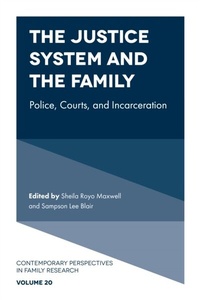
The Justice System and the Family
Police, Courts, and Incarceration
1st Edition
Published on 14. October 2022
360 pages
978-1-80382-361-4 (ISBN)
Description

Around the globe, millions of individuals are entangled in justice systems daily. For individual offenders, contact often begins with the police, frequently leading to court involvement, and for offenders found guilty, to correctional supervision or incarceration. But how do these encounters affect the family? How do police and justice entanglements result in tremendous strains upon families economically and socially? Do they endanger family relationships?
To better comprehend how involvement at any level of the justice system affects families, this multidisciplinary edited collection focuses on the justice system and the family. Chapters include topics such as how court processes impact family members and their support networks; how prolonged incarceration impacts children and parenting processes and family coping; how intimate relationships are impacted during and after incarceration including marriage, divorce and partner violence; and, whether system involvement leads to unintended consequences among family members such as heightened fear of crime and victimizations and fears of the police.
An enlightening insight into the family dynamics surrounding contact with the justice system, Police, Courts, and Incarceration is interesting reading for researchers and students of family, sociology and criminology.
To better comprehend how involvement at any level of the justice system affects families, this multidisciplinary edited collection focuses on the justice system and the family. Chapters include topics such as how court processes impact family members and their support networks; how prolonged incarceration impacts children and parenting processes and family coping; how intimate relationships are impacted during and after incarceration including marriage, divorce and partner violence; and, whether system involvement leads to unintended consequences among family members such as heightened fear of crime and victimizations and fears of the police.
An enlightening insight into the family dynamics surrounding contact with the justice system, Police, Courts, and Incarceration is interesting reading for researchers and students of family, sociology and criminology.
More details
Series
Language
English
Place of publication
Bingley
United Kingdom
Target group
Professional and scholarly
File size
3,20 MB
ISBN-13
978-1-80382-361-4 (9781803823614)
Copyright in bibliographic data and cover images is held by Nielsen Book Services Limited or by the publishers or by their respective licensors: all rights reserved.
Schweitzer Classification
Other editions
Additional editions
Sheila Royo Maxwell | Sampson Lee Blair
The Justice System and the Family
Police, Courts, and Incarceration
Book
10/2022
Emerald Publishing Limited
€150.00
Article exhausted; check different version
Persons
Sheila Royo Maxwell is a criminologist at the School of Criminal Justice at Michigan State University. Maxwell is a Fulbright Scholar Awardee and studies offending behaviours and attitudes towards law and sanctioning across ethnic, cultural and social-structural milieus.
Sampson Lee Blair is a family sociologist and demographer at The State University of New York (Buffalo). A Fulbright Scholar Award recipient, he has served as chair of the Children and Youth research section of the ASA, vice-president of the Research Committee on Youth in the International Sociological Association, and received the Distinguished Career Service Award from the ASA.
Sampson Lee Blair is a family sociologist and demographer at The State University of New York (Buffalo). A Fulbright Scholar Award recipient, he has served as chair of the Children and Youth research section of the ASA, vice-president of the Research Committee on Youth in the International Sociological Association, and received the Distinguished Career Service Award from the ASA.
Content
Chapter 1. A Family Affair: The Effect of Criminal Justice Processing on Family Relationships; Heather L. Scheuerman and Shelley Keith
Chapter 2. Do Parental Monitoring Habits Change in Response to Juvenile Recidivism?; Caitlin Cavanagh, Erica Dalzell, Alyssa LaBerge, and Elizabeth Cauffman
Chapter 3. The Associations between Home Economics Education and Familial Risk Factors for Delinquency: An Exploratory Study; Xiaoli Su, Jacqueline McNett, Etta Morgan, and Manoj Sharma
Chapter 4. Parents and Siblings of Incarcerated Men: Questioning Intersectionality and Familial Invisibility; Moran Benisty
Chapter 5. Supporting Incarcerated Parents Prior to Reentry: A Gender and Racial Equity-Oriented Lens; Robyn E. Metcalfe, Claudia Reino, Arriell Jackson, Jean M. Kjellstrand, and J. Mark Eddy
Chapter 6. Maintaining Family Ties and Facilitating Father-Child Contact during Jail: The Role of Extended Kin; Britni L. Adams
Chapter 7. The Ripple-Effects of Carceral Policy; Linda Mussell
Chapter 8. Criminal Justice Contact and Coresidence in Young Adulthood: Exploring the Role of the Family Context; Cody Warner
Chapter 9. Restorative Justice and Crime Victim's Family in China - A Case Analysis; Hong Lu, Bin Liang, and Deena DeVore
Chapter 10. Falling through the Fault Lines: Victims Experiencing Poor and Fragmented Legal Responses to Domestic Abuse in England and Wales; Mandy D. Burton
Chapter 11. Domestic Violence against LGBTQS: The Promise and the Challenges of the Istanbul Convention; Laima Vaige
Chapter 12. Familial Violence and Human Trafficking: Stories from India; Sharon Menezes
Chapter 2. Do Parental Monitoring Habits Change in Response to Juvenile Recidivism?; Caitlin Cavanagh, Erica Dalzell, Alyssa LaBerge, and Elizabeth Cauffman
Chapter 3. The Associations between Home Economics Education and Familial Risk Factors for Delinquency: An Exploratory Study; Xiaoli Su, Jacqueline McNett, Etta Morgan, and Manoj Sharma
Chapter 4. Parents and Siblings of Incarcerated Men: Questioning Intersectionality and Familial Invisibility; Moran Benisty
Chapter 5. Supporting Incarcerated Parents Prior to Reentry: A Gender and Racial Equity-Oriented Lens; Robyn E. Metcalfe, Claudia Reino, Arriell Jackson, Jean M. Kjellstrand, and J. Mark Eddy
Chapter 6. Maintaining Family Ties and Facilitating Father-Child Contact during Jail: The Role of Extended Kin; Britni L. Adams
Chapter 7. The Ripple-Effects of Carceral Policy; Linda Mussell
Chapter 8. Criminal Justice Contact and Coresidence in Young Adulthood: Exploring the Role of the Family Context; Cody Warner
Chapter 9. Restorative Justice and Crime Victim's Family in China - A Case Analysis; Hong Lu, Bin Liang, and Deena DeVore
Chapter 10. Falling through the Fault Lines: Victims Experiencing Poor and Fragmented Legal Responses to Domestic Abuse in England and Wales; Mandy D. Burton
Chapter 11. Domestic Violence against LGBTQS: The Promise and the Challenges of the Istanbul Convention; Laima Vaige
Chapter 12. Familial Violence and Human Trafficking: Stories from India; Sharon Menezes
