

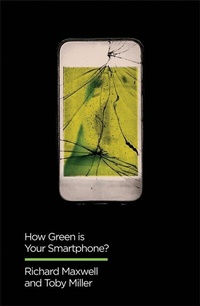
How Green is Your Smartphone?
Description

In this succinct and lively book, Maxwell and Miller take a critical look at contemporary gadgets and the systems that connect them, shedding light on environmental risks. Contrary to widespread claims, consumer electronics and other digital technologies are made in ways that cause some of the worst environmental disasters of our time - conflict-minerals extraction, fatal and life-threatening occupational hazards, toxic pollution of ecosystems, rising energy consumption linked to increased carbon emissions, and e-waste. Nonetheless, a greener future is possible, in which technology meets its emancipatory and progressive potential.
How Green is Your Smartphone? encourages us to look at our phones in a wholly new way, and is important reading for anyone concerned by the impact of everyday technologies on our environment.
More details
Other editions
Additional editions
Persons
Toby Miller is Stuart Hall Professor of Cultural Studies, Universidad Autónoma de México, Cuajimalpa, and Professor in Media and Creative Industries at Loughborough University London.
Content
1 Outsmart Your Smartphone
2 The Greatest Smartphone is the One You Already Own
3 Calling Bullshit on Anti-Science Propaganda
Conclusion: What Next?
References
Index
INTRODUCTION
The Economist identified 2019 as "peak smartphone." The "most successful consumer product in history" had reached four billion of the world's five and half billion adults. Over 95 percent of Americans owned a cellphone, and smartphones comprised 77 percent of that total. The highest concentration was among educated 19 to 49-year-old city dwellers (Pew Research Center, 2018). South Korea topped the world's list with 94 percent smartphone ownership, and the trend was similar throughout developed economies, with Japan, Germany, Italy, France, and the UK slowly catching up to US levels (Poushter, Bishop, and Chwe, 2018).
Cultural, social, economic, health, and ecological corollaries of peak smartphone have accompanied this expansion. Umberto Eco reimagines David Lean's Dr Zhivago (1965) for our own times, recalling: "the tragedy of Zhivago, who after years sees Lara from the tram (remember the final scene of the film?), doesn't manage to get off in time, and dies. Had they both had a mobile phone, would we have had a happy ending?" (2014, p. viii). The smartphone is a reassuring talisman: we may find ourselves one day on unfamiliar terrain, but can find our way out through its mapping functions. We may wander into a "dodgy" part of town, but can rely on it to communicate our whereabouts to loved ones or the state apparatus (Morley, 2017).
Meanwhile, the companies concerned revel in cell-phone saturation of the world's ears, eyes, and fingers. Apple says "We believe everyone should be able to do what they love with iPhone."1 Samsung invites customers to "meet our latest and greatest innovation" - its Galaxy S10.2 Google boasts that the Pixel 3 is "Everything you wish your phone could do."3 That all sounds rather grand - stylish new phones that give us what we want. Trust Apple, trust Samsung, trust Google. But a 2019 report on the Mobile World Congress announced in a letter to "Dear Visionaries" that the industry was "suffering from a combination of split personality disorder and ADHD" (ABI Research for Visionaries/MWC 19 Barcelona, 2019). That diagnosis derived from the differing interests of two fractions of capital - phone manufacturers versus carriers. And there was no room in this world of visionaries for either party to consider whether their phones were green.
Because the diffusion of these devices has been more rapid than their innovation, sales finally began to diminish in 2018: there is a dwindling number of first-time customers left to corral. But even though improvements have become ever more marginal, the industry can count on 2.8 billion people replacing their phones every two years ("The Maturing," 2019). Meanwhile, the consumer market is slowly becoming less significant than demand from military, medical, meat, and manufacturing segments of the economy (ABI Research for Visionaries/MWC 19 Barcelona, 2019).
For all that, digital utopians continue to fete the phone's popularity, reach, and effects. According to Bell Labs, "more than 5 zettabytes of data . pass through the network every year. That is the equivalent of everyone in the world tweeting non-stop for more than 100 years."4 For Edgar Morin, the instantaneity of phone communication means that our "world is made more and more whole" (1999). In similar vein, Ulrich Beck says the cellphone has altered "sociological categories of time, space, place, proximity and distance" as it "makes those who are absent present, always and everywhere" (2002: 31). It is said that one day the smartphone may even provide material clues to the way we lived:
The phone has much in common with the portable artifacts of a more traditional archaeology, like flint hand-axes or pottery vessels . an object scaled to fit the human world . shaped to fit the hand and fingers, and has action capabilities . orientated towards other parts of the body . (Edgeworth 2010: 143)
But there's another side to this seeming cornucopia. The World Privacy Forum proposes that we inhabit a One-Way Mirror Society, where power accretes to corporations through the supposedly even-handed tool of interactivity (Dixon, 2010). Former true-believers at Wired magazine see the internet undone by the corporatization of knowledge and the sealed-set model of phone applications (Anderson and Wolff, 2010). Dan Schiller describes the displacement and deracination of modern life as a blend of individuation with mobility. He argues that political-economic arrangements mean that mobile telephony has emerged in a form befitting divided societies (2007).
And, while the gap in mobile-phone ownership between rich and poor has narrowed in the US, nearly 30 percent of adults with household incomes below $30,000 don't own a smartphone, and over 40 percent of such households lack broadband, a desktop, or a laptop. About 26 percent of low-income Americans with smartphones but no home broadband depend on cellular services for network connectivity. That number has doubled since 2013 (Anderson and Kumar, 2019).
Globally, the smartphone gap between rich and poor regions is shrinking, though inequalities in access and service standards remain (Silver and Johnson, 2018). The International Telecommunications Union (ITU) reports that "[a]lmost the whole world population now lives within range of a mobile-cellular network signal," and more than half are online (2018a, p. 2). The ITU notes (and promotes) the growing importance of mobile cellular telecommunications for economic growth in Africa, the Arab States, Asia, and Latin America (2018a, p. 4).
But by its own reckoning, there is immense variation within the Global South in smartphone ownership, access to mobile networks, and, perhaps most importantly, affordable, fast, and reliable connections (2018a, pp. 104-6 and 125-30; Alvarez, 2014; Bianchi, 2015). In addition, much of the Global South has a very significant gender gap in access to smartphones (Bhandari, 2019).
Ignoring these obdurate limitations, the ITU, the telecommunications industry, and electronics manufacturers insist that mobile cellular communication will inevitably and beneficially expand from the wealthy countries where they are headquartered. The industry's hype has an imperious ring: we are heading inexorably toward the next stage of technological and human progress and pleasure. Mobile communication will be foundational.
In the face of such breathless predictions, we should keep in mind that the idea of technological progress has only been around since the nineteenth century, when it was deployed as propaganda "to deny the legitimacy and rationality" of organized opposition to industrial machinery (Noble, 1995). The Luddites, famous for sometimes destroying machines they feared would ruin their livelihoods and the quality of their craft, "did not believe in technological progress, nor could they have; the alien idea was invented after them, to try to prevent their recurrence" (Noble, 1995, p. 2).
They weren't opposed to new technology per se, only to boosters' obliviousness to its undemocratic designs and socially destructive deployment. We adhere to that critique in our examination of the smartphone as an emblem of technological progress. The world has been subject to the incessant promotion of smartphone innovations for over a decade. Such rhetoric ignores the central topics of this book: environmental harm, labor exploitation, and the connivance of industry with anti-science propaganda.
It's ironic that The Economist used an adjective generally applied to the "terror" of running out of petroleum - "peak oil" - to describe super-saturation of the world cellphone market. For both industries have played malevolent roles in our planetary crisis. And both relate to the concept "green" in our title. "Green" can signify displeasure, even disgust. For example, "he turned green" or "it's indefensible to have green lawns in LA." But the meaning of the term is more complex than that. It is simultaneously serene, beneficial, disturbing, corrupted, radical, and conservative: green consumption, green certification, new (green) deal, and greenwashing.
In the late 1960s and early 1970s, the word "pollution" was in vogue to explain environmental hazards. Both a ubiquitous and a local sign, it seemed to be everywhere, yet isolable. The problems it described occurred when particular waterways, neighborhoods, or fields suffered negative externalities from mining, farming, and manufacturing. The issue was how to restore these places to their prior state: pristine, unspoiled, enduring. Pollution was about corporate malfeasance, governmental neglect, and public ignorance, and how to remedy their malign impact. It could be cleaned up if governments compelled companies to do so - and would soon be over, once those involved understood the problem.
But when greenhouse gases, environmental racism, global warming, occupational health, and environmental imperialism appeared on the agenda, pollution reached beyond national boundaries and became ontological, threatening the very Earth that gives and sustains life, and doing so in demographically unequal ways.
A word was found...
