

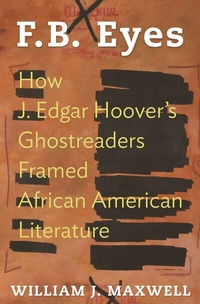
F.B. Eyes
How J. Edgar Hoover's Ghostreaders Framed African American Literature
1st Edition
Published on 28. July 2015
384 pages
978-1-4008-5206-2 (ISBN)
Description

How FBI surveillance influenced African American writing
Few institutions seem more opposed than African American literature and J. Edgar Hoover's white-bread Federal Bureau of Investigation. But behind the scenes the FBI's hostility to black protest was energized by fear of and respect for black writing. Drawing on nearly 14,000 pages of newly released FBI files, F.B. Eyes exposes the Bureau's intimate policing of five decades of African American poems, plays, essays, and novels. Starting in 1919, year one of Harlem's renaissance and Hoover's career at the Bureau, secretive FBI "ghostreaders" monitored the latest developments in African American letters. By the time of Hoover's death in 1972, these ghostreaders knew enough to simulate a sinister black literature of their own. The official aim behind the Bureau's close reading was to anticipate political unrest. Yet, as William J. Maxwell reveals, FBI surveillance came to influence the creation and public reception of African American literature in the heart of the twentieth century.
Taking his title from Richard Wright's poem "The FB Eye Blues," Maxwell details how the FBI threatened the international travels of African American writers and prepared to jail dozens of them in times of national emergency. All the same, he shows that the Bureau's paranoid style could prompt insightful criticism from Hoover's ghostreaders and creative replies from their literary targets. For authors such as Claude McKay, James Baldwin, and Sonia Sanchez, the suspicion that government spy-critics tracked their every word inspired rewarding stylistic experiments as well as disabling self-censorship.
Illuminating both the serious harms of state surveillance and the ways in which imaginative writing can withstand and exploit it, F.B. Eyes is a groundbreaking account of a long-hidden dimension of African American literature.
Few institutions seem more opposed than African American literature and J. Edgar Hoover's white-bread Federal Bureau of Investigation. But behind the scenes the FBI's hostility to black protest was energized by fear of and respect for black writing. Drawing on nearly 14,000 pages of newly released FBI files, F.B. Eyes exposes the Bureau's intimate policing of five decades of African American poems, plays, essays, and novels. Starting in 1919, year one of Harlem's renaissance and Hoover's career at the Bureau, secretive FBI "ghostreaders" monitored the latest developments in African American letters. By the time of Hoover's death in 1972, these ghostreaders knew enough to simulate a sinister black literature of their own. The official aim behind the Bureau's close reading was to anticipate political unrest. Yet, as William J. Maxwell reveals, FBI surveillance came to influence the creation and public reception of African American literature in the heart of the twentieth century.
Taking his title from Richard Wright's poem "The FB Eye Blues," Maxwell details how the FBI threatened the international travels of African American writers and prepared to jail dozens of them in times of national emergency. All the same, he shows that the Bureau's paranoid style could prompt insightful criticism from Hoover's ghostreaders and creative replies from their literary targets. For authors such as Claude McKay, James Baldwin, and Sonia Sanchez, the suspicion that government spy-critics tracked their every word inspired rewarding stylistic experiments as well as disabling self-censorship.
Illuminating both the serious harms of state surveillance and the ways in which imaginative writing can withstand and exploit it, F.B. Eyes is a groundbreaking account of a long-hidden dimension of African American literature.
All prices
More details
Edition
Course Book
Language
English
Place of publication
Princeton, NJ
United States
Publishing group
De Gruyter
Target group
Professional and scholarly
Edition type
Digital original
Product notice
Reflowable
Illustrations
10 halftones.
File size
4,42 MB
ISBN-13
978-1-4008-5206-2 (9781400852062)
Schweitzer Classification
Other editions
Additional editions
Book
12/2016
Princeton University Press
€28.50
Shipment within 10-20 days
Book
01/2015
Princeton University Press
€43.40
Shipment within 10-20 days
Person
William J. Maxwell is professor of English and African and African American studies at Washington University in St. Louis. His F.B. Eyes Digital Archive presents copies of 51 of the FBI files discussed in this book.
Content
Acknowledgments xi
Introduction 1
The FBI against and for African American Literature 1
The Files and the FOIA 7
Five Theses and the Way Forward 15
Part One/Thesis One: The Birth of the Bureau, Coupled with the Birth of J. Edgar Hoover, Ensured the FBI's Attention to African American Literature 25
The Bureau before Hoover 29
Hoover before the Bureau 35
Bureau of Letters: Lit.-Cop Federalism, the Hoover Raids, and the Harlem Renaissance 42
Part Two/Thesis Two: The FBI's Aggressive Filing and Long Study of African American Writers Was Tightly Bound to the Agency's Successful Evolution under Hoover 59
Flatfoot Montage: The Genre of the Counterliterary FBI File 63
The Counterliterary State and the Charismatic Bureaucracy: Trimming the First Amendment, Fencing the Harlem Renaissance 68
Persons to Racial Conditions: Literary G-Men and FBI Counterliterature from the New Deal to the Second World War 76
Afro-Loyalty and Custodial Detention: Files of World War II 85
Total Literary Awareness: Files of the Cold War 94
COINTELPRO Minstrelsy: Files of Black Power 107
Part Three/Thesis Three: The FBI Is Perhaps the Most Dedicated and Influential Forgotten Critic of African American Literature 127
Reading Like a CIA Agent 131
Reading Like an FBI Agent 141
Critics behind the Bureau Curtain: Meet Robert Adger Bowen and William C. Sullivan 150
Ask Dr. Hoover: Model Citizen Criticism and the FBI's Interpretive Oracle 165
Part Four/Thesis Four: The FBI Helped to Define the Twentieth-Century Black Atlantic, Both Blocking and Forcing Its Flows 175
The State in the Nation-State; the State of the Transnational Turn 180
The State of Black Transnationalism; the State in the Black Atlantic 186
Checking Diasporan ID: Hostile Translation and the Passport Office 195
State-Sponsored Transnationalism: The Stop Notice and the Travel Bureau 205
Jazz Ambassadors versus Literary Escapees 212
Part Five/Thesis Five: Consciousness of FBI Ghostreading Fills a Deep and Characteristic Vein of African American Literature 215
Reading Ghostreading in the Harlem Renaissance: New Negro Journalists and Claude McKay 225
Invisible G-Men En Route to the Cold War: George Schuyler, Langston Hughes, and Ralph Ellison 232
Mysteries and Antifiles of Black Paris: Richard Wright, William Gardner Smith, and Chester Himes 243
Black Arts Antifiles and the "Hoover Poem": John A. Williams, James Baldwin, Sam Greenlee, Melvin Van Peebles, Ishmael Reed, Amiri Baraka, Nikki Giovanni, and Sonia Sanchez 259
Bureau Writing after Hoover: Dudley Randall, Ai, Audre Lorde, Danzy Senna, and Gloria Naylor 269
Appendix: FOIA Requests for FBI Files on African American Authors Active from 1919 to 1972 277
Notes 285
Works Cited 315
Index 343
Introduction 1
The FBI against and for African American Literature 1
The Files and the FOIA 7
Five Theses and the Way Forward 15
Part One/Thesis One: The Birth of the Bureau, Coupled with the Birth of J. Edgar Hoover, Ensured the FBI's Attention to African American Literature 25
The Bureau before Hoover 29
Hoover before the Bureau 35
Bureau of Letters: Lit.-Cop Federalism, the Hoover Raids, and the Harlem Renaissance 42
Part Two/Thesis Two: The FBI's Aggressive Filing and Long Study of African American Writers Was Tightly Bound to the Agency's Successful Evolution under Hoover 59
Flatfoot Montage: The Genre of the Counterliterary FBI File 63
The Counterliterary State and the Charismatic Bureaucracy: Trimming the First Amendment, Fencing the Harlem Renaissance 68
Persons to Racial Conditions: Literary G-Men and FBI Counterliterature from the New Deal to the Second World War 76
Afro-Loyalty and Custodial Detention: Files of World War II 85
Total Literary Awareness: Files of the Cold War 94
COINTELPRO Minstrelsy: Files of Black Power 107
Part Three/Thesis Three: The FBI Is Perhaps the Most Dedicated and Influential Forgotten Critic of African American Literature 127
Reading Like a CIA Agent 131
Reading Like an FBI Agent 141
Critics behind the Bureau Curtain: Meet Robert Adger Bowen and William C. Sullivan 150
Ask Dr. Hoover: Model Citizen Criticism and the FBI's Interpretive Oracle 165
Part Four/Thesis Four: The FBI Helped to Define the Twentieth-Century Black Atlantic, Both Blocking and Forcing Its Flows 175
The State in the Nation-State; the State of the Transnational Turn 180
The State of Black Transnationalism; the State in the Black Atlantic 186
Checking Diasporan ID: Hostile Translation and the Passport Office 195
State-Sponsored Transnationalism: The Stop Notice and the Travel Bureau 205
Jazz Ambassadors versus Literary Escapees 212
Part Five/Thesis Five: Consciousness of FBI Ghostreading Fills a Deep and Characteristic Vein of African American Literature 215
Reading Ghostreading in the Harlem Renaissance: New Negro Journalists and Claude McKay 225
Invisible G-Men En Route to the Cold War: George Schuyler, Langston Hughes, and Ralph Ellison 232
Mysteries and Antifiles of Black Paris: Richard Wright, William Gardner Smith, and Chester Himes 243
Black Arts Antifiles and the "Hoover Poem": John A. Williams, James Baldwin, Sam Greenlee, Melvin Van Peebles, Ishmael Reed, Amiri Baraka, Nikki Giovanni, and Sonia Sanchez 259
Bureau Writing after Hoover: Dudley Randall, Ai, Audre Lorde, Danzy Senna, and Gloria Naylor 269
Appendix: FOIA Requests for FBI Files on African American Authors Active from 1919 to 1972 277
Notes 285
Works Cited 315
Index 343

