

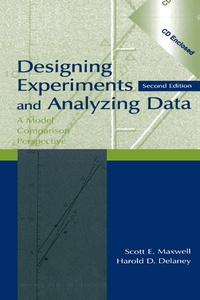
Designing Experiments and Analyzing Data
A Model Comparison Perspective, Second Edition
2nd Edition
Published on 17. October 2003
920 pages
978-1-135-65347-7 (ISBN)
Description

Through this book's unique model comparison approach, students and researchers are introduced to a set of fundamental principles for analyzing data. After seeing how these principles can be applied in simple designs, students are shown how these same principles also apply in more complicated designs.
Drs. Maxwell and Delaney believe that the model comparison approach better prepares students to understand the logic behind a general strategy of data analysis appropriate for various designs; and builds a stronger foundation, which allows for the introduction of more complex topics omitted from other books.
Several learning tools further strengthen the reader's understanding:
*flowcharts assist in choosing the most appropriate technique;
*an equation cross-referencing system aids in locating the initial, detailed definition and numerous summary equation tables assist readers in understanding differences between different methods for analyzing their data;
*examples based on actual research in a variety of behavioral sciences help students see the applications of the material;
*numerous exercises help develop a deeper understanding of the subject. Detailed solutions are provided for some of the exercises and *realistic data sets allow the reader to see an analysis of data from each design in its entirety.
Updated throughout, the second edition features:
*significantly increased attention to measures of effects, including confidence intervals, strength of association, and effect size estimation for complex and simple designs;
*an increased use of statistical packages and the graphical presentation of data;
*new chapters (15 & 16) on multilevel models;
*the current controversies regarding statistical reasoning, such as the latest debates on hypothesis testing (ch. 2);
*a new preview of the experimental designs covered in the book (ch. 2);
*a CD with SPSS and SAS data sets for many of the text exercises, as well as tutorials reviewing basic statistics and regression; and
*a Web site containing examples of SPSS and SAS syntax for analyzing many of the text exercises.
Appropriate for advanced courses on experimental design or analysis, applied statistics, or analysis of variance taught in departments of psychology, education, statistics, business, and other social sciences, the book is also ideal for practicing researchers in these disciplines. A prerequisite of undergraduate statistics is assumed. An Instructor's Solutions Manual is available to those who adopt the book for classroom use.
Drs. Maxwell and Delaney believe that the model comparison approach better prepares students to understand the logic behind a general strategy of data analysis appropriate for various designs; and builds a stronger foundation, which allows for the introduction of more complex topics omitted from other books.
Several learning tools further strengthen the reader's understanding:
*flowcharts assist in choosing the most appropriate technique;
*an equation cross-referencing system aids in locating the initial, detailed definition and numerous summary equation tables assist readers in understanding differences between different methods for analyzing their data;
*examples based on actual research in a variety of behavioral sciences help students see the applications of the material;
*numerous exercises help develop a deeper understanding of the subject. Detailed solutions are provided for some of the exercises and *realistic data sets allow the reader to see an analysis of data from each design in its entirety.
Updated throughout, the second edition features:
*significantly increased attention to measures of effects, including confidence intervals, strength of association, and effect size estimation for complex and simple designs;
*an increased use of statistical packages and the graphical presentation of data;
*new chapters (15 & 16) on multilevel models;
*the current controversies regarding statistical reasoning, such as the latest debates on hypothesis testing (ch. 2);
*a new preview of the experimental designs covered in the book (ch. 2);
*a CD with SPSS and SAS data sets for many of the text exercises, as well as tutorials reviewing basic statistics and regression; and
*a Web site containing examples of SPSS and SAS syntax for analyzing many of the text exercises.
Appropriate for advanced courses on experimental design or analysis, applied statistics, or analysis of variance taught in departments of psychology, education, statistics, business, and other social sciences, the book is also ideal for practicing researchers in these disciplines. A prerequisite of undergraduate statistics is assumed. An Instructor's Solutions Manual is available to those who adopt the book for classroom use.
Reviews / Votes
"Overall, this is an excellent resource for those designing and analyzing experiments, and for those wishing to consolidate their knowledge of individual designs into a unified conceptual framework."-American Statistician
More details
Edition
2nd edition
Language
English
Place of publication
London
United Kingdom
Publishing group
Taylor & Francis Ltd
Target group
College/higher education
Edition type
Revised edition
File size
22,75 MB
ISBN-13
978-1-135-65347-7 (9781135653477)
Copyright in bibliographic data and cover images is held by Nielsen Book Services Limited or by the publishers or by their respective licensors: all rights reserved.
Schweitzer Classification
Other editions
Additional editions
Scott E. Maxwell | Harold D. Delaney
Designing Experiments and Analyzing Data
A Model Comparison Perspective
Book
10/2003
2nd Edition
Lawrence Erlbaum Associates Inc
€20.62
Shipment within 10-20 days
Scott E. Maxwell | Harold D. Delaney | Ken Kelley
Designing Experiments and Analyzing Data
A Model Comparison Perspective, Second Edition
Book
07/2003
2nd Edition
Routledge Academic
€119.04
Article exhausted; check for reprint
Content
Contents: Preface. Part I: Conceptual Bases of Experimental Design and Analysis. The Logic of Experimental Design. Introduction to the Fisher Tradition. Part II: Model Comparisons for Between-Subjects Designs. Introduction to Model Comparisons: One-Way Between-Subjects Designs. Individual Comparisons of Means. Testing Several Contrasts: The Multiple-Comparison Problem. Trend Analysis. Two-Way Between-Subjects Factorial Designs. Higher Order Between-Subjects Factorial Designs. Designs With Covariates: ANCOVA and Blocking. Designs With Random or Nested Factors. Part III: Model Comparisons for Designs Involving Within-Subjects Factors. One-Way Within-Subjects Designs: Univariate Approach. Higher-Order Designs With Within-Subjects Factors: Univariate Approach. One-Way Within-Subjects Designs: Multivariate Approach. Higher Order Designs With Within-Subjects Factors: Multivariate Approach. Part IV: Alternative Analysis Strategies. An Introduction to Multilevel Models for Within-Subjects Designs. An Introduction to Multilevel Hierarchical Mixed Models: Nested Designs. Appendices: Statistical Tables. Part 1. Linear Models: The Relation Between ANOVA and Regression. Part 2. A Brief Primer of Principles of Formulating and Comparing Models. Notes. Solutions to Selected Exercises. References.
