

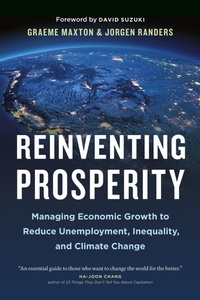
Reinventing Prosperity
Description

"An important contribution to the global debate about growth, equality, climate change, and the path to a viable human future." -David Korten, international bestselling author of When Corporations Rule the World The biggest challenges facing human wellbeing today-widening income inequality, continuing global poverty, and environmental degradation-may be simple to solve in theory. But, because we are required to come up with solutions that are acceptable to a political majority in the rich world, they are much harder to solve in practice. Most of the commonly proposed "solutions" are simply not acceptable to most people. Many of these proposed solutions-like stopping the use of fossil fuels-require a sacrifice today in order to obtain an uncertain advantage in the far future. Therefore they are politically infeasible in the modern world, which is marked by relatively short term thinking. In Reinventing Prosperity, Graeme Maxton and Jorgen Randers provide a new approach altogether through thirteen recommendations which are both politically acceptable and which can be implemented in the current period of slow economic growth around the world. Reinventing Prosperity solves the forty-year-old growth/no-growth standoff, by providing a solution to income inequality, continuing global poverty and climate change, a solution that will provide for economic growth but with a declining ecological footprint. Reinventing Prosperity shows us how to live better on our finite planet-and in ways we can agree on. "An essential guide to those who want to change the world for the better-and for certain." -Ha-Joon Chang, international bestselling author of 23 Things They Don't Tell You About Capitalism "[A] well-argued book... explaining complex issues in a style that is clear, logical, and succinct." - Publishers Weekly
More details
Other editions
Additional editions
Persons
Jorgen Randers is a professor of climate strategy at the Norwegian Business School, a former Deputy Director General of WWF International, and has contributed to numerous books, including Limits to Growth.
David Suzuki is an internationally renowned geneticist and environmentalist and a cofounder of the David Suzuki Foundation. He is the author of more than 40 books, is a recipient of the Right Livelihood Award, and was named one of Time Magazine's Heroes of the Environment. He lives in Vancouver.
Content
- Intro
- Title Page
- Contents
- List of Boxes
- List of Graphs
- List of Tables
- Foreword by David Suzuki
- Preface
- Chapter 1. Two Urgent Problems in the Rich World
- Chapter 2. The Traditional Solution: Economic Growth
- Chapter 3. The Old Approach No Longer Works
- Chapter 4. Advancing Robotization
- Chapter 5. Other Threats to the Current Economic System
- Chapter 6. Dead End: The Failure of Extreme Free-Market Thinking
- Chapter 7. The Storms Ahead
- Chapter 8. A New Approach
- Chapter 9. Thirteen Politically Feasible Proposals to Reduce Unemployment, Inequality, and Climate Change
- Chapter 10. Let the Majority Decide
- Chapter 11. Let the Poor World Grow
- Chapter 12. Saving the World
- Chapter 13. The Epic Battle to Come
- Acknowledgments
- Notes
- Select Bibliography and Further Reading
- About the Authors
- About the Cartoonist
- Index
- Copyright Page
