

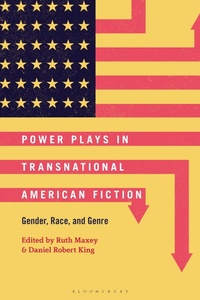
Power Plays in Transnational American Fiction
Gender, Race, and Genre
Published on 16. April 2026
240 pages
979-8-7651-2526-7 (ISBN)
Description

Inspired by the career of Judie Newman, a genuinely ground-breaking scholar in the fields of U.S. and postcolonial literature, this book moves beyond strict national or genre boundaries in its approach to American literature and cultural production.
Power Plays in Transnational American Fiction derives its breadth and focus from an international range of contributors who examine the significant ways in which U.S. cultural texts travel across various contested borders. Reading a rich range of 19th-century, 20th-century, and contemporary American literature and film, contributors explore questions of genre, race, gender, production, circulation, and legacy.
With original essays by leading scholars from the U.K., Ireland, Israel, and the U.S.A., this book achieves an ambitious historical and intellectual sweep through new research on the rise of American print technologies and early space travel novels in the 19th century to re-readings of Sinclair Lewis's It Can't Happen Here, the Black American detective novel, and the work of Saul Bellow and John Updike.
And with a further focus on the afterlife of Shirley Jackson's writing and key fictions of America by contemporary U.S., Canadian and British writers and filmmakers - Ted Chiang, Denis Villeneuve, Bharati Mukherjee, and Maggie O'Farrell - Power Plays in Transnational American Fiction breaks new ground across a host of fields from literary studies and the history of the book to adaptation theory and postcolonial studies.
Power Plays in Transnational American Fiction derives its breadth and focus from an international range of contributors who examine the significant ways in which U.S. cultural texts travel across various contested borders. Reading a rich range of 19th-century, 20th-century, and contemporary American literature and film, contributors explore questions of genre, race, gender, production, circulation, and legacy.
With original essays by leading scholars from the U.K., Ireland, Israel, and the U.S.A., this book achieves an ambitious historical and intellectual sweep through new research on the rise of American print technologies and early space travel novels in the 19th century to re-readings of Sinclair Lewis's It Can't Happen Here, the Black American detective novel, and the work of Saul Bellow and John Updike.
And with a further focus on the afterlife of Shirley Jackson's writing and key fictions of America by contemporary U.S., Canadian and British writers and filmmakers - Ted Chiang, Denis Villeneuve, Bharati Mukherjee, and Maggie O'Farrell - Power Plays in Transnational American Fiction breaks new ground across a host of fields from literary studies and the history of the book to adaptation theory and postcolonial studies.
More details
Language
English
Place of publication
New York
United States
Publishing group
Bloomsbury Publishing Plc
Target group
Professional and scholarly
File size
2,44 MB
ISBN-13
979-8-7651-2526-7 (9798765125267)
Copyright in bibliographic data and cover images is held by Nielsen Book Services Limited or by the publishers or by their respective licensors: all rights reserved.
Schweitzer Classification
Other editions
Additional editions
Ruth Maxey | Daniel Robert King
Power Plays in Transnational American Fiction
Gender, Race, and Genre
Book
05/2026
Bloomsbury Academic
€123.20
Shipment within 15-20 days
Persons
Ruth Maxey is Associate Professor of Modern American Literature at University of Nottingham, UK. Her publications include The Collected Short Stories of Bharati Mukherjee (2023), 21st Century US Historical Fiction (2020), Understanding Bharati Mukherjee (2019), India at 70 (2019), and South Asian Atlantic Literature, 1970-2010 (2012).
Daniel Robert King is Teaching Fellow in American Literature at University of Leicester, UK, and author of Cormac McCarthy's Literary Evolution (2016). His work has also appeared in the Journal of American Studies, Open Library of Humanities, and Marilynne Robinson (2022).
Daniel Robert King is Teaching Fellow in American Literature at University of Leicester, UK, and author of Cormac McCarthy's Literary Evolution (2016). His work has also appeared in the Journal of American Studies, Open Library of Humanities, and Marilynne Robinson (2022).
Content
Acknowledgments
1. Reimagining Transnational American Fiction (Ruth Maxey, University of Nottingham, UK, and Daniel King, University of Leicester, UK)
Part 1: Gender
2. "What Happens to All Lost Girls?": Unpacking the Shirley Jackson Renaissance (Bernice M. Murphy, Trinity College Dublin, Ireland)
3. "Soil Is Memory Made Flesh": Maggie O'Farrell's Transatlantic Families in This Must Be the Place (Heidi Slettedahl Macpherson, SUNY Brockport, USA)
4. Exploring Power and Vulnerability in Saul Bellow's "Leaving the Yellow House" (Jamal Assadi, College of Sakhnin, Israel)
Part 2: Race
5. Updating Updike: John Updike, Chinua Achebe, and the Transnational Struggle with Modernity (Yoav Fromer, Tel Aviv University, Israel)
6. The Traumascapes of Detective Fiction (Cynthia S. Hamilton, Liverpool Hope University, UK)
7. Epistolary Power: Letters from the Intersections of Race, Sex, and Class in Alice Walker's The Color Purple (Sue Norton, Technological University Dublin, Ireland)
8. "The Story of North America Turned Inside Out": Bharati Mukherjee's The Holder of the World (Claire Chambers, University of York, UK)
Part 3: Genre
9. Nineteenth-Century Literature Machines (Graham Thompson, University of Nottingham, UK)
10. Voyages into Imperial Space: The First American Narratives of Space Travel (David Seed, Liverpool University, UK)
11. What's Happening Here? Serious Times in Mid-Thirties Fiction (Kasia Boddy, University of Cambridge, UK)
12. Runaway Aliens: Adapting Ted Chiang across the Canada-US Border (Gillian Roberts, University of Nottingham, UK)
Contributors
Index
1. Reimagining Transnational American Fiction (Ruth Maxey, University of Nottingham, UK, and Daniel King, University of Leicester, UK)
Part 1: Gender
2. "What Happens to All Lost Girls?": Unpacking the Shirley Jackson Renaissance (Bernice M. Murphy, Trinity College Dublin, Ireland)
3. "Soil Is Memory Made Flesh": Maggie O'Farrell's Transatlantic Families in This Must Be the Place (Heidi Slettedahl Macpherson, SUNY Brockport, USA)
4. Exploring Power and Vulnerability in Saul Bellow's "Leaving the Yellow House" (Jamal Assadi, College of Sakhnin, Israel)
Part 2: Race
5. Updating Updike: John Updike, Chinua Achebe, and the Transnational Struggle with Modernity (Yoav Fromer, Tel Aviv University, Israel)
6. The Traumascapes of Detective Fiction (Cynthia S. Hamilton, Liverpool Hope University, UK)
7. Epistolary Power: Letters from the Intersections of Race, Sex, and Class in Alice Walker's The Color Purple (Sue Norton, Technological University Dublin, Ireland)
8. "The Story of North America Turned Inside Out": Bharati Mukherjee's The Holder of the World (Claire Chambers, University of York, UK)
Part 3: Genre
9. Nineteenth-Century Literature Machines (Graham Thompson, University of Nottingham, UK)
10. Voyages into Imperial Space: The First American Narratives of Space Travel (David Seed, Liverpool University, UK)
11. What's Happening Here? Serious Times in Mid-Thirties Fiction (Kasia Boddy, University of Cambridge, UK)
12. Runaway Aliens: Adapting Ted Chiang across the Canada-US Border (Gillian Roberts, University of Nottingham, UK)
Contributors
Index
