

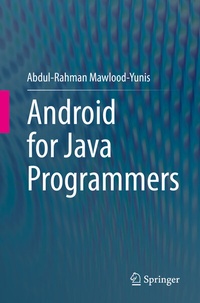
Android for Java Programmers
Description

This textbook is about learning Android and developing native apps using the Java programming language. It follows Java and Object-Oriented (OO) programmers' experiences and expectations and thus enables them to easily map Android concepts to familiar ones.
Each chapter of the book is dedicated to one or more Android development topics and has one or more illustrating apps. The topics covered include activities and transitions between activities, Android user interfaces and widgets, activity layouts, Android debugging and testing, fragments, shared preferences, SQLite and firebase databases, XML and JSON processing, the content provider, services, message broadcasting, async task and threading, the media player, sensors, Android Google maps, etc.
The book is intended for introductory or advanced Android courses to be taught in one or two semesters at universities and colleges. It uses code samples and exercises extensively to explain and clarify Android coding and concepts. It is written for students and programmers who have no prior Android programming knowledge as well as those who already have some Android programming skills and are excited to study more advanced concepts or acquire a deeper knowledge and understanding of Android programming. All the apps in the book are native Android apps and do not need to use or include third-party technologies to run.
More details
Other editions
Additional editions
Person
Content
1. Java Review.- 2. Getting Started with Android.- 3. Your First Android Application.- 4. Debugging and Testing Using Junit, Espresso, and Mockito Frameworks.- 5. Activity Lifecycle and Passing Objects Between Screens Using Parcelable Interface.- 6. User Interface Essential Classes, Layouts, Styles, Themes, and Dimensions.- 7. ListView, ScrollList, Date and Time Pickers, and RecyclerView.- 8. Toolbar, Menu, Dialog Boxes, Shared Preferences, Implicit Intent, and Directory Structure.- 9. Fragments, Dynamic Binding, Inheritance, Pinching, and Screen Swiping.- 10. Parsing Remote XML and JSON Files, Using HTTPUrlConnection, XmlPullParser, and AsyncTask.- 11. Android SQLite, Firebase, and Room Databases.- 12. Content Provider, Service, Message Broadcasting, and MultimediaPlayer.- 13. Sensors, Location-Based Service, and Google Maps.
