

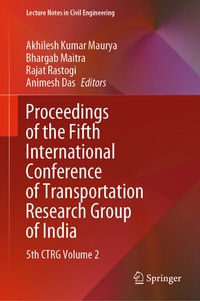
Proceedings of the Fifth International Conference of Transportation Research Group of India
5th CTRG Volume 2
1st Edition
Published on 5. March 2022
XXII, 558 pages
978-981-16-8259-9 (ISBN)
Description

This book (in three volumes) comprises the proceedings of the Fifth Conference of Transportation Research Group of India (CTRG2019) focusing on emerging opportunities and challenges in the field of transportation of people and freight. The contents of the volume include characterization of conventional and innovative pavement materials, operational effects of road geometry, user impact of multimodal transport projects, spatial analysis of travel patterns, socio-economic impacts of transport projects, analysis of transportation policy and planning for safety and security, technology enabled models of mobility services, etc. This book will be beneficial to researchers, educators, practitioners and policy makers alike.
More details
Series
Language
English
Place of publication
Singapore
Singapore
Publishing group
Springer Singapore
Target group
Professional and scholarly
Product notice
Reflowable
Illustrations
XXII, 558 p. 227 illus., 185 illus. in color.
File size
16,47 MB
ISBN-13
978-981-16-8259-9 (9789811682599)
DOI
10.1007/978-981-16-8259-9
Schweitzer Classification
Other editions
Additional editions
Akhilesh Kumar Maurya | Bhargab Maitra | Rajat Rastogi
Proceedings of the Fifth International Conference of Transportation Research Group of India
5th CTRG Volume 2
Book
03/2022
Springer
€235.39
Shipment within 3-4 weeks
Persons
Dr. Akhilesh Kumar Maurya is currently Professor in Department of Civil Engineering at Indian Institute of Technology (IIT) Guwahati, India. He received his Ph.D. degree in Civil Engineering from Indian Institute of Technology (IIT) Kanpur and M. Tech. degree in Computer Aided Design from Indian Institute of Technology (IIT) Roorkee. He is active academically and professionally in the area of traffic flow modeling, driver behavior, road safety audit and accident analysis, traffic data collection and analysis studies since more than one decade. He has published more than 95 technical papers in international journals and conferences. He has received the DAAD fellowship for one month visited at Technische Universität Darmstadt. He is currently President of "Transportation Research Group (TRG)" of India, member of World Conference on Transport Research Society (WCTRS) and the life member of "Indian Roads Congress". He is also certified "Road safety Auditor" by International Road Federation (India) and Australian Road Research Board. Apart from several Indian Institutions, he has also delivered invited lectures at various International Institutes like Technische Universität Berlin, Technische Universität Darmstadt, University Duisburg-Essen and National University of Singapore.
Dr. Bhargab Maitra is currently a Professor in Department of Civil Engineering, and former Head of RCG School of Infrastructure Design and Management, Indian Institute of Technology (IIT) Kharagpur, India. His research interest includes travel behavior analysis, public transportation system, sustainable transportation, traffic management & control, road safety, and transport policy. He has published nearly 150 technical papers and case studies in various journals and proceedings of conferences, seminars and workshops. He has carried out several sponsored research and consultancy projects in the area of traffic and transportation system. He has been instrumental inleading the large interdisciplinary mega project "Future of Cities" involving more than 40 researchers across several departments and institutes in India and abroad. He is an Alexander von Humboldt Fellow and DAAD Fellow. He also received Pt. Jawaharlal Nehru Birth Centenary Award from the Indian Roads Congress.
Dr. Rajat Rastogi is presently working as Professor in the Department of Civil Engineering at Indian Institute of Technology (IIT) Roorkee. He has a research and teaching experience of 31 years in the area of Transportation Engineering. He pursued his Ph.D. from IIT Bombay and M.E. (Highways) and B.E. (Civil Engineering) from Punjab Engineering College, India. His research interests are in pedestrian and non-motorized traffic, travel behavior and its modelling, integration of transportation systems, policy analysis, traffic flow analysis and road safety. He has published over 125 papers in journals and conferences. He has supervised 7 Ph.D. theses and35 M.Tech. theses. He is a member of professional bodies like IRC, TRG of India, IUT, and IGS. He also worked as a core member in the development of Indian Highway Capacity Manual (Indo-HCM). Presently he is a member of IRC H-1 and H-8 committee and Co-convenor of G-6 committee. The present work on public transport, active transportation and pedestrian flows on escalators will be of value for relevant IRC documents or codes.
Dr. Animesh Das is a Professor in the Department of Civil Engineering, IIT Kanpur. Dr. Das's area of expertise is pavement material characterization, analysis, design, and evaluation. He is interested in both theoretical as well as experimental studies. He has worked on problems related to characterization of asphalt mix and aggregates, asphalt recycling, asphalt micromechanics, microstructure and image analysis of asphaltic material, pavement design optimization, pavement surface characterization etc. He has published several papers in various journals and conference proceedings of repute.
Dr. Bhargab Maitra is currently a Professor in Department of Civil Engineering, and former Head of RCG School of Infrastructure Design and Management, Indian Institute of Technology (IIT) Kharagpur, India. His research interest includes travel behavior analysis, public transportation system, sustainable transportation, traffic management & control, road safety, and transport policy. He has published nearly 150 technical papers and case studies in various journals and proceedings of conferences, seminars and workshops. He has carried out several sponsored research and consultancy projects in the area of traffic and transportation system. He has been instrumental inleading the large interdisciplinary mega project "Future of Cities" involving more than 40 researchers across several departments and institutes in India and abroad. He is an Alexander von Humboldt Fellow and DAAD Fellow. He also received Pt. Jawaharlal Nehru Birth Centenary Award from the Indian Roads Congress.
Dr. Rajat Rastogi is presently working as Professor in the Department of Civil Engineering at Indian Institute of Technology (IIT) Roorkee. He has a research and teaching experience of 31 years in the area of Transportation Engineering. He pursued his Ph.D. from IIT Bombay and M.E. (Highways) and B.E. (Civil Engineering) from Punjab Engineering College, India. His research interests are in pedestrian and non-motorized traffic, travel behavior and its modelling, integration of transportation systems, policy analysis, traffic flow analysis and road safety. He has published over 125 papers in journals and conferences. He has supervised 7 Ph.D. theses and35 M.Tech. theses. He is a member of professional bodies like IRC, TRG of India, IUT, and IGS. He also worked as a core member in the development of Indian Highway Capacity Manual (Indo-HCM). Presently he is a member of IRC H-1 and H-8 committee and Co-convenor of G-6 committee. The present work on public transport, active transportation and pedestrian flows on escalators will be of value for relevant IRC documents or codes.
Dr. Animesh Das is a Professor in the Department of Civil Engineering, IIT Kanpur. Dr. Das's area of expertise is pavement material characterization, analysis, design, and evaluation. He is interested in both theoretical as well as experimental studies. He has worked on problems related to characterization of asphalt mix and aggregates, asphalt recycling, asphalt micromechanics, microstructure and image analysis of asphaltic material, pavement design optimization, pavement surface characterization etc. He has published several papers in various journals and conference proceedings of repute.
Content
- Intro
- Preface
- About TRG and CTRG
- List of Reviewers
- Contents
- About the Editors
- Estimation and Comparison of Saturation Flow at Signalized Intersection in Mixed Traffic Condition
- 1 Introduction
- 2 Objectives and Scope of Study
- 3 Literature Review
- 4 Study Area, Data Collection, and Extraction
- 5 Estimation of Saturation Flow
- 6 Discussions and Conclusions
- 6.1 Comparison of the Estimated Saturation Flow with the Saturation Flow Proposed by Different Authors
- 6.2 Conclusion
- 7 Future Scope
- References
- Value Capture Finance: An Innovative Tool for Financing Urban Rail Transit Projects
- 1 Introduction
- 2 VCF Methods in Practice
- 2.1 Land Value Tax
- 2.2 Fees for Change in Land Use
- 2.3 Betterment Levy
- 2.4 Development Charge (Impact Fee)
- 2.5 Transfer of Development Rights (TDR)
- 2.6 Premium on Additional FSI/FAR
- 2.7 Vacant Land Tax (VLT)
- 2.8 Tax Increment Financing (TIF)
- 2.9 Land Pooling System
- 3 Literature Study for VCF Implementation
- 3.1 International Case Studies
- 3.2 Indian Case Studies
- 4 Case Study of Nagpur Metro Phase II
- 4.1 Ridership and Fare Box Revenue
- 5 VCF Implementation in Nagpur
- 5.1 Study Methodology
- 6 Nagpur TOD Policy
- 6.1 Maximum Permissible FSI
- 6.2 Payable Premium
- 6.3 Permissibility of Mixed Use in NMRC
- 7 Real Estate Market Study
- 8 Revenue Assessment from VCF Sources
- 8.1 Premium on Sale of Additional FSI
- 8.2 Additional Surcharge on Property Transactions
- 8.3 Increase in Development Charge
- 9 VCF from Supply Side
- 9.1 Built-Up Area Estimation and Land Supply
- 9.2 Revenue Assessment
- 10 VCF from Demand Side
- 10.1 Methodology for Estimation of Residential Demand
- 10.2 Methodology for Estimation of Commercial Demand
- 10.3 Corridor-Wise Estimation of Residential and Commercial Demand
- 10.4 Revenue Assessment
- 11 Estimation of Revenue from Property Development
- 12 Financial Analysis
- 13 Conclusion
- References
- Analysis of the Key Determinants of Electric Two-Wheeler Use in the Indian Context
- 1 Introduction
- 2 Literature Review
- 3 Prioritization of Attributes
- 3.1 Data Collection
- 3.2 Analytical Hierarchy Process (AHP) Analysis
- 3.3 Results
- 4 Consistency Test
- 4.1 Friedman Test
- 5 Discussions
- 6 Conclusions
- References
- Speed and Headway Behaviour of Motorcycles on an Exclusive Motorcycle Lane
- 1 Introduction
- 2 Study Area and Data Collection
- 3 Speed Behaviour of Motorised Two-Wheelers
- 4 Headway Behaviour of MTW
- 4.1 Statistical Validation
- 5 Conclusions
- References
- Performance Evaluation and Enhancement of Unsignalized Intersection Using Microsimulation in VISSIM
- 1 Introduction
- 2 Literature Survey
- 3 Methodology
- 3.1 Data Requirements
- 3.2 Vehicle and Intersection Geometry Representation
- 3.3 Traffic Representation
- 3.4 Simulation with Default Parameters
- 3.5 Sensitivity Analysis
- 3.6 Latin Hypercube Sampling and Multiple Linear Regression
- 3.7 Model Optimization by Genetic Algorithm
- 3.8 Validation
- 3.9 Performance Evaluation
- 4 Study Area, Data Collection, and Analysis
- 4.1 Data Extraction
- 4.2 Development of VISSIM Model
- 4.3 Simulation with Default Parameters
- 4.4 Analysis of Variance
- 4.5 LHS and Multiple Linear Regression
- 4.6 Model Optimization Using GA
- 4.7 Validation
- 4.8 Performance Evaluation
- 4.9 Traffic Management Using Signal-Controlled Intersection
- 5 Conclusion
- References
- Modeling Phase Changing Behavior of Traffic Constables at Manually Controlled Intersection-A Case Study in India
- 1 Introduction
- 2 Literature Review
- 3 Methodology
- 3.1 Phase Change Model
- 3.2 Phase Change Model Validation
- 3.3 Determination of Critical Phase Times
- 4 Case Study
- 4.1 Calibration of Phase Change Model
- 4.2 Validation of Phase Change Model
- 4.3 Calculation of Critical Phase Times
- 5 Summary and Conclusion
- References
- Cost-Effective Analysis for Electric Vehicle (EV) Bus Procurement
- 1 Introduction
- 2 Background of the Study
- 3 Methodology
- 4 Major Components of Procurement and Operational Cost
- 4.1 Procurement and Operational Cost in Outright Purchase Model
- 4.2 Procurement and Operational Cost in GCC Model
- 4.3 Cost Calculations for GCC and Outright Purchase Model
- 5 Conclusion
- 6 Policy Implications and Recommendations
- 7 Limitations and Future Scope
- References
- Effect of Traffic Flow Characteristics on Saturation Flow at Signalized Intersections of Ahmedabad City
- 1 Introduction
- 2 Literature Review
- 3 Methodology
- 3.1 Pilot Survey
- 3.2 Data Collection
- 3.3 Data Extraction
- 4 Data Analysis
- 4.1 Traffic Composition
- 4.2 Determination of Saturated Green Time
- 4.3 Variation of Composition with Respect to PCU
- 5 Saturation Flow Model Development
- 6 Sensitivity Analysis
- 7 Model Validation
- 8 Modification of INDO HCM
- 8.1 Validation
- 9 Conclusion
- References
- Simulation-Based Optimization for Heterogeneous Traffic Control
- 1 Introduction
- 2 Review of Literature
- 2.1 Optimal Signal Control Design
- 2.2 Simulation-Based Optimization in Optimal Traffic Signal Control Design
- 3 Study Area and Input Data
- 4 Methodology
- 4.1 Problem Formulation
- 4.2 Implementation of SO Algorithm
- 5 Results and Discussion
- 5.1 Signal Design Using Conventional Webster and HCM Methods
- 5.2 Signal Design Based on the Proposed SO Method
- 6 Summary
- References
- Intersection Identification Using Large-Scale Vehicle Trajectory Data
- 1 Introduction
- 2 Methodology
- 2.1 Turning Point Extraction
- 2.2 Density-Based Clustering
- 2.3 Cluster Analysis
- 3 Experiment
- 3.1 Data Used
- 3.2 Turning Point Extraction and Clustering
- 3.3 DDI and TDI Filtering
- 4 Results
- 5 Conclusion
- References
- Crowd Density Prediction Using Kalman Filtering Technique
- 1 Introduction
- 2 Literature Review
- 3 Study Location, Data Collection and Extraction
- 4 Analysis
- 4.1 Comparison of Densities
- 4.2 Predicting Densities Using KFT
- 4.3 Corroboration of Results
- 5 Conclusion
- References
- Calibration and Validation of VISSIM Parameters in Mixed Traffic
- 1 Introduction
- 2 Literature Review
- 2.1 The Merging Process
- 2.2 Modeling the Merging Capacity
- 2.3 Usage of VISSIM to Simulate Mixed Traffic
- 2.4 Gaps in Literature Review Pertaining to Mixed Traffic
- 3 Data Collection and Network Development in VISSIM
- 3.1 Field Data Collection
- 3.2 VISSIM Network Development
- 4 Calibration and Validation
- 4.1 Identification of Sensitive Parameters
- 4.2 Calibration of VISSIM Parameters
- 4.3 Validation of VISSIM Model
- 5 Effect of Ramp Traffic
- 6 Conclusion
- Appendix
- References
- Lateral Gap Maintaining Behaviour of Vehicles from Road Median
- 1 Introduction
- 2 Background
- 2.1 Impact of Median Divider/Shoulder on Lateral Placement of Vehicles
- 2.2 Impact of Operating Speed on Lateral Placement of Vehicles
- 3 Motivation and Objective
- 4 Study Methodology and Data Collection
- 5 Model Development and Validation
- 6 Concluding Remarks
- References
- Assessment of Impact of Roadside Bus-Stops on Capacity of Urban Divided Roads Using Microscopic Simulation Model
- 1 Introduction
- 2 Data Collection and Extraction
- 3 Development of Simulation Model
- 3.1 Vehicle Generation
- 3.2 Vehicle Placement
- 3.3 Vehicle Movement
- 3.4 Object Oriented Programming Concepts
- 4 Model Calibration and Validation
- 5 Estimation of Capacity Reduction Due to Bus-Stops
- 5.1 Modification of the Model to Implement Bus-Stop
- 5.2 Validation of Bus-Stop Model and Estimation of Capacity Reduction
- 5.3 Effect of Change in Proportion of Buses on Capacity and Speed
- 6 Summary and Conclusions
- References
- State-of-Art on Data Mining and Microscopic Simulation Techniques for Evaluation of Urban Uncontrolled Intersections
- 1 Introduction
- 2 Methodology Followed for the Literature Investigation
- 3 State-of-Art on Soft Computing and Non-parametric Machine Learning/Data Mining Techniques for Performance Evaluation
- 4 State-of-Art on Microscopic Traffic Flow Simulation Techniques for Performance Evaluation
- 5 Conclusion
- References
- Assessing Spatial Accessibility to Amenities, Facilities, and Services from Public Transit Using Non-motorized Transport: A Case of Nagpur City
- 1 Introduction
- 1.1 Relevance of the Study
- 2 Measures and Indicators
- 3 Study Area and Data Sources
- 4 Data Analysis
- 4.1 Macro-level Accessibility Analysis
- 4.2 Micro-level Accessibility Analysis
- 5 Discussion and Conclusion
- References
- Study of Driver's Behavior for Lateral Moving Vehicles
- 1 Introduction
- 2 Literature Review
- 3 Methodology
- 3.1 Site Selection
- 3.2 Data Collection
- 3.3 Data Extraction
- 4 Data Analysis
- 5 Conclusion
- References
- Evaluation of Queue Discharge and Lane Occupancy Due to Seepage Behaviour of Small Sized Vehicles at Intersection
- 1 Introduction
- 2 Literature Review
- 3 Methodology
- 3.1 Study Location and Data Collection
- 3.2 Data Extraction and Analysis
- 3.3 Representation of the Queue Area and Area Occupied by the Vehicles and Effective Utilization of the Queue Area by the Vehicles
- 3.4 Determination of Variance in Lateral Movement and Lane Changing Behaviour of Vehicles
- 4 Observed Seepage Behaviour at Intersection in Each Cycle of Signal Timing
- 5 Results and Conclusion
- References
- Transit-Oriented Development to, for, and in Delhi
- 1 Transit-Oriented Development: Living with Transit
- 2 Need for TOD Measurement Tool
- 3 What Is TOD to Delhi?
- 4 TOD Definition for Delhi
- 5 What Are the Existing Levels of TOD in Delhi?
- 6 What's Next? Action Plans!
- 7 Conclusions
- References
- Study on Impact of Newly Opened NH 66 Bypass in Kollam City
- 1 Introduction
- 1.1 Study Area
- 2 Literature Review
- 3 Study Objectives
- 4 Methodology Adopted for the Study
- 4.1 Data Collection
- 4.2 Data Analysis
- 5 Existing Situation Analysis
- 5.1 Road Network Characteristics
- 5.2 Speed and Delay Characteristics
- 5.3 Causes of Delay
- 5.4 Traffic Volume at Major Intersections
- 5.5 Vehicle Crash Data of NH Bypass
- 5.6 Road Safety Audit (RSA)
- 6 Impact Analysis
- 6.1 Travel Speed and Travel Time
- 6.2 Volume-Capacity Ratio (V/C Ratio)
- 6.3 Vehicle Operating Cost (VOC)
- 6.4 Pedestrian Safety on NH 66
- 6.5 Vehicle Crashes in NH 66
- 7 Recommended Proposals for Safety Issues on Bypass Road
- 8 Conclusions
- References
- Development of Speed Management Measures at Uncontrolled Intersection
- Case Study of Hyderabad, India
- 1 Introduction
- 2 Objectives of the Study
- 3 Methodology
- 3.1 Study Area Selection
- 3.2 Data Collection
- 3.3 Spot Speed Data Presentation
- 3.4 Spot Speed Data Distribution and Temporal Analysis
- 4 Result and Analysis
- 5 Conclusion
- References
- Objective and Subjective Approaches Towards Analysis of Level of Service of Sidewalks
- 1 Introduction
- 2 Study Area
- 3 Methodology
- 3.1 Perceptual Data/Subjective Data Collection
- 3.2 Selection of Factors Affecting PLOS
- 3.3 Design of Questionnaire Survey
- 3.4 Pilot Study
- 3.5 Final Questionnaire and Process of Data Collection
- 3.6 Sampling Method Adopted
- 3.7 Determination of Sample Size
- 3.8 Objective Data Collection
- 4 Formulation of Indices
- 4.1 Choosing Factors from Literature
- 4.2 Finding Association
- 4.3 Checking for Correlation
- 4.4 Statistical Confirmation of Groups
- 4.5 Normalization and Aggregation of Factors to Form Indices
- 5 Results and Discussion
- 5.1 Socio-Demographic Characteristics of Respondents
- 5.2 Distribution of Perceived PLOS Categories Before and After Evaluation
- 5.3 Objective and Subjective Factors
- 5.4 Association of Objectively Measured Factors with PLOS
- 5.5 Association of Subjectively Measured Factors with PLOS
- 5.6 Association of Objectively and Subjectively Measured Factors with Pedestrian Level of Service
- 5.7 Association of Objectively and Subjectively Measured Factors with Pedestrian Level of Service
- 6 Conclusion
- References
- Development of Public Transport Serviceability Index for Metro Cities-A Case Study of Kochi City
- 1 Introduction
- 2 Scope and Objectives
- 3 Literature Review
- 4 Study Area
- 5 Methodology
- 5.1 General
- 6 Data Collection
- 6.1 Expert Opinion Survey
- 6.2 Passenger Opinion Survey
- 7 Preliminary Data Analysis
- 8 Estimation of Sustainability Indicators and Sustainability Integration Indices for the Study Area
- 9 Estimation of Public Transport Serviceability Index
- 10 Conclusions
- References
- Economic Evaluation of a Highway Project Using HDM-4: A Case Study of Widening of Ahmedabad-Bagodara National Highway
- 1 Introduction
- 1.1 Literature Review
- 1.2 Methods of Economic Evaluation
- 1.3 Introduction to HDM-4
- 2 Research Objective
- 3 Methodology
- 4 Data Collection
- 4.1 Study Area Profile
- 4.2 Road Inventory
- 4.3 Traffic Survey
- 4.4 Pavement Condition Survey
- 4.5 Pavement Composition and Soil CBR
- 4.6 Topographical Data
- 4.7 Petrol-Pump Sales Data
- 5 Capacity Analysis
- 6 Economic Evaluation Using IRC SP:30-2009
- 6.1 Traffic Forecast
- 6.2 Congestion Factors
- 6.3 Vehicle Operating Costs
- 6.4 Economic Evaluation
- 6.5 Sensitivity Analysis
- 7 Economic Evaluation Using HDM-4
- 7.1 Sectioning of the Study Area
- 7.2 Construction and Analysis Period
- 7.3 Project Cost
- 7.4 Standard Conversion Factors
- 7.5 Traffic Composition Data
- 7.6 HDM-4 Calibration Parameters
- 7.7 Road Network Data
- 7.8 Vehicle Fleet Data
- 7.9 HDM-4 Configuration
- 7.10 Unit Costs for Vehicles
- 7.11 Maintenance Strategy and Cost
- 7.12 Results of Economic Evaluation
- 7.13 Sensitivity Analysis
- 8 Conclusions
- References
- BPNN (ANN) Based Operating Speed Models for Horizontal Curves Using Naturalistic Driving Data
- 1 Introduction
- 2 Speed Models
- 3 Data Collection
- 3.1 Speed Data
- 3.2 Geometric Data
- 4 Development of ANN (BPNN) Model
- 5 Relative Influence (%) of Geometric Parameters on Vp
- 6 Conclusions
- References
- Modification of NPV Value Based on Real Option Study
- 1 Introduction
- 2 Limitations of NPV Analysis Approach
- 3 Real Options Analysis
- 4 Case Study
- 4.1 Traffic Uncertainty
- 4.2 Binomial Lattice Model
- 4.3 Leakage Rate
- 4.4 Option Value Calculation
- 4.5 Monte Carlo Simulation Technique
- 5 Analysis of Results
- 6 Conclusion
- Annexure 1
- References
- Impact of Foot Over Bridge (FOB) Upgradation Over Pedestrian Movement: A Case Study of Guwahati City
- 1 Introduction
- 2 Data Collection and Analysis
- 2.1 Data Collections Sites
- 2.2 Extraction and Analysis of Data
- 2.3 Model Development
- 3 Conclusion and Application
- References
- Effect of Two-Wheeler Proportion on Passenger Car Unit at Urban Signalised Intersections
- 1 Introduction
- 2 Literature Review
- 3 Study Methodology
- 4 Data Collection
- 5 Data Analysis and Results
- 5.1 PCU Estimation
- 5.2 Saturation Flow and Unit Base Saturation Flow Rate Determination
- 5.3 Bus Blockage Adjustment
- 5.4 Capacity and V/C Ratio Determination
- 5.5 Simulation Modelling
- 6 Conclusion
- References
- Influence of Platooning of Heavy Transport Vehicles Operation on Traffic Flow Mix of Intercity Highways
- 1 Introduction
- 2 Literature Review
- 3 Data Collection
- 4 Data Analysis and Results
- 4.1 Speed Statistics of Vehicles
- 4.2 Speed Versus Time Headway Analysis
- 4.3 Passenger Car Unit (PCU) Estimation
- 4.4 Temporal Variation of Traffic Flow
- 4.5 HTVs' Platooning Operation in Different Lanes
- 5 Conclusion
- References
- Determination of Service Quality of Bus Transit System Using SERVQUAL Method Based on User's Perceptions and Expectations
- 1 Introduction
- 2 Case Study Area and Selection of Transit System
- 3 Methodology
- 4 Results and Discussion
- 5 Conclusion
- References
- Impact of Street Design and Operational Factors on Level of Satisfaction of Green Transport Users in a Large Metropolitan Area
- 1 Green Transport Scenario
- 1.1 Background and Need for the Study
- 2 Current Status in NMT Research
- 2.1 Application of Users' Satisfaction Analysis in NMT Decision-Making Process
- 2.2 Modeling User Satisfaction for NMT Users
- 3 Study Design
- 3.1 Scope
- 3.2 Study Area
- 4 Methodology
- 4.1 Selection of Attributes Affecting Overall Satisfaction of Individual NMT Users
- 4.2 Survey Design and Data Collection
- 4.3 Methodology for Statistical Analysis
- 5 Descriptive Findings from Collected Responses
- 5.1 Assessment of Travel Characteristics for Pedestrians
- 5.2 Assessment of Travel Characteristics for Cycle/e-Rickshaw Users
- 6 Modeling NMT User Satisfaction
- 6.1 Attributes Impacting Overall Pedestrian Satisfaction
- 6.2 Improving Level of Satisfaction-ORA Exercise
- 7 Conclusion
- References
- Lateral Placement of Vehicles Under Mixed Traffic in Indian Urban Scenario
- 1 Introduction
- 2 Data Collection and Analysis
- 3 Capacity of Roadway Section
- 4 Methodology for Calibration
- 5 Calibration of Speed Data
- 6 Modelling Lateral Clearance of Vehicles
- 7 Percentile Variation of Speed Versus Lateral Clearance
- 8 Conclusions
- References
- Trajectory Data and Driver Behavior Analysis at Urban Mid-Block Section
- 1 Introduction
- 1.1 Objectives
- 2 Literature Review
- 2.1 Gaps in the Literature
- 3 Study Area and Methodology
- 3.1 Longitudinal Flow Characteristics
- 3.2 Lateral Flow Characteristics
- 3.3 Lateral Amplitude
- 4 Summary and Conclusions
- References
- Dynamics of Rental Prices and Land Value Relative to Changes in Transportation Infrastructure
- 1 Introduction
- 1.1 Background Information on Transportation in Mumbai
- 2 Models
- 2.1 Data Collection
- 2.2 Survey Descriptive and Results
- 3 Discussion
- References
- Control Delay Estimation at Signalized Intersections Using Vehicular Trajectory Data
- 1 Introduction
- 2 Data Analysis
- 2.1 Data Collection
- 2.2 Data Extraction
- 2.3 Preliminary Analysis
- 3 Delay Estimation
- 3.1 GPS Probe Vehicle-Based Delay Estimation
- 3.2 Field Traffic Trajectory-Based Delay Estimation.
- 3.3 Delay Estimation Models
- 3.4 Guidelines-Based Delay Estimation
- 4 Results
- 5 Conclusion and Summary
- References
