

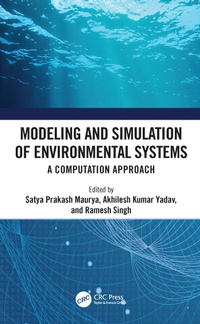
Modeling and Simulation of Environmental Systems
A Computation Approach
1st Edition
Published on 24. August 2022
376 pages
978-1-000-62663-6 (ISBN)
Description

This book presents an overview of modeling and simulation of environmental systems via diverse research problems and pertinent case studies. It is divided into four parts covering sustainable water resources modeling, air pollution modeling, Internet of Things (IoT) based applications in environmental systems, and future algorithms and conceptual frameworks in environmental systems. Each of the chapters demonstrate how the models, indicators, and ecological processes could be applied directly in the environmental sub-disciplines. It includes range of concepts and case studies focusing on a holistic management approach at the global level for environmental practitioners.
Features:
Covers computational approaches as applied to problems of air and water pollution domain.
Delivers generic methods of modeling with spatio-temporal analyses using soft computation and programming paradigms.
Includes theoretical aspects of environmental processes with their complexity and programmable mathematical approaches.
Adopts a realistic approach involving formulas, algorithms, and techniques to establish mathematical models/computations.
Provides a pathway for real-time implementation of complex modeling problem formulations including case studies.
This book is aimed at researchers, professionals and graduate students in Environmental Engineering, Computational Engineering/Computer Science, Modeling/Simulation, Environmental Management, Environmental Modeling and Operations Research.
Features:
Covers computational approaches as applied to problems of air and water pollution domain.
Delivers generic methods of modeling with spatio-temporal analyses using soft computation and programming paradigms.
Includes theoretical aspects of environmental processes with their complexity and programmable mathematical approaches.
Adopts a realistic approach involving formulas, algorithms, and techniques to establish mathematical models/computations.
Provides a pathway for real-time implementation of complex modeling problem formulations including case studies.
This book is aimed at researchers, professionals and graduate students in Environmental Engineering, Computational Engineering/Computer Science, Modeling/Simulation, Environmental Management, Environmental Modeling and Operations Research.
More details
Edition
1. Auflage
Language
English
Place of publication
London
United Kingdom
Publishing group
Taylor & Francis Ltd
Target group
Professional and scholarly
College/higher education
Product notice
Reflowable
Illustrations
61 Tables, black and white; 72 Line drawings, black and white; 23 Halftones, black and white; 95 Illustrations, black and white
ISBN-13
978-1-000-62663-6 (9781000626636)
Copyright in bibliographic data and cover images is held by Nielsen Book Services Limited or by the publishers or by their respective licensors: all rights reserved.
Schweitzer Classification
Other editions
Additional editions
Satya Prakash Maurya | Akhilesh Kumar Yadav | Ramesh Singh
Modeling and Simulation of Environmental Systems
A Computation Approach
Book
11/2024
1st Edition
CRC Press
€72.30
Shipment within 10-20 days
Satya Prakash Maurya | Akhilesh Kumar Yadav | Ramesh Singh
Modeling and Simulation of Environmental Systems
A Computation Approach
Book
08/2022
1st Edition
CRC Press
€207.30
Shipment within 10-20 days
Persons
Satya Prakash Maurya earned his B. Tech. in Computer Science & Engineering, M. Tech. in GIS & RS. He completed his PhD in Geoinformatics under the research domain of Spatial Decision Support System from Indian Institute of Technology (BHU), Varanasi (India). He has also studied Civil Engineering from IEI (India), Kolkata. He has worked as an Assistant Professor in CSED at PCE, Jaipur (India) with a research interest in computational approach in machine learning, data modeling, expert systems and artificial intelligence with application of urban water modeling and futuristic prediction and soft computing. Presently, he is working as a Project Scientist-I in NSDI funded project at IIT (BHU). He has published a number of research papers and is also a reviewer for a few reputed journals. He is also an associate member in professional bodies such as the International Association of Engineers, the_IRED, USA and IEI, India.
Akhilesh Kumar Yadav earned his B. Tech. in Electronics and Communication Engineering from Chaudhary Charan Singh University, Meerut, India; M. Tech. in Environmental Engineering from Madan Mohan Malaviya Engineering College, Gorakhpur (Dr. APJ AKTU, Lucknow), India; and Doctoral degree with research domain of air pollution from Indian Institute of Technology (BHU) Varanasi, India. His research interests are air pollution, climate change, vulnerability, and human health risk assessments, and GIS applications in air pollution management. He has received the Young Engineer Award by the Institution of Engineers (India), Kolkata in 2017 and published articles in peer-reviewed journals and serves as a reviewer for reputed journals. He is an active member of reputed international professional bodies such as the Institution of Engineers (India), Kolkata; Engineering Council of India, New Delhi; Association of Environmental Analytical Chemistry of India, Mumbai.
Ramesh Singh earned his B.Tech in Civil Engineering with a Gold Medal from IT-BHU, Varanasi and M.S. in Sanitary Engineering from IHE Netherland. He worked as field engineer for 37+ years with Govt. of U.P. (India) and was involved with planning and implementation of various national and foreign aided projects for abatement works of rivers and lakes, and urban and rural water supply and environmental sanitation. He has worked as Visiting Faculty in Civil Engineering at IIT(BHU), Varanasi. Presently, he is engaged as Technical Advisor of Kokusai Kogyo Co. Ltd, Tokyo, Japan and Directorate Environment and Climate Change, Govt. of Manipur (India). He has published a few research papers and is also a reviewer for reputed journals. He is fellow member of Indian Water Works Association (India), life member of Institution of Engineers (India), Indian Association of Environmental Management and The Indian Concrete Journal.
Akhilesh Kumar Yadav earned his B. Tech. in Electronics and Communication Engineering from Chaudhary Charan Singh University, Meerut, India; M. Tech. in Environmental Engineering from Madan Mohan Malaviya Engineering College, Gorakhpur (Dr. APJ AKTU, Lucknow), India; and Doctoral degree with research domain of air pollution from Indian Institute of Technology (BHU) Varanasi, India. His research interests are air pollution, climate change, vulnerability, and human health risk assessments, and GIS applications in air pollution management. He has received the Young Engineer Award by the Institution of Engineers (India), Kolkata in 2017 and published articles in peer-reviewed journals and serves as a reviewer for reputed journals. He is an active member of reputed international professional bodies such as the Institution of Engineers (India), Kolkata; Engineering Council of India, New Delhi; Association of Environmental Analytical Chemistry of India, Mumbai.
Ramesh Singh earned his B.Tech in Civil Engineering with a Gold Medal from IT-BHU, Varanasi and M.S. in Sanitary Engineering from IHE Netherland. He worked as field engineer for 37+ years with Govt. of U.P. (India) and was involved with planning and implementation of various national and foreign aided projects for abatement works of rivers and lakes, and urban and rural water supply and environmental sanitation. He has worked as Visiting Faculty in Civil Engineering at IIT(BHU), Varanasi. Presently, he is engaged as Technical Advisor of Kokusai Kogyo Co. Ltd, Tokyo, Japan and Directorate Environment and Climate Change, Govt. of Manipur (India). He has published a few research papers and is also a reviewer for reputed journals. He is fellow member of Indian Water Works Association (India), life member of Institution of Engineers (India), Indian Association of Environmental Management and The Indian Concrete Journal.
Content
1. Computational models for water resource management: opportunities and challenges
2. Applicability of Soft Computational Models for Integrated Water Resource Management
3. Computational Models for Exchange of Water between Ground Water and Surface Water Resources over a Sub-basin
4. Computational and Field Approach to Assess Artificial Recharge of Groundwater
5. Multi-Objective Optimization in Water Resource Management
6. Tools in Decision Making of Allocation of Non-traditional Resources for Sustainable Water Development
7. Soft Computing Techniques for Forecasting of Water Demand
8. Intervention of Computational Models for Groundwater Pollution Source Characterization
9. Artificial Intelligence for Air Quality and Control Systems: Status and Future Trends
10. Fuzzy and Neural Network Model based Environmental Quality Monitoring System: Past, Present, and Future
11. Internet of Things (IoT) - Powered Enhancements to Industrial Pollution Monitoring Systems
12. Impact of Temporary COVID-related lockdowns on air quality across the globe: A systematic review
13. Impact of Lockdown on Air Quality during COVID-19 Outbreak: A Global Scenario
14. Integration of Geospatial Techniques in Environment Monitoring Systems
15. Agent Based Modeling for Integrated Urban Water Management
16. Data-Driven Modelling Approach in Model Rainfall-Runoff for a Mountainous Catchment
17. Geospatial Technology-based Artificial Groundwater Recharge Site Selection for Sustainable Water Resource Management: A Case Study of Rajkot District, Gujarat
18. Rainfall-Runoff Estimation for Rapti River Catchment Using Geospatial Technology
19. Methodologies of Scenario Development for Water Resource Management: A Review
20. Process-based Scenario Analyses of Future Socio-environmental Systems: Recent Efforts and a Salient Research Agenda for Decision Making
21. From Quantitative to Qualitative Environmental Analyses: Translating Mental Modeling into Physical Modeling
22. An Interdisciplinary Modeling Approach for Dynamic Adaptive Policy Pathways
2. Applicability of Soft Computational Models for Integrated Water Resource Management
3. Computational Models for Exchange of Water between Ground Water and Surface Water Resources over a Sub-basin
4. Computational and Field Approach to Assess Artificial Recharge of Groundwater
5. Multi-Objective Optimization in Water Resource Management
6. Tools in Decision Making of Allocation of Non-traditional Resources for Sustainable Water Development
7. Soft Computing Techniques for Forecasting of Water Demand
8. Intervention of Computational Models for Groundwater Pollution Source Characterization
9. Artificial Intelligence for Air Quality and Control Systems: Status and Future Trends
10. Fuzzy and Neural Network Model based Environmental Quality Monitoring System: Past, Present, and Future
11. Internet of Things (IoT) - Powered Enhancements to Industrial Pollution Monitoring Systems
12. Impact of Temporary COVID-related lockdowns on air quality across the globe: A systematic review
13. Impact of Lockdown on Air Quality during COVID-19 Outbreak: A Global Scenario
14. Integration of Geospatial Techniques in Environment Monitoring Systems
15. Agent Based Modeling for Integrated Urban Water Management
16. Data-Driven Modelling Approach in Model Rainfall-Runoff for a Mountainous Catchment
17. Geospatial Technology-based Artificial Groundwater Recharge Site Selection for Sustainable Water Resource Management: A Case Study of Rajkot District, Gujarat
18. Rainfall-Runoff Estimation for Rapti River Catchment Using Geospatial Technology
19. Methodologies of Scenario Development for Water Resource Management: A Review
20. Process-based Scenario Analyses of Future Socio-environmental Systems: Recent Efforts and a Salient Research Agenda for Decision Making
21. From Quantitative to Qualitative Environmental Analyses: Translating Mental Modeling into Physical Modeling
22. An Interdisciplinary Modeling Approach for Dynamic Adaptive Policy Pathways
