

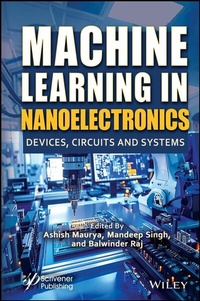
Machine Learning in Nanoelectronics
Description

Bridge the gap between advanced algorithms and hardware innovation with this essential book, which details how machine learning is being used to overcome challenges in nanoelectronics while laying the critical groundwork for the future of neuromorphic computing hardware.
New techniques for obtaining insights from enormous amounts of data and efficiently acquiring smaller data sets are provided by recent developments in machine learning. Researchers in nanoscience and nanoelectronics are experimenting with these tools to tackle challenges across many fields. Nanoscience and nanoelectronics not only advance machine learning but also lay the groundwork for neuromorphic computing hardware to broaden machine learning algorithm implementation. This book is a collection of possibilities for machine learning in nanoelectronics, semiconductor devices, and based circuits. With an easy-to-understand approach, this book explores the latest in machine learning in nanoelectronics materials and nanoscale devices through insights and analysis of recent developments in nanoelectronics.
More details
Other editions
Additional editions
Content
Preface xiii
1 Introduction to Machine Learning in Nanoelectronics 1 Bandi Srinivasa Rao, Rangana Bhanu Meher Srinivas, Kenguva Sai Chandar Rao, Mandeep Singh, Anil Kumar Yadav, Balwinder Raj and Tarun Chaudhary
1.1 Introduction 2
1.1.1 The Need for Advanced Modeling in Nanoelectronics 2
1.1.2 Scope of Machine Learning Applications in Semiconductors 4
1.2 Evolution of Nanoelectronics: From Macroscale to Nanoscale 4
1.2.1 Moore's Law, Transistor Scaling Challenges 4
1.2.2 Physical Scaling Limits in Nanoscale Devices 7
1.2.3 Various Nanoscale Device Technologies 9
1.2.4 Machine Learning's Role in Overcoming Scaling Barriers 11
1.3 Machine Learning in Nanoscale Device Simulation 11
1.3.1 Traditional Simulation Techniques 12
1.3.1.1 Drift-Diffusion Model (DDM) 12
1.3.1.2 Monte Carlo (MC) Simulations 13
1.3.1.3 Non-Equilibrium Green's Function (NEGF) Method 15
1.3.1.4 Molecular Dynamics (MD) 16
1.3.1.5 Quantum Mechanical Models: Density Functional Theory (DFT) and Tight-Binding (TB) Models 17
1.3.2 Surrogate Modeling for Device Behaviour 18
1.3.2.1 Acceleration of Quantum Simulations 18
1.3.2.2 Design Space Exploration and Optimization 19
1.3.2.3 Handling Variability and Defects 19
1.3.2.4 Transfer Learning for New Materials and Devices 19
1.3.2.5 Real-Time Parameter Tuning 20
1.4 Process Optimization in Semiconductor Manufacturing 21
1.4.1 Variability and Yield in Nanoscale Manufacturing 21
1.4.2 Real-Time Process Control with ml 22
1.4.3 Case Study: Graph-Based Yield Prediction in IC Manufacturing 24
1.4.4 Reliability, Fault Detection and Self-Heating Systems 24
1.5 Case Study: Machine Learning in Nanowire Tunnel FET Design 25
1.5.1 Device Structure 25
1.5.2 Machine Learning Approach 27
1.5.3 Design Space Exploration 28
1.5.4 Predictive Modeling 28
1.5.5 Process Variation Mitigation 28
1.6 Future Directions and Challenges 29
1.7 Conclusion 31
Summary 32
References 32
2 Machine Learning to Explore Opportunities in Quantum 43 Jyoti Khandelwal
2.1 Introduction to Quantum Opportunities 44
2.2 Understanding Quantum Data 46
2.3 Machine Learning Techniques for Quantum Applications 49
2.4 Case Studies and Applications 57
2.5 Tools and Frameworks for Implementation 60
2.6 Challenges and Opportunities in QML 63
2.7 Conclusion 63
References 64
3 Machine Learning (ML) and Nanotechnology to Heal Cancer: A Review 67 Anshu Srivastava and Shakun Srivastava
3.1 Introduction 69
3.2 Predictive Modelling and Machine Learning's Application in Cancer Diagnostics 69
3.2.1 Diagnosis of Cancer 69
3.2.2 Treatment Planning 71
3.3 Customized Medical Care 72
3.3.1 Overview of Machine Learning in Healthcare 73
3.3.2 Machine Learning Applications in Cancer Therapy 74
3.3.3 Nanotechnology Applications in Cancer Therapy 76
3.4 Result and Future Perspective 77
References 79
4 Multiplexing the Brain Signals for Low Power Robust Electrode Sensing in Medical Diagnosis 89 Sarin Vijay Mythry, Dinesh N., Asha V Thalange, Chakradhar Adupa, Nanditha Krishna, Praveen Kumar Reddy and Madhuri Gummineni
4.1 Introduction 90
4.2 Methodology 94
4.3 Simulation Results 96
4.4 Conclusion 104
References 104
5 Hardware Architectures and Optimization Techniques for Convolutional Neural Network Accelerators 113 Hemkant Nehete, Gaurav Verma, Amit Monga, Alok Kumar Shukla, Shailendra Yadav and Brajesh Kumar Kaushik
5.1 Introduction 114
5.2 Computational Complexities of Convolutional Neural Networks 115
5.3 Evolution of CNN Accelerators 119
5.4 Model Compression Approaches 121
5.5 Hardware Optimization Techniques 124
5.6 Design Space Exploration 129
5.7 Hardware Platforms for Implementing CNNs 134
5.8 Sparse Neural Networks 141
5.9 Future Scope and Summary 145
References 146
6 Flexible Energy Storage Devices 155 Tanya Singh, Akriti Dewangan, Puja Kumari, Balwinder Raj, Tarun Chaudhary Mandeep Singh and Yogesh Thakur
6.1 Introduction 155
6.1.1 Flexible Devices 156
6.1.2 History and Origins of Flexible Devices 156
6.1.3 The Evolution of Flexible Devices 158
6.2 Energy Storage 159
6.2.1 Energy Storage Technologies and Their History 160
6.2.1.1 Batteries 160
6.2.1.2 Supercapacitor Storage Systems (SSSs) 166
6.3 Criteria for a Device to Store Energy 167
6.3.1 The Critical Role of Energy Storage in Modern Energy Systems 168
6.4 Need of Flexible Energy Storage Devices 169
6.4.1 Advantages of Flexible Energy Storage Devices 170
6.4.2 Disadvantages of Flexible Energy Storage Devices 171
6.5 Different Structures That are Being Used in Flexible Energy Storage 172
6.5.1 Fiber Structures 173
6.5.2 Island Bridge Structure 177
6.5.3 Interdigital Structure 178
6.6 Emergence of Micro-Supercapacitors 179
6.7 Materials for Energy Storage Devices 180
6.8 Electrode Materials 180
6.8.1 Carbon-Based Electrode 181
6.8.2 Graphene-Based Flexible Electrodes 184
6.9 Comparison Sheet of Different Materials 187
References 188
7 VLSI Design for AI Applications 197 Mandeep Singh, Tarun Chaudhary, Balwinder Raj, Ravi Teja, Akku Naidu and Sivaram
7.1 Introduction 198
7.2 Specialized Neural Networks Accelerators 201
7.3 Memory Hierarchy Optimization 204
7.4 High Speed Interconnects 208
7.5 Power Optimization 211
7.6 Scalability 213
7.7 Key Components of VLSI Design for AI 214
7.7.1 Field Programmable Gate Array (FPGA) 215
7.7.2 Application-Specific Integrated Circuit (ASIC) 216
7.8 Accelerating Chip Design Using ml 217
7.9 Future Trends in VLSI Design for AI 219
7.10 Industrial Application of VLSI Design 221
References 223
8 Ultra Low Power Adiabatic Logic Circuits at Nanometer Scale 231 Jitendra Kanungo, Jitendra Raghuwanshi and Sudeb Dasgupta
8.1 Introduction 232
8.2 Adiabatic Charging Principle 232
8.3 Adiabatic Logic Family 234
8.4 Comparative Simulation Results 236
8.5 Key Challenges 236
8.6 Comparative Analysis of Energy Recovery Logic and Conventional CMOS Logic 240
Summary 247
References 248
9 High-Frequency Laminate Material-Based Antennas: Deploying Bridge-Coupled Antenna Arrays for mm Wave 5G and IoT V2X Telemetry Systems in Smart Cities 257 Arun Raj and Durbadal Mandal
9.1 Introduction 258
9.2 Antenna Design Equations 260
9.3 Design and Simulation 262
9.4 Conclusions 292
References 294
10 Layout Dependent Effects 307 Kirti and Deepti Kakkar
10.1 Overview of Layout Considerations 308
10.1.1 Design Rules 308
10.2 Analog Layout Techniques 312
10.2.1 Multifinger Transistors 312
10.2.2 Symmetry 315
10.2.3 Shallow Trench Isolation Issues 319
10.3 Effects of Layout in Deep Nanoscale CMOS 320
10.3.1 Types of LDEs 321
10.4 Mismatch of Devices 326
10.4.1 Impact of Mismatch 329
10.4.2 Types of Matching 329
10.4.3 Advantages and Limitations of cc 331
References 332
11 Study of FIR Filter Hardware Architecture for Real-Time Multimedia Applications 343 Anuraj V. and Dhandapani Vaithiyanathan
11.1 Introduction 344
11.2 Digital Filtering Techniques 345
11.3 Hardware Architecture 347
11.3.1 Direct Form and Transposed Form 350
11.3.2 Hardware Analysis of an FIR Filter 353
11.3.3 Adder Logic 353
11.3.4 Multiplier Technique 354
11.3.5 Multiplier-Accumulator (MAC) Unit 354
11.3.6 FIR Filter Design without Using Multiplier 355
11.4 Simulation Setup and Results Analysis 356
11.5 Summary 359
References 360
12 Recent Trends in Deep Neural Networks and Their Hardware Implementation for Biomedical Applications 363 Amit Monga, Hemkant Nehete, Seema Dhull, Arshid Nisar, Shailendra Yadav and Brajesh Kumar Kaushik
12.1 Introduction 364
12.2 Neural Network Architectures 365
12.3 Deep Learning Algorithms for Medical Images 373
12.4 Recent Trends in Hardware Architectures of DNN 386
12.5 Challenges and Opportunities 393
12.6 Summary 396
Acknowledgements 397
References 397
13 Integration with IoT for Smart Homes 409 Akash Kumar Prajapati, Shubham Patel, Suramya Kumar Rawat, Mandeep Singh, Tarun Chaudhary and Balwinder Raj
13.1 Introduction 410
13.2 Sensors for Smart Homes 413
13.2.1 Motion Detection 413
13.2.2 Flame-Gas Detection Sensor 413
13.2.3 Toxic Gas Detection 414
13.2.4 Moisture Leak Detection 415
13.2.5 Proximity Sensors 416
13.2.6 Temperature Sensors 416
13.2.7 Humidity Sensors 417
13.2.8 Light Sensors 418
13.2.9 Smart Thermostat Sensor 418
13.2.10 Intercom/Hub 418
13.3 Connectivity Protocols for IoT Smart Homes 419
13.3.1 Zigbee 419
13.3.2 Z-Wave 419
13.3.3 Wi-Fi 420
13.3.4 Bluetooth and Bluetooth Low Energy (BLE) 420
13.3.5 MQTT (Message Queuing Telemetry Transport) 420
13.3.6 CoAP (Constrained Application Protocol) 421
13.3.7 LoRa WAN (Long Range Wide Area Network) 421
13.3.8 NFC (Near Field Communication) 421
13.3.9 Cellular(4G/5G) 422
13.4 Smart Appliances for Smart Homes 422
13.4.1 Smart Kitchen Appliances 422
13.4.2 Smart Laundry Appliances 422
13.4.3 Smart Cleaning Devices 423
13.4.4 Smart Security Devices 423
13.4.5 Smart Lighting 423
13.4.6 Smart Speaker and Hubs 423
13.4.7 Smart Energy Monitors 423
13.4.8 Integration and Automation 424
13.4.9 Benefits of Smart Devices 424
13.5 Voice Assistants 424
13.5.1 Amazon Alexa 425
13.5.2 Google Assistant 425
13.5.3 Apple Siri 425
13.5.4 Microsoft Cortana 426
13.5.5 Samsung Bixby 426
13.5.6 Raspberry Pi and Custom Assistants 426
13.6 Security and Surveillance 426
13.7 Home Healthcare System 427
13.7.1 Features for Healthcare in Smart Home 428
13.7.2 User Safety 428
13.7.3 Patient Health 429
13.7.4 Design Flexibility 430
13.7.5 Information and User Engagement 430
13.8 User Interfaces and Experiences 430
13.8.1 Mobile Apps and Dashboards 431
13.8.2 Wearable and Voice Interaction 431
13.8.3 Intuitive Design for Usability 432
13.8.4 Remote and In-Home Control Panels 432
13.9 Sustainability and Smart Homes 433
13.9.1 Energy Management 433
13.9.2 Sustainable Appliances 434
13.9.3 Smart Grids and Renewable Integration 434
13.9.4 Automated Water and Climate Control 434
13.10 Future Trends in Smart Home IoT 435
13.10.1 AI and Machine Learning 435
13.10.2 Edge Computing 436
13.10.3 5G and the Future of Connectivity 436
13.10.4 Interoperability and Universal Standards 436
13.10.5 Sustainability and Green Energy Solutions 437
13.11 Conclusions 437
References 438
About the Editors 449
Index 451
Preface
Researchers in nanoscience and nanoelectronics are experimenting with various tools to tackle challenges in many fields. Nanoscience and nanoelectronics not only advance machine learning (ML), but they also lay the groundwork for neuromorphic computing hardware to broaden ML algorithm implementation. Studies have been conducted on the application of machine learning to accelerate the discovery of new materials, including the use of ML to guide experimental design through the use of active learning, and the nanoscience of memristive devices to realize hardware customized for ML.
This book is a collection of possibilities of using ML in nanoelectronics and more effectively in the semiconductor devices and based circuits. Large data sets that sample widely from the range of parameters of the target problem are necessary for many applications, for effective and confident usage of machine learning. Standardizing data format and meta-data norms to facilitate cross-study comparisons is a crucial step towards drastically expanding the amount of data accessible to researchers. Since it is unknown which of the many structural or compositional descriptors are most beneficial for a particular feature, meta-data is essential for nanomaterials research. Even if there are many practical obstacles to be solved, standardisation of this kind could result in a "nanomaterials genome" that could serve as a catalyst for a variety of research projects. Because simulation allows for complete control over the initial conditions and often yields faster results than experiments, it is a popular method for producing training data for machine learning algorithms. This book has 13 chapters, each of which is summarized below.
Chapter 1: The field of nanoelectronics, characterized by devices and systems operating at nanometer scales, faces significant challenges as it continues to evolve. Quantum effects, material variability, scaling constraints, and the growing complexity of device design and production procedures are some of these difficulties. More creative ways are required because traditional procedures frequently fail to adequately handle these problems. With its potent capabilities for pattern identification, predictive modeling, and process optimization, machine learning (ML) has become a game-changing technology in this regard. This chapter delves into the integration of ML in nanoelectronics, highlighting its applications in various domains such as nanoscale device simulation, process optimization, and defect detection. The use of ML-driven surrogate models for quantum simulations, reinforcement learning for real-time parameter tuning, and predictive maintenance techniques are thoroughly examined. Case studies, such as the application of ML in the design of Nanowire Tunnel Field-Effect Transistors (TFETs), illustrate how ML accelerates design space exploration, mitigates process variations, and enhances device performance. Additionally, this chapter explores the potential of ML to revolutionize the semiconductor industry by enabling high-throughput experimentation, advancing quantum and neuromorphic computing, and supporting green manufacturing practices. There is also discussion of potential future directions, such as the creation of hybrid models, transfer learning for new materials, and autonomous systems for experimental study. Researchers and engineers can get beyond current obstacles by incorporating machine learning (ML) into nanoelectronics, which will spur innovation and guarantee the continuous development of this crucial technological field.
Chapter 2: In this era when the world is facing problems related to computing in many fields, machine learning and quantum computing offer promising progress in many fields. The enormous amount of data being generated and the developments in technology may make it difficult for the probabilistic and optimization-based classical machine learning (ML) algorithms to handle real-world challenges. This chapter focuses on machine learning to explore the opportunities in quantum. Quantum machine learning (QML), which focuses on the intersection of machine learning and quantum computing, is rapidly promoting advancement of data processing. The chapter is divided into sections that cover the different aspects of the topic. The discussion starts with an understanding of quantum data. That section is focused on difficulties linked to gathering and analyzing the quantum data. The conversation is initially led by several machine-learning models and quality algorithms of QML, which provide computation with novel ideas. The foundation of QML is the quantum computing ideas of entanglement and superposition, which are perfectly suited to addressing ML issues in the future. Advances in algorithms and growing processing capacity have made machine learning techniques useful tools for finding patterns in data. It is the creative solution for dealing with quantum challenges. The chapter also focuses on real-life case studies like drug development and many more. These case studies focused on the machine learning effect in data analysis. The discussion about the latest framework is also included for future development. The last sections include the challenges and advantages of possibilities in the quantum realm. The conclusion section shows the expectation that if quantum and machine learning are used together, many areas will benefit.
Chapter 3: The logical designs of individual and remedial platforms, as well as the investigation of their relationship, are exceedingly delicate due to substantial intratumor and interpatient heterogeneity. By utilizing pattern analysis and bracket algorithms for improved individual and remedial delicacy, the integration of AI techniques can close this gap. AI's ability to optimize material packets in accordance with predicted relationships with the target medication, natural fluids, susceptible systems, vasculature, and cell membranes-all of which affect restorative efficacy-benefits nanomedicine design as well. Next, abiotic generalizations in AI are discussed, along with the benefits and promise of combining nanotechnology with AI to create the ultimate cancer treatment in the future. One promising area for transforming the early detection and surgical treatment of stomach tumors is nanotechnology. Drug inefficacy and high rates of recurrence from surgical and pharmaceutical therapy are the main factors affecting curative efficacy in GIC patients. Nanotechnology is an emerging and cutting-edge field of research due to its unique optical properties, excellent biocompatibility, surface effects, and small-size effects, making it ideal for cancer detection and treatment. Given the drawbacks of GIC MRI and endoscopy as well as the difficulty of gastric surgery, nanotechnology has shown promise in the early detection and timely treatment of stomach disorders. Nanoparticles target tumor cells directly, permitting their identification and elimination. Additionally, it can be designed to deliver particular payloads, such as medications or contrast chemicals, to increase the precision and efficacy of cancer therapy. This work used XGBoost and RNN-CNN as a classification approach, utilizing the boosting methodology of machine learning to capture nonlinear interactions between a large number of input variables and outputs.
Chapter 4: Modern medical diagnostics rely heavily on brain signal monitoring and analysis for the identification and treatment of neurological illnesses including epilepsy, Parkinson's disease, and sleep disturbances. Accurate capture of brain electrical impulses is crucial for technologies like electroencephalography (EEG) and brain-computer interfaces (BCIs). High power consumption, noise sensitivity, and the need for scalable and durable electrode designs are some of the major obstacles that these systems must overcome. A technology that has recently gained popularity in communication systems, multiplexing, offers the potential to address these issues. Improved data handling, lower power consumption, and uncompromised signal integrity are all benefits of multiplexing, which combines several signals for concurrent processing and transmission. The use of dense electrode arrays is made possible without adding complexity to the system, and multiplexing significantly enhances energy efficiency when applied to the capture of brain signals. Multiplexing brain signals to accomplish low-power, robust electrode sensing in medical diagnostic systems is the topic of this research. Brain signal capture, multiplexing concepts, and their incorporation into new sensing technologies are all covered. Multiplexing has the ability to transform medical diagnostics by tackling these difficulties and making them more efficient, accurate, and accessible. A multiplexer is a device used in electronics that conducts multiplexing; it passes one analog or digital input signal, chosen from a variety of input signals, into a single line. This study presents the design of a 90nm CMOS 4:1 multiplexer with low power consumption using n-Pass Time Division Techniques. This research compares and simulates a few important multiplexer factors, including area, transistor count, and power dissipation. The measured area is 4.35µm2 and no DRC violation. We shall specify Vdd as the constant power supply in static CMOS logic. Because energy recovery does not occur as it does in the case of static CMOS logic, the whole amount of energy is wasted across the resistor, resulting in very little energy being held by the capacitor.
Chapter 5: The rapid advancement in artificial intelligence (AI), particularly in convolutional neural networks (CNNs) for...
